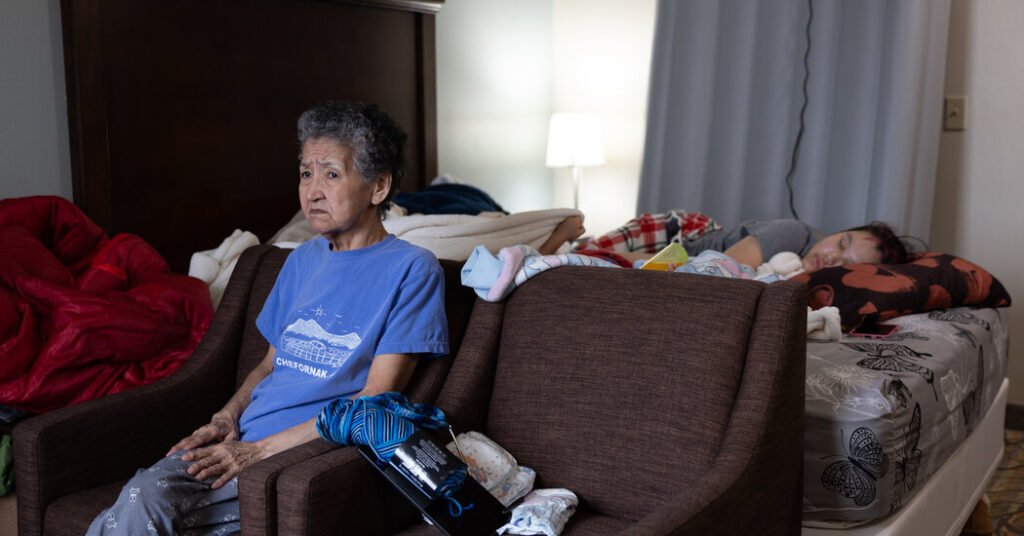
From the beige confines of Room 207 at the Aspen Suites Hotel on the outskirts of Anchorage, Maggie Paul and her daughter, Jamie, struggle to envision the future.
A little more than a month ago, the women were evacuated along with about 1,000 others from Kipnuk, their remote coastal village in western Alaska that was destroyed by the remnants of a typhoon. They were airlifted to safety; there are no roads to their community. Many landed in hotels about 500 miles away in Anchorage, which might as well be a different planet for all the ways the city differs from their tight-knit rural community.
It’s here the Pauls are wrestling with the kind of uncertainty facing more communities as the planet warms, weather grows more destructive and vulnerable places face repeated disasters.
Maggie Paul, 64, wants to return to Kipnuk and the way life used to be, before a series of floods and storms repeatedly bashed the village, with the most powerful blow yet landing on Oct. 12. However long it takes to put the decimated village back together, Ms. Paul said, “I will wait.”
Jamie Paul, 38, thinks the community’s only safe option is to move to higher ground, somewhere more protected. “The land is sinking,” she said, referring to the permafrost upon which the village was built and that is now buckling as rising temperatures cause it to thaw. “It’s not how it used to be.”
It’s a conundrum in search of clarity, with suspended lives in the balance.
A Growing Existential Threat
Kipnuk dates back a century, to when the U.S. government and Christian missionaries pressured tribes to abandon semi-nomadic customs and build permanent homes, churches and schools. Since its settlement on the edge of the Bering Sea in the 1920s, Kipnuk has always dealt with autumn storms, which spin up when cold air from northeastern Asia crosses the ocean that has been warmed by summer sunshine.
But the village was never as vulnerable as it is today.
It sits six miles from the ocean in a flat region known as the Yukon-Kuskokwim Delta. Villages sit atop permafrost plateaus anywhere from a few inches to a few feet above the water level. Some 200 villages dot the Alaskan coast and riverbanks, and are home to nearly half of Alaska’s 160,000 Native people, according to the Alaska Native Tribal Health Consortium.
As the ground warms, whatever hills were once present in the tundra have been gradually collapsing. Rising seas and powerful daily tides have scoured away the banks of the Kugkaktlik River, Kipnuk’s artery to the Bering, threatening the village infrastructure as the shoreline recedes.
Storms are a growing threat. Decades or centuries ago, a barrier of ice fastened to shorelines would have held back the floodwaters of many storms and slowed their winds. Now, that ice takes months longer to build up, leaving the villages more exposed, said Aviva Braun, warning coordination meteorologist at the National Weather Service’s forecasting office in Anchorage.
At the same time, warming North Pacific waters have allowed storms spawned in the tropics to reach western Alaska, something that was once nearly impossible but now has happened three times since 2022, according to Rick Thoman, a climate scientist at the Alaska Center for Climate Assessment and Policy at the University of Alaska, Fairbanks.
On Oct. 12, the remnants of Typhoon Halong slammed into Kipnuk, flooding the modest one-story houses and pushing many off their foundations, contaminating the drinking water and tearing up the wooden boardwalks used by pedestrians and small vehicles.
When the storm hit in the middle of the night, the Paul family huddled together as water poured in and tossed their small home. Had it not been tethered to electric lines, and had it not crashed into the neighbor’s house, it might have been pulled away by floodwaters like the home of a woman Jamie Paul knew. When the friend shared her location on her iPhone, it showed that her house had been carried several miles away, with the woman still inside.
Now, there is a recognition along the Alaskan coast that it is just a matter of time before other villages face such a devastating storm. Besides the destruction in Kipnuk, Halong also caused significant damage and one death in the neighboring village of Kwigillingok, where two people remain missing.
The warming climate threatens 144 native Alaskan villages, according to a 2019 report to the Denali Commission, a federal panel. About $4 billion would be needed over the next 50 years to harden those villages against the threats, the tribal health commission found in a study issued in 2024.
Government Help Is Uncertain
State and federal officials have said they will do what it takes to get the people of Kipnuk back on their feet.
For now, state officials are focused on getting evacuees out of hotels and into longer-term housing and repairing Kipnuk “so as many people as possible can return to their communities,” Jeff Turner, a spokesman for Gov. Mike Dunleavy, a Republican, wrote in an email.
Bryan Fisher, director of Alaska’s Division of Homeland Security and Emergency Management, said he hoped Kipnuk could be restored in ways that could withstand future storms. For example, a small number of homes and some of the community’s wooden boardwalks (it has no paved roads and relies on all terrain vehicles, snowmobiles and boats for transportation) survived the October disaster because they were built atop pilings.
A more resilient Kipnuk could then consider the weighty decisions around relocation, he said. “It’s my goal to buy them time to have that conversation,” Mr. Fisher said.
Relocating a village of 1,000 could take years, and carry unknown costs, Mr. Fisher said. It has taken decades, $150 million and a lot of difficulty to move Newtok, another village up the coast.
Mr. Turner said he expected discussions about Kipnuk’s future to occur during the state legislative session, which begins in January.
State and federal officials stressed that decisions about whether to rebuild or relocate the village should be made by the community.
“The federal government has an important role to play, but recovery will continue to hinge on thoughtful, community-based decision-making,” Senator Lisa Murkowski, an Alaska Republican, said in a statement.
But existing government programs are not designed to help a locality move, only to rebuild.
And some federal grants that might have assisted Kipnuk to take the next steps are no longer available to the community, something Mr. Fisher called “unfortunate.” That includes two Federal Emergency Management Agency grant programs designed to help communities adapt to extreme weather hazards, one of which the Trump administration canceled, saying it was “wasteful and ineffective” and “concerned with political agendas.” Alaska applied for money through the other program, but was denied.
In addition, the village had been counting on a $20 million Environmental Protection Agency grant to stabilize its eroding riverbanks. But the administration canceled it this year, saying it violated an executive order banning diversity, equity and inclusion programs.
“We have limited resources for Kipnuk, so I hope Donald Trump or JD Vance hears our voice,” said Daniel Paul, 39, Maggie Paul’s son and the current village president. Mr. Paul said he had voted for Mr. Trump and hoped the president would not only help the village but also visit.
“It’s not going to be a small amount of money that’s going to move the whole village,” he said, adding, “we’re United States citizens.”
Newtok voted three decades ago to move, and still hasn’t finished the process. The Biden administration gave the village $25 million for its relocation in 2022, plus another $25 million for Napakiak, another village exploring a move.
Though Newtok has faced many challenges along the way, the decision to relocate meant that when the October storm slammed into the coast, the village’s residents were nine miles away, safely on higher ground.
Villagers Face an Agonizing Decision
The people of Kipnuk, scattered among hotels in Anchorage or staying with relatives in other communities, are trying to adjust to so much that is unfamiliar.
Most of them speak English as a second language after their native Yugtun, also known as Central Alaskan Yup’ik. To be plunged into a city of 290,000 is a shock.
At a resource fair for evacuees on a recent Saturday at the William A. Egan Civic and Convention Center in Anchorage, an escalator became such an object of fascination for the small children who had never before seen one, it had to be turned off.
Kipnuk villagers who would normally eat moose, seals and fish in winter on the tundra found themselves eating more snack food in Anchorage and relying on hot meals of chicken and vegetables or beef stew delivered to their hotels by aid workers.
“I haven’t been to jail, but I hear some people say it’s like jail food,” said Chester Kusegta, a 37-year-old member of the village council.
At the civic center, Sky Mayeda’s eyes widened when a man began passing around a tray of akutaq, a native dish made of frozen berries and sugar. It was a long-awaited taste of home for the 15-year-old.
In recent days, other villages and native organizations have donated frozen moose and salmon so that families could prepare traditional foods in their hotel room kitchenettes.
Living in Anchorage means residents suddenly have access to alcohol and marijuana that weren’t allowed in Kipnuk. Drunken behavior has gotten some people kicked out of hotels, Mr. Kusegta said. They have been able to move to other hotels, and there is hope they can soon move into apartments the state is readying for all the evacuees.
Eventually, village leaders plan to survey everyone to see if there is a consensus on the ultimate question: whether to return home, or relocate.
“It’s a hard, hard, hard decision,” Mr. Kusegta said.
The thought of returning to Kipnuk scares Jamie Paul’s 15-year-old daughter, Leah, who, like the other village children, has enrolled in a new school in Anchorage, much bigger than the one in Kipnuk. It provides some normality and routine for the children, many of whom ended up in a school with a Yup’ik-language immersion program, but also challenges.
One recent day, Leah Paul stayed at the hotel instead of going to school, saying she didn’t feel well. She scrolled on her phone on the bed next to her grandmother, who was searching YouTube for Kris Kristoffersen music and knitting a bright yellow phone case.
She was thinking about Kipnuk. “I’m not going back,” Leah whispered, adding that she would only feel safe on higher ground.
In Anchorage, the Pauls’ hotel sits next to a small airport, where jets land and take off each day. Sometimes, the sight of one excites little Taylor Paul, Leah’s 3-year-old brother — because he knows it’s the type of plane that typically ferries people to Kipnuk, his grandmother said.
“He asks me if we can go home,” Maggie Paul said.
Scott Dance is a Times reporter who covers how climate change and extreme weather are transforming society.
The post An Alaskan Village Confronts Its Changing Climate: Rebuild or Relocate? appeared first on New York Times.