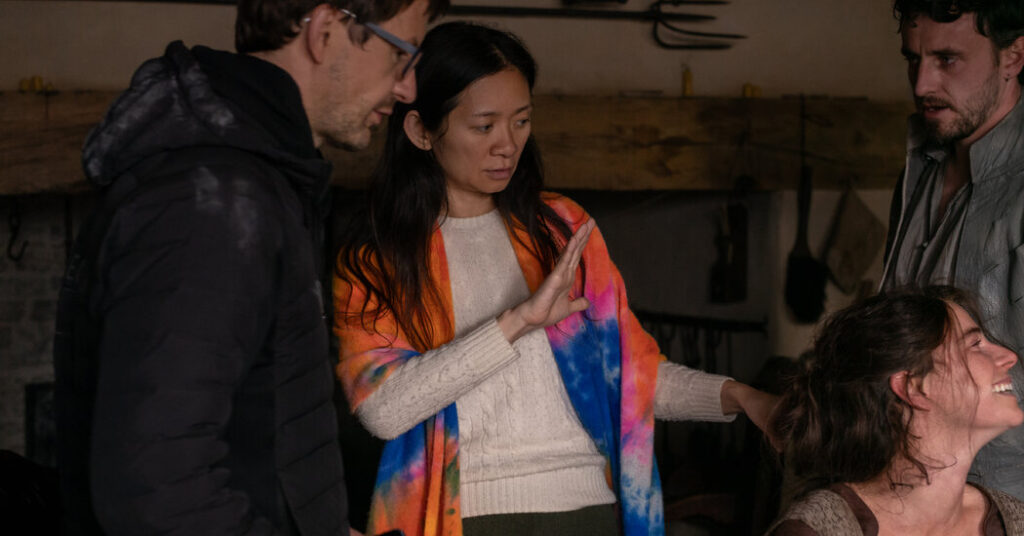
Chloé Zhao had always thought of Shakespeare’s tragedy “Hamlet” as a revenge play.
But her understanding of the work was upended when she began working on a movie chronicling events that shaped the play’s creation — adapted from Maggie O’Farrell’s 2020 historical fiction novel “Hamnet,” which follows Shakespeare and his wife, Agnes, as the couple grieves the death of their 11-year-old son, Hamnet.
“It’s usually advertised as very violent and masculine, but I was like, ‘There’s so much more to this,’” said Zhao, who won the Oscar for best director for her 2021 drama, “Nomadland.”
Over six months and hundreds of voice memos, Zhao, who is based in Los Angeles, and O’Farrell, who lives in Edinburgh, collaborated on the screenplay for “Hamnet,” now in theaters.
Jessie Buckley (“The Lost Daughter”) plays Agnes, whom O’Farrell imagines as a free-spirited young woman. She captures the eye of a teenage William — played by Paul Mescal, (“Aftersun”) — who, when they meet, is repressed, restless and still in search of his life’s purpose.
Early reviews have been glowing — in The New York Times, Alissa Wilkinson called the film “ardent and searing and brimming with emotion,” and Buckley’s performance “ferocious” and “astounding.” After winning the top award at the Toronto International Film Festival, the movie has emerged as an early contender in the best picture Oscars race.
In a video call last month — Zhao, 43, in a black camisole in her sunny residence, and O’Farrell, 53, in a turtleneck sweater at home, where her Bengal kitten, Griffin, occasionally sauntered across her keyboard — discussed the changes they made to bring the story to the screen and what they learned from working with each other. These are edited excerpts from the conversation.
Maggie, what intrigued you about Shakespeare’s wife? How did you get the idea to tell the story from her point of view in the novel?
MAGGIE O’FARRELL No artist, no writer, would casually name a play after their dead son. It had to mean something. That was where I started. But while I was reading about Shakespeare, I got so distracted by how badly his wife was being treated by history and scholarship and literary criticism. There’s just always been one narrative told about her, which is that he hated her, that they had to get married, that he ran away to London to get away from her. There’s not a shred of evidence for any of that; in fact, quite the opposite. So I wanted to put them center stage and look at the play — which I think is his greatest — through the lens of: Maybe he did love his wife, and maybe she was a very, very important figure in his life.
Chloé, how did you get involved?
CHLOÉ ZHAO Paul Mescal read the book and was obsessed with it, and wanted to play Will. He said: “You have to read it. It’s not what you think.” I was blown away. Not only did I feel it was a container for me to tell a great story, but also to explore my own inner ideas that I hadn’t allowed to come through, like many women. Once Jessie said yes, I knew I could get Maggie to agree.
Maggie, you were initially reluctant to write the screenplay. What did Chloé say?
O’FARRELL I knew Chloé was never going to be a person to make a pristine, costume-y costume drama, which I never wanted a film of “Hamnet” to be. I wanted people to look filthy. It makes me happy every single time I see Jessie’s hand and her nails are really black. I also knew that Chloé wasn’t particularly steeped in Shakespeare, which was important because I didn’t want a director to put him center stage. I wanted it to be about the children and the family.
But I didn’t think I wanted to adapt it, because I’d moved on to another project. We got on a Zoom call, and I was all ready to say, “No, no, no, I don’t think I’m the person.” I don’t know what happened. I think she put a spell on me because by the end of the call, I had not only agreed to write it with her, but I’d agreed to write the first pass in a month or two.
Tell me about your long-distance collaboration process.
O’FARRELL Chloé is an amazing leaver of voice notes. I would wake up in Scotland, and there’d be this cascade of ping, ping, ping, ping, ping. On very busy nights, when I’d been asleep and Chloé was awake, there would sometimes be 13, maybe 16, voice notes. Some of them were really short, sometimes about really tiny details. Others were about big thematic issues. The longest one Chloé sent me was 58 minutes. It was basically a narrative podcast.
Maggie, this was your first time writing a screenplay. What did you learn?
O’FARRELL To make a 400-page novel into a 100-page script, there’s a lot of stripping back. And Chloé had a really clear idea from the beginning of which threads of the novel she wanted to take out and weave into a film.
ZHAO I’m always looking for the most polarizing stuff, because when there’s tension, there’s juice. The idea of life and death, or love and loss, creation and destruction, is so vivid in the book, and then the metamorphosis of art and storytelling in between. I told Maggie that you could totally make a mini-series just about the women in Stratford.
We also needed to have more of the play in the end, which was probably the biggest lift. We added 25 pages to the final sequence.
How did you tackle that?
O’FARRELL In the final sequence at the Globe in the novel, Agnes goes into the theater alone, and she has this very interior, emotional experience about watching “Hamlet.” To get around that in the script, we just brought her brother in so she could talk to him.
On the other end of the spectrum, Chloé is brilliant at communicating somebody’s interior thoughts by sublimating them into a landscape. That happens in “Nomadland” with Frances McDormand and these huge caverns and vistas, and in “Hamnet,” with Jessie in the forest, and Paul in the glove workshop.
What were some of your toughest trims?
ZHAO After Hamnet’s death, in the book, there is in-depth description of everyone’s nuanced way of dealing with grief and their relationship with the ghost of Hamnet and the natural environment. And there’s so much of Agnes looking for Hamnet. We shot all those scenes of just her in that house, waiting for him. But after we tested the film, I got feedback from filmmakers I really trust. They said, “Look, Chloé, you just need to get the audience to the Globe.” Because Jessie’s incredible performance is so overwhelming for the audience, they just can’t handle that much before we deal with the catharsis.
Chloé, Jessie seems like a natural choice for Agnes, but Paul is more surprising casting as Shakespeare. What jumped out at you about him?
ZHAO Something about him feels like there’s something vibrating inside, like volcanic, like there’s an animal that wants to break out. And I feel that with Shakespeare. There must be so much bubbling inside for that much creativity to come out.
What did you each learn from the other during the process?
O’FARRELL I’ve learned from Chloé the way to construct a narrative for the screen and the way to look at a scene through other people’s eyes, because the way an audience interacts with a cinema screen is completely different from the way a reader interacts with a book.
Chloé, would you ever have a desire to write a book?
ZHAO If I could be a novelist, I wouldn’t make films.
O’FARRELL Please don’t stop making films.
ZHAO I tried in my 20s to write — and I will one day; I really, really want to — but the language barrier, the lack of confidence, makes me feel like I can’t quite do it. There’s a purity in the way Maggie is interacting with these characters on the page. I always want to, when I write a screenplay, write it a bit more like if I were the author and not worry about if it’s going to be made into a film.
Also, going to Maggie’s house was a big moment for me. She lives — it’s so cliché to say “a writer’s life” — but she really does. You see the world of her book, the characters in her life. For someone who lives out of a suitcase in hotel rooms, to see her garden, her kitchen, her home — I would love to be able to write from that kind of embodied place. Can I move in with you for a while?
O’FARRELL [To Maggie] This is my son’s room, and it’s empty. Feel free!
Sarah Bahr writes about culture and style for The Times.
The post What ‘Hamnet’ Lost (and Gained) on the Way From Page to Screen appeared first on New York Times.