What kind of negotiator gives the other side everything that it wants with the hope of eventually getting something in return?
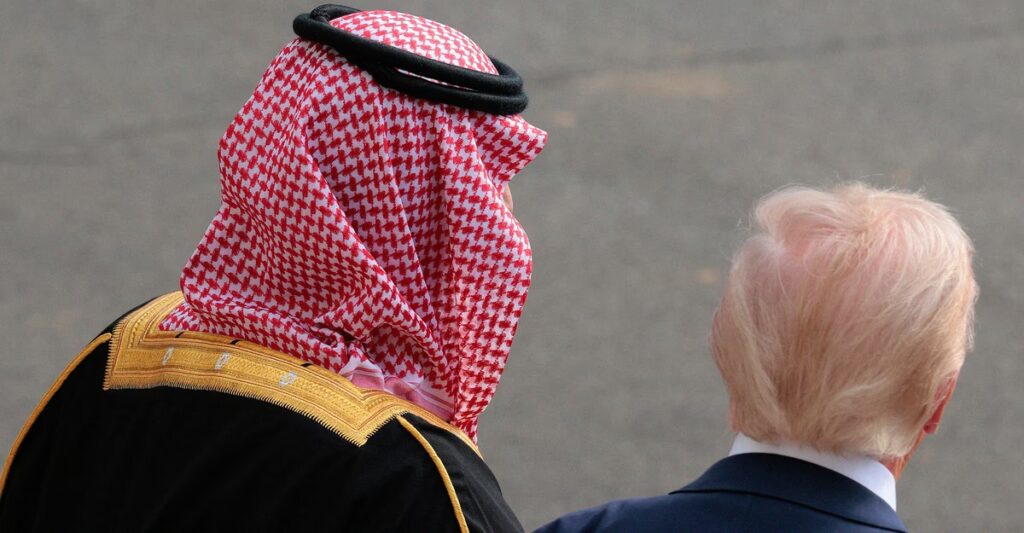
It’s a question that even some of President Trump’s own allies are asking after his administration signed a landmark deal to develop a civilian nuclear program in Saudi Arabia using American technology. The deal’s opponents, in the United States and Israel, worry that the new pact might ultimately allow for uranium enrichment—and if so, that Trump just gave Crown Prince Mohammed bin Salman the tools he needs to build a bomb. What did the U.S. require in return? Pretty much zip.
That, at least, is how things stood when the agreement was finalized yesterday. Then, just before 8 a.m. today, Trump took to social media to deliver what seemed like an after-the-fact ultimatum: The deal, he wrote, is “totally subject to Saudi Arabia joining the very respected and successful Abraham Accords,” the Middle East initiative launched in Trump’s first term that is designed to normalize relations between Israel and countries in the region.
Trump-administration officials argued that the deal is an “America First” policy triumph because the 30-year, multibillion-dollar agreement gives American companies (which already do huge business in Saudi Arabia) a central role in developing the kingdom’s nuclear infrastructure while shutting out foreign competitors. Karoline Leavitt, the White House press secretary, told reporters today that the arrangement “will ultimately benefit American industry workers and supply chains.”
It may not benefit Trump’s image as a consummate dealmaker, however. The framework of Saudi Arabia joining the Abraham accords and, in return, getting defense guarantees and U.S. help to develop a civilian nuclear program has been on the table for years. It came close to fruition during the Biden administration. But the kingdom received a defense package in November and the nuclear deal this week. Neither agreement stipulated the normalizing of relations with Israel as a precondition. “Leave it to this administration to negotiate after the signatures are barely dry,” Elisa Ewers, a senior fellow for Middle East studies at the Council on Foreign Relations, told us.
When the agreement was unveiled yesterday, U.S. lawmakers and Israeli politicians were startled by its lax conditions for Riyadh. Trump by this morning may have decided to provide reassurance with his Abraham Accords announcement—so he did what he often does.
“The president wakes up every day, and every day, at least on Middle East policy, is an improvisation,” F. Gregory Gause, a professor emeritus at the Bush School of Government and Public Service at Texas A&M University, told us. “He was getting some pushback on the Saudi deal, and so he added this sweetener to it for people in Congress who might feel that if the Saudis had a regular diplomatic relationship with Israel, they would be less concerned.”
Trump, he noted, may improvise again and remove the stipulation if the furor dies down. Last week, the president said that the U.S. would impose a 20 percent fee on the value of the cargo on ships passing through the Strait of Hormuz to counter Iranian efforts to control the waterway. The next day, the president reversed himself. “So it could be that by tomorrow, this goes away from the president’s mind,” Gause said. But if he gives the Saudis what they want without asking for anything in return, he also would have thrown away all of his leverage.
In 2023, top officials in the Biden administration shuttled between Washington and Riyadh, believing that they were on the precipice of a major breakthrough: Bin Salman, known as MBS, was close to joining the Abraham Accords, a development that officials saw as a bulwark against Iran’s rising nuclear threat in the region. Talks to flesh out the details were scheduled for mid-October of that year. But the negotiations unraveled after Hamas’s October 7 attack on Israel and the devastating Gaza war that followed. In the aftermath, Saudi leaders concluded that normalization was politically untenable.
Biden-administration officials then looked for other ways to entice the Saudis to both restart normalization talks and help secure the Gaza Strip. They focused on a mutual-defense agreement, which included nuclear cooperation, even though President Biden had made known his dislike for the crown prince after the 2018 murder of the journalist Jamal Khashoggi. Jon Wolfsthal, a former adviser on U.S.-Saudi nuclear cooperation, told us that the Biden administration calculated that “if the U.S. didn’t get in the game, particularly as a nuclear provider, one of America’s adversaries might, and that is much worse for U.S. national security.”
But with the 2024 election looming, Saudi Arabia’s government gambled that a Trump victory would bring more favorable terms, and the talks stalled.
[Read: Iraq’s man in the middle]
The Saudis were right. Saudi leaders already saw in Trump a partner whose approach was similar to their own: pragmatic, transactional, and largely unbothered by concerns about human rights. The relationship extended beyond official diplomacy. MBS had developed a close rapport with Trump’s son-in-law Jared Kushner during Trump’s first term, communicating with him directly over WhatsApp. Saudi Arabia’s Public Investment Fund had previously committed $2 billion to Kushner’s private-equity firm.
Following his return to the Oval Office, Trump grew fixated on getting Saudi Arabia to normalize ties with Israel. As in his first term, Trump picked Saudi Arabia for his first official overseas visit, arriving with an entourage of American business executives in an effort to foster deeper corporate ties, particularly in technology. During a meeting in Washington, D.C., in November, Trump, raising his voice, pressed MBS to join the Abraham Accords. MBS insisted that the only way to achieve this would be by agreeing on a path toward Palestinian statehood. (Israeli Prime Minister Benjamin Netanyahu has rejected the prospect of a sovereign Palestinian state.) Still, the U.S. and Saudi Arabia reached an understanding on a defense agreement, which would include the sale of advanced F-35 fighter jets.
Months later, Trump tried to link an expansion of the Abraham Accords to his plan for peace with Iran, suggesting in a conference call with several regional leaders that they sign up, according to U.S. and Middle Eastern officials. After that conversation finished, he called MBS personally to press the issue once more. But Trump got the same answer. Still, talks over a Saudi civilian nuclear program continued.
The Trump administration says that this week’s deal is designed to help Saudi Arabia develop civilian nuclear power only. Energy Secretary Chris Wright, who signed the agreement, said in a statement that the terms “uphold the highest standards of nuclear safety and nonproliferation.” The Saudi government said that the deal supports its domestic efforts to diversify energy sources, and that the government is committed to the “highest international standards” of nuclear safety, security, and nonproliferation.
But Saudi Arabia also has talked about becoming a nuclear-weapons power if Iran were able to develop its own weapon. Preventing Tehran from doing so is a central goal of the U.S. conflict, but its outcome is uncertain, as is the fate of Iran’s nuclear program. “Saudi Arabia does not want to acquire any nuclear bomb, but without a doubt if Iran developed a nuclear bomb, we will follow suit as soon as possible,” MBS told CBS News in 2018.
Advocates of nonproliferation contend that the U.S.-Saudi deal lacks the necessary guardrails to prevent that: no measures to prevent the sharing of uranium-enrichment and plutonium-separation technologies, no commitment by Saudi Arabia to comply with the safety standards of, and monitoring by, the International Atomic Energy Agency.
Under the agreement, American companies would build nuclear reactors in Saudi Arabia, and the two countries would study whether Saudi Arabia should eventually enrich uranium on its own, instead of importing nuclear fuel. Enriching uranium is necessary to produce the fuel for nuclear-power plants, but can also be a key step toward making a nuclear weapon. “Your best route to avoiding proliferation is this kind of very, very close relationship with the United States, with U.S. technology, that we control, that we monitor, and that is of a long duration,” Victoria Coates, a former deputy national security adviser to Trump, who now works at the Heritage Foundation, told us.
Trump denied that enrichment is on the table. The deal notes that the U.S. will ultimately decide, after a study is conducted, whether enrichment shouldn’t take place, and if that’s the conclusion, Saudi Arabia would be barred from pursuing it on its own or with another country for 10 years. But giving the U.S., rather than international inspectors, that authority could lead other regimes to choose their own inspectors, too, opening the door to broader proliferation.
[Read: The forever negotiation]
“Making all of this subjective—and ‘you can choose your own inspectors,’ and all those other things—is a really bad route to go down,” Jon Alterman, a global-security scholar at the Center for Strategic and International Studies, told us. In theory, the agreement could give Iranians the license and precedent to credibly say: “We have Russian inspectors, we have Chinese inspectors, so we’re doing just what the Saudis are doing.”
Alterman noted that the U.S. even has a model for a better arrangement: a 2009 agreement with the United Arab Emirates. “The Emiratis built a genuinely robust and safe domestic nuclear program,” Alterman said. “There are robust safeguards against proliferation. And it deepened the partnership between the UAE and the United States.” But that’s not what the U.S. asked of Saudi Arabia this week.
The post The Art of the Giveaway appeared first on The Atlantic.