During the third season of “Spartacus,” the swords-and-sandals drama that aired in the early 2010s on Starz, Ashur, the cunning Syrian schemer played by Nick E. Tarabay, muses about his ambitions.
He will thwart the budding slave rebellion; vanquish its leader, Spartacus; and take over the gladiator training school formerly run by Batiatus (John Hannah), ushering in the rise of the House of Ashur.
The showrunner, Steven S. DeKnight, always thought this vision would make a great premise for a series. And if he ever got a chance to make more “Spartacus,” he knew he wanted Ashur’s ill-begotten gladiator academy to be the primary focus.
“The only problem is that Ashur got his head chopped off,” DeKnight said with a laugh in a recent video interview, recalling the character’s grisly demise near the end of the second season. “So how do you do that?”
The answer, it turns out, is to mess with history — both the show’s and the world’s. Enter DeKnight’s “Spartacus: House of Ashur,” premiering Dec. 5, an unusual work of speculative fiction that imagines a fun “what if?” spin on the events of the original series.
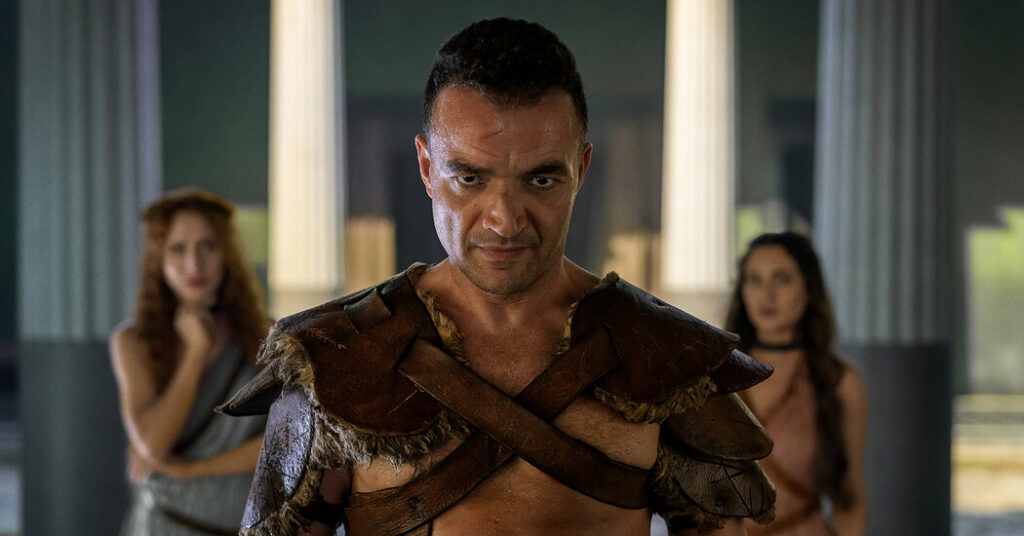
Tarabay is back as Ashur, a slave turned “lanista” (a kind of gladiator trainer and impresario), following a new and surprising timeline that charts a different course through the well-known past. Ashur’s altered fate has a butterfly effect on the rest of the record book: Where the original “Spartacus” followed a historical blueprint, “House of Ashur” is free to change things up.
When the fourth season of “Spartacus,” subtitled “War of the Damned,” wrapped up in spring 2013, Ashur had been decapitated, the slave uprising had been wiped out, and the eponymous hero had been killed by the Roman general Crassus (Simon Merrells). As an ending, it could hardly have been more definitive — the door was not exactly wide open for this story to continue on.
The original pitch for “Spartacus” was to tell the famous tale of the Thracian slave and gladiator turned rebel leader — familiar to most audiences from the 1960 movie starring Kirk Douglas and directed by Stanley Kubrick — in the style of “300,” Zack Snyder’s lurid and spectacular action epic from 2006. The series was packed with musclebound warriors, graphic slow-motion violence, raunchy sex scenes and “Deadwood”-style profanity, which The Times described in a review as “the four B’s of its appeal,” that is “beefcake, blood, breasts and the Bard.”
Though it lacked the critical acclaim of other premium cable shows of its era, such as AMC’s “Mad Men” or HBO’s “Game of Thrones,” the original “Spartacus,” which debuted in 2010, was one of the top-performing shows on Starz, with more than 1.2 million viewers tuning in for its first season finale. Audiences loved its titillating content and juicy drama, unabashedly lowbrow compared to most prestige television, and the network considered the stylized, shamelessly over-the-top action series a jewel in its crown.
That affection has only grown over time. Kathryn Busby, the president of original programming at Starz, said that “Spartacus” remains “one of our most-watched library titles on streaming and continues to fuel social engagement across all our platforms,” with a “fiercely loyal and vocal fan base” that has continued to express a keen interest in the show.
What makes the enduring popularity more remarkable is that the franchise has undergone its own improbable, confusing and tragic twists along the way. After the first season of “Spartacus,” the lead actor, Andy Whitfield, was diagnosed with Stage 4 non-Hodgkin’s lymphoma. Production of a second season was delayed — the producers instead pivoted to a six-episode prequel mini-series, “Spartacus: Gods of the Arena,” which focused on the history of the House of Batiatus.
In fall 2011, Whitfield’s cancer returned, and when he died suddenly, the network made the difficult to decision to recast the role. “Spartacus: Vengeance,” the show’s third season — and second chronologically — was released in early 2012, with the actor Liam McIntyre taking on the part.
Starz had approached DeKnight many times in the years since “Spartacus” ended about reviving the story, despite the fact that the title character had been killed off and the historical events that inspired it had already been depicted in full. They suggested a reboot or spinoff, and DeKnight considered what he described as “the usual suspects” of that period, including the rise and fall of Julius Caesar (“it’s been done to death”) and the story of Antony and Cleopatra (“a great idea, but not cheap to do correctly”).
That left his crazy dream of bringing Ashur back from the dead.
“I pitched this nutty idea to Starz and Lionsgate, fully expecting them to tell me I was insane,” DeKnight said. “Instead, they said, ‘Great, we love it. Let’s do it.’ And so here we are.”
Busby said that however nutty the concept seemed to DeKnight, Starz was an easy sell. “The idea of taking history and turning it on its head through his signature storytelling was all we needed to convince us to move forward,” she said.
Perhaps the most surprising thing about the concept is how little it actually matters to the action of the show: DeKnight said he wanted to offer a halfway plausible explanation for why Ashur made it back alive but didn’t want to belabor it.
“Spartacus: House of Ashur” begins with Ashur in the underworld, having just been decapitated by the slave turned warrior Naevia (Cynthia Addai-Robinson), as he was in the original series. But he is informed by the ghostly visage of Lucretia, a dead “Spartacus” character played by Lucy Lawless, that there is an alternate reality in which he didn’t perish in that battle. Instead Ashur helped the Romans overthrow the slaves, a coup that brought him wealth and power. Then he wakes up in bed at his “ludus” (a gladiator training school), and his former fate is never mentioned again.
When DeKnight explained this setup to the network, they wanted to know if there would be other supernatural elements in the show. More about the underworld, perhaps, or run-ins with Hades or the Gods?
“No,” he told them flatly. “Just that.”
Much else will be familiar to fans of the original series — especially the first and prequel seasons, which were smaller in scale and set almost entirely at the gladiator school. As a reward for quelling the slave rebellion, Ashur was offered possession of the ludus owned by the dead Batiatus, so much of “House of Ashur” takes place in and around that recognizable set, which is to “Spartacus” what the coffee shop is to “Friends.”
“I always thought there was something special about that construct,” DeKnight said. “It was budget-friendly, and I could tell great stories without it becoming too sprawling.”
The budget is comparable to the earlier seasons, though advances in visual effects technology has made it possible to do more with less. The period vistas and teeming colosseums now look far more realistic than they did in 2011, with more cinematic-feeling C.G.I. work.
“There are a lot of shots in the first season that make me wince now,” DeKnight said. “At that time, especially on TV, unless you had a gazillion dollars it was very tricky. But what we can do on the new show is incredible.”
New characters, including the female “gladiatrix” Achillia (Tenika Davis), keep things fresh. But with its slo-mo swordplay and brawny, foul-mouthed warriors, the new “Spartacus” feels very much like the old “Spartacus.”
DeKnight said the franchise’s trials and chaotic history — and his being forced to rework the series on the fly in response — helped set the stage for this latest twist, in which “Spartacus” returns more than a decade later led by a formerly dead man. “It certainly gave me some more elbow room to try something new,” he said.
“There are a bunch of ways we could have done this that are a lot more traditional,” he added. “But what I love is that now there’s no way to know what’s going to happen historically — that’s really exciting.”
The post A Gladiator Epic, Back From the Dead appeared first on New York Times.