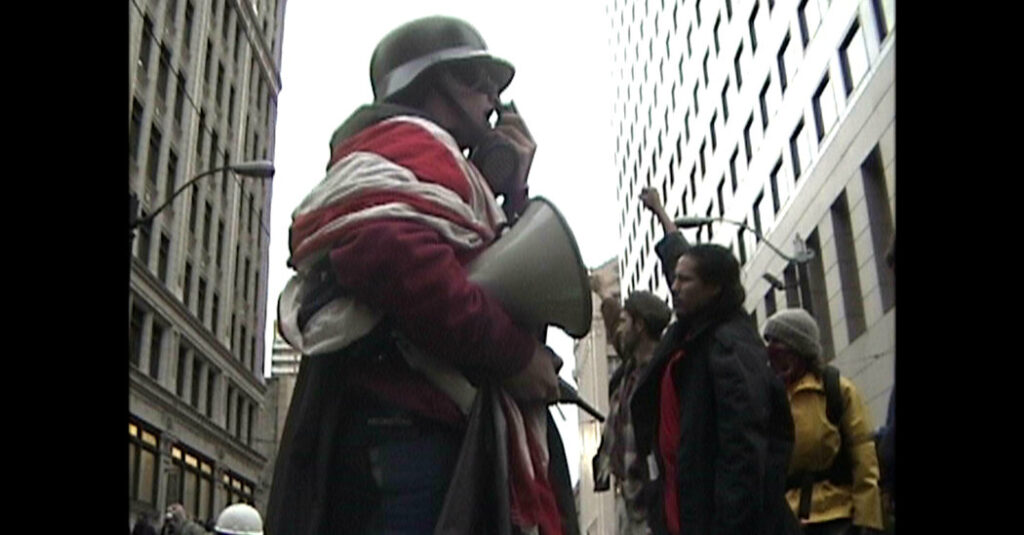
When the World Trade Organization ministerial conference went to Seattle in late 1999, so did the protesters. They hailed from across the political spectrum, with concerns ranging from corporate greed, workers’ rights and child labor, to the accusation that the W.T.O. threatened national sovereignty. Many of the demonstrators held some form of anti-globalization view. And over the course of four days, the mostly peaceful protests were eventually met with tear gas and rubber bullets from the police. Ultimately, the talks ended in failure.
Ian Bell’s documentary, “WTO/99” (in theaters), makes the argument that this moment — sometimes called the “Battle of Seattle” — was a turning point in American police brutality, free speech suppression and media distortion. But since “WTO/99” is an all-archival documentary, that argument is made through juxtaposition. It’s clear that the movie has a point of view; what’s most interesting, though, is the raw materials it employs.
There’s news footage, which starts out hyperlocal — the first shots are from the Seattle Police Department’s “video newsletter,” called “Beyond the Badge” — and eventually telescopes outward toward national news as the situation intensifies. Television journalists frequently appear in the film, in part because several were hit with tear gas or even arrested while covering the protests. Eventually, scenes of news conferences with the mayor at the time, Paul Schell, and other city officials join the narrative, demonstrating how official responses evolved over several days of protests.
But far more interesting is the amateur footage. With many archival films (like “The White House Effect”) about events in the 20th century, most of the imagery was shot by professionals: journalists, filmmakers and others who are trained to hold a camera. That naturally results in a certain perspective: We are often watching the official story, whatever shot the camera operator was allowed to get by the press secretary or handler in charge. As viewers, we’re left to read meaning into those images, both what’s seen and what’s left unseen.
By 1999, however, camcorders and other video devices were much cheaper, widely available to consumers, lightweight and easy to carry around. Many people appear to have brought video cameras to the protests to document what was happening, and a lot of their work is in “WTO/99.” Naturally, much of it is unpolished. Images zig and zag and bump unsteadily, because the camera is hand-held. You can hear people talking offscreen, or sometimes reacting in horror or panic to gas or rubber bullets. And with no single camera person, there’s no main character — the crowd seems like an entity unto itself, and you can also sense both the energy and the chaos.
This means that “WTO/99” is an interesting take on a moment not just in political history, but in cinematic history. At one point, two protesters are standing at the top of a hill, one pointing a camera at the police as armored vehicles roll up. One remarks to the other that a police officer is pointing his own camera at them: “Hey, you’re videoing him videoing you!” he says, and Bell cuts between the two perspectives, using only the protesters’ audio. This gives us a view we’re more used to in a fiction film: shot, reverse shot.
That moment was startling and revealing to me because I saw that the film had captured another turning point: In the future, cameras would become a primary tool for civilians to monitor law enforcement. It’s hard to imagine that anyone caught in the thick of the protests had time to think about that — but watching “WTO/99” is like peering into a portal to the future.
Alissa Wilkinson is a Times movie critic. She’s been writing about movies since 2005.
The post The Protesters and the Police Are Both the Focus and the Filmmakers appeared first on New York Times.