This is an edition of The Atlantic Daily, a newsletter that guides you through the biggest stories of the day, helps you discover new ideas, and recommends the best in culture. Sign up for it here.
When Hurricane Helene hit western North Carolina in September 2024, it left behind it a trail of death and destruction—and a huge number of legal headaches. Residents struggled to understand the process of receiving help from FEMA, people were beset by scams and price gouging, and tenants whose homes had been destroyed or made uninhabitable puzzled over their rights.
Pisgah Legal Services, a nonprofit that provides civil legal aid in the region, had 120 staffers, and all of them were somehow affected, Jaclyn Kiger, Pisgah’s executive director, told me. Within about a week, though, Pisgah Legal had hosted three clinics; it ultimately helped thousands of Helene victims.
Civil legal services like these may not be well understood, but they serve an essential role in ensuring that everyone has access to justice. The Supreme Court’s landmark 1963 decision in Gideon v. Wainwright established that any criminal defendant has a right to legal counsel. But most legal issues are civil, not criminal. This includes any number of disputes between parties, but also issues such as evictions, scams targeting senior citizens, and domestic-violence protective orders. Recourse to courts in such cases can be lifesaving, but they are not free, and they are not easy for ordinary people to handle on their own.
Since 1981, every state has created programs to fund civil legal services with Interest on Lawyers’ Trust Accounts. It’s an elegant solution: Lawyers frequently hold money in accounts for clients, accruing interest that doesn’t truly belong to any party. IOLTA-funded programs use that interest to provide legal support without any cost to taxpayers. Kiger told me that Pisgah Legal received nearly $2 million in fiscal year 2025; overall, NC IOLTA provided clients roughly $12 million for civil legal services that year.
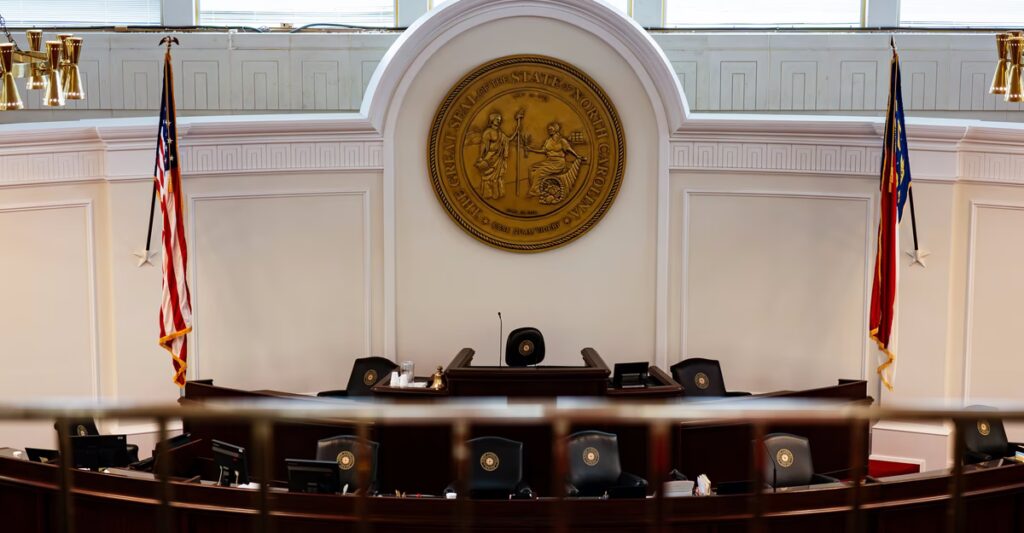
But in a budget passed this month, the Republican-dominated North Carolina General Assembly effectively cut this funding off. The budget permits $2 million in IOLTA funding in the coming fiscal year for civil legal aid, but that will sunset in the future. (Governor Josh Stein, a Democrat, signed the budget—the first that the state has managed to pass in more than a year—while criticizing elements of it, including the IOLTA cut, which he said “cruelly punishes low-income people who need access to justice.”) Most IOLTA money will be redirected to criminal legal services for indigent defendants, which the state is already constitutionally required to fund. Providers I’ve spoken with recently are crestfallen but also baffled. Although they all support funding for public defenders, they note that civil legal aid gets no other state money. “Hundreds of thousands of low-income people in the mountains are going to suffer,” Kiger said.
Civil legal services have historically been a bipartisan priority, popular among both parties and lawyers as well. Last year, a coalition of leaders of some of the state’s biggest law firms wrote a letter to the state supreme court backing IOLTA funding for civil legal services. “We believe a fair and functioning court system is not a partisan goal—it is a constitutional one,” they wrote. “By enabling litigants to participate effectively, IOLTA-funded legal aid strengthens both the efficiency and fairness of judicial proceedings.”
But some North Carolina Republicans have objected to the fact that some of the state’s biggest providers of civil legal aid also engage in progressive political advocacy or do legal work related to immigration or social-justice issues. The driving force behind the change in this month’s budget is state House Speaker Destin Hall, who is also an attorney in private practice. “IOLTA funds were shifted to ensure they’re not being utilized to bankroll progressive political pet projects like the NC Justice Center or provide government services to illegal immigrants. Instead, those funds will be used to provide legal services to underserved communities,” he said in a statement in June.
To that end, the general assembly placed political limits on a small portion of civil legal aid. The budget allows IOLTA money collected before July 2025 to be distributed, but only $2 million a year until the funds run out, and only to providers who don’t engage in political advocacy or take cases involving transgender health care or federal immigration law. This is less a way of removing politics from legal aid and more a way of instituting a different set of ideological priorities, and in any case, it applies only to this small and disappearing pot of money. The overarching goal appears to be not just going after progressive groups, but ensuring reductions in civil legal aid per se. This has led providers to speculate that the general assembly is less worried about “wokeness” and more interested in defending business interests. “I think it comes down to who we serve,” Kiger said. “We are serving the most vulnerable among us.”
When I contacted Hall’s office to try to understand the decision, a spokesperson asked me for detailed questions but never replied when I sent them. Ashley Campbell, who leads Legal Aid of North Carolina, the state’s largest civil-legal-aid firm, told me that she sought meetings with Hall but was rebuffed. In a statement, the executive director of the North Carolina State Bar lamented that “months of good-faith efforts” by the bar and NC IOLTA leaders had failed to sway the general assembly: “This loss of funding will prove devastating to the tens of thousands of low-income North Carolinians facing legal concerns that threaten their housing stability, income, access to health care and benefits, and safety from domestic violence and human trafficking.”
The defunding of IOLTA in North Carolina is a major event in the state, but it could have national implications. As I have been reporting for more than a decade now, many of the major currents in national politics have originated in the Old North State. The state has also been used as a proving ground, including for Donald Trump–style attacks on elections. Right now, the partisan warfare over civil legal aid in North Carolina is an outlier; Texas GOP legislators even strengthened IOLTA funding in 2023. But a failed Montana bill last year tried to weaken IOLTA, and Trump has proposed eliminating or drastically reducing funding for the Legal Services Corporation, a national civil-legal-aid group established by Congress. People I spoke with in North Carolina worry that the state budget could provide a template for other states as well. If that happens, access to justice could become just another luxury good.
Related:
Here are three new stories from The Atlantic:
- The mess the Iran war made
- Radio Atlantic: Is the age of reading over?
- The other victims of a wrongful conviction
Today’s News
- President Trump said the nuclear agreement signed with Saudi Arabia yesterday is contingent on the kingdom normalizing relations with Israel by joining the Abraham Accords, a condition that had not been publicly disclosed when the deal was announced.
- A member of Vice President Vance’s Secret Service detail is under administrative investigation and may face a criminal inquiry over allegations of compromising operations and information security. The Secret Service has not disclosed what information was allegedly compromised.
- Global oil prices surpassed $100 a barrel for the first time since May, after Houthi militants claimed to have struck two Saudi oil tankers in the Red Sea.
Dispatches
- Time-Travel Thursdays: Jake Lundberg explores what an office murder in 1841 revealed about the American workplace.
Explore all of our newsletters here.
Evening Read

The New Chilling Effect
By Jacob Blane, Annabelle Garland and Sam Gross
If you’re looking for a reason to despair over the state of American education, there are many places you could start. You could, for example, worry about the all-consuming phones—or the gambling and TikTok addictions that come with them. You could worry about the free fall in literacy, the decline in math fluency, the rise of AI, the insanity of college-obsessed parents, the sharp increase in truancy, the teen mental-health crisis, and on and on.
Yet something that deserves more attention is damage to free expression—not in the classroom but in the public sphere of high school: the realms of student newspapers, student government, and other aspects of everyday life. School is meant to prepare students for the real world, but too many institutions are training kids to be silent.
More From The Atlantic
- The Trump family sparks a revolution in Albania.
- Music’s new superstar is here—and she’s rather relaxed.
- The Smithsonian’s show trial on Capitol Hill
- A startling glimpse at AI’s ruthless efficiency
- Tom Nichols: The American people need the truth about the Iran war.
Culture Break

Watch with everyone else. The Odyssey’s box-office success affirms the power of spectacle, David Sims writes.
Don’t just take the iPad away. In 2014, Daniel Willingham gave advice on how to trick your kids into reading all summer long.
PS
Katie Crutchfield, who records as Waxahatchee, is one of the best active singer-songwriters; her 2024 album, Tigers Blood, was one of my favorites of this decade. We probably can’t expect new music from her too soon, because she just had a baby, but two of her sometime collaborators have new records coming out that I’m hoping will tide me over during her absence. Brennan Wedl’s self-titled album (co-produced by Crutchfield) is out next month, and yesterday she released a rerecording of her excellent song “Two Dollar Pistol.” Jess Williamson, Crutchfield’s partner in the sublime one-off band Plains, is releasing A Mile South of Heaven in October, and the lead single, “Goodbye to All That,” is a promising tease.
— David
Rafaela Jinich contributed to this newsletter.
When you buy a book using a link in this newsletter, we receive a commission. Thank you for supporting The Atlantic.
The post When Justice Is Only Available to Those Who Can Pay appeared first on The Atlantic.