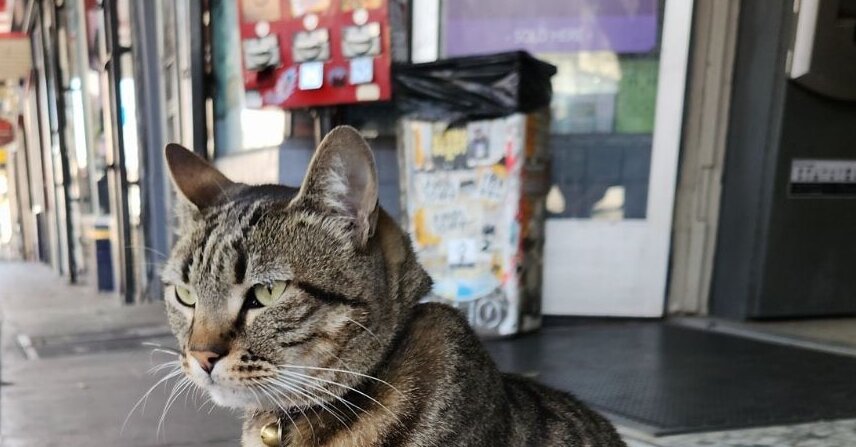
Meg Brigman met Kit Kat, perhaps San Francisco’s most famous cat in life and certainly in death, as she was drinking a sparkling wine cocktail at a bar in the city’s Mission District.
The striped tabby approached her, eager to be petted. She was happy to oblige, calling him “an absolute sweetheart.”
Twenty minutes later, Ms. Brigman saw him again as he sauntered from the sidewalk to the street, beneath the front of a Waymo self-driving taxi, its lights flashing as it waited to pick up passengers.
She rushed over to the vehicle, a white Jaguar, crouched down and tried to lure Kit Kat away. Instead, the cat retreated to the back of the taxi’s underbelly. At that moment, the taxi with whirring sensors pulled away, sending the cat scurrying out from the back after being hit by a rear tire.
Footage of the tragic encounter was captured on a security camera mounted above the door of Randa’s Market, the cat’s home and starting point for his adventures to nearby bars for years.
The footage, obtained by The New York Times, shows the moments leading up to Kit Kat’s death and sheds new light as residents debate how safe autonomous vehicles are.
The Oct. 27 death of Kit Kat, a bodega pet so familiar that neighborhood residents called him the Mayor of 16th Street, made international headlines. The episode started a heated debate between those who despise automation and those who believe robots can improve their everyday lives.
Those who defend Waymo taxis have pointed out that human drivers kill hundreds of animals each year in San Francisco. But Ms. Brigman believes that Kit Kat might still be alive if a human had been behind the wheel that October night.
A human driver, she believes, would have stopped and asked if everything was OK after seeing a concerned person kneeling in front of their car and peering underneath.
“I didn’t know if I should reach out and hit one of the cameras or scream,” she said of the perilous moment. “I sort of froze, honestly. It was disorienting that Waymo was pulling away with me so close to it.”
Until now, it had not been clear exactly what happened.
Mike Zeidan, the owner of Randa’s Market, took in Kit Kat six years ago to chase mice and had a unique view into the cat’s death for the past several weeks. He had combed through the footage captured by his store cameras soon after his mouser’s death and found the snippet, but he said he chose not to speak of it or share it until now.
“After the accident, we were overwhelmed by the media frenzy and decided not to release the video,” Mr. Zeidan explained in a text. “However, after discussing it with members of our community, there is a need to raise awareness about enhancing technology, including the possible integration of sensors underneath cars to detect living beings.”
Katherine Barna, a spokeswoman for Waymo, confirmed that the cars do not have sensors in their undercarriage. The cars are designed to have no blind spots around the vehicles, but like cars driven by humans, she pointed out, there is no view of the road below them.
The cars, owned by Google’s parent company Alphabet, have become ubiquitous around San Francisco, with 1,000 of them in the Bay Area. Last month, Waymo received permission from state regulators to expand its service even farther in California with driverless testing in the Napa Valley, Sacramento and San Diego.
In the video footage, one of the most dramatic moments occurs when Ms. Brigman realizes that Kit Kat had been struck by the Waymo vehicle as it pulls out. The injured cat scrambles up onto the sidewalk, and Ms. Brigman covers her mouth, aghast, and then flails her hands in horror.
The footage ends there. The questions do not.
Human drivers kill hundreds of animals and dozens of people every year in San Francisco. They drink alcohol. They text. They have medical crises. A Waymo research paper, which has been peer reviewed, shows that robot taxis are far safer and result in far fewer crashes.
People already outraged by Kit Kat’s death have since become more attuned to reports of robot taxi mishaps, and when another Waymo hit a dog in the city on Sunday night, a new round of media coverage erupted.
Waymo officials acknowledged that one of their vehicles had “made contact with a small, unleashed dog,” and Ms. Barna told The Times that the dog had died.
Ms. Brigman said she had complicated feelings about Kit Kat’s death, as she is both a cat lover coping with her own pet’s feline leukemia and an early employee at Curo, a start-up that pairs owners of electric vehicle fleets with owners of charging stations.
She hates what happened when her personal and professional realms collided in those awful seconds that night.
“It’s just one of those things you’ll think about for years to come,” she said.
She said that she was a big supporter of Waymo, but she thinks the company should add sensors under the cars and have a way for people outside its vehicles to communicate with them.
Ms. Barna, the Waymo spokeswoman, said the company had viewed the car’s own footage shortly after Kit Kat’s death. Her description of Waymo’s video aligned with the series of events in the footage from the Randa’s Market security camera.
The company said in its initial statement that a cat had “darted under our vehicle as it was pulling away.” Ms. Barna explained this week that the company did not mention that a pedestrian had initially been crouching in front of the vehicle because it did not want to suggest that she was to blame for Kit Kat fleeing to the back of the car. Once the pedestrian had moved out of the path of the vehicle, the car pulled away, Ms. Barna said.
Waymo passengers can get support from humans by tapping a button on the car’s screen or in the Waymo app on their cellphone. If a person outside a Waymo sees a problem with the vehicle, the only official remedy is to scan a QR code on the outside of the car, which leads to a webpage with contact information.
Ms. Brigman said she wondered in hindsight if she should have stood in front of the Waymo to try to block it, but her partner, Benjamin Wallo, told her that would have been far too risky.
Matthew Wansley, a professor at the Cardozo School of Law in New York who specializes in emerging automotive technologies, said that Waymo vehicles are adept at predicting the physical actions a passerby will take. They can, for instance, interpret a police officer’s hand signals directing traffic. But he said that the Waymo vehicle was probably unable to determine that Ms. Brigman’s crouching in front of the car and looking under it might signal a problem.
“That is something we as humans do all the time,” he said. “But it sounds like a hard problem for an automated driving system.”
After the Waymo taxi pulled away and an injured Kit Kat scrambled onto the sidewalk, multiple people from nearby bars and other venues huddled over the feline, nursed him and called emergency veterinarian clinics. Kit Kat died at one of them soon after.
Ms. Brigman and Mr. Wallo, a venture capitalist, shared photos with The Times that they took of the sidewalk scene. The images show that another car quickly pulled up as Kit Kat lay dying. It, too, was a Waymo.
Back at Randa’s Market, Mr. Zeidan is still grieving Kit Kat’s death. But he has found new joy, too. A neighbor gave him a white kitten, who lives in the bodega’s back storeroom, playing among boxes of Modelo beer and Sprite.
He calls her Coco.
“We’re going to be more careful this time,” he said. “Definitely.”
Heather Knight is a reporter in San Francisco, leading The Times’s coverage of the Bay Area and Northern California.
The post How Kit Kat Was Killed: Video Shows What a Robot Taxi Couldn’t See appeared first on New York Times.