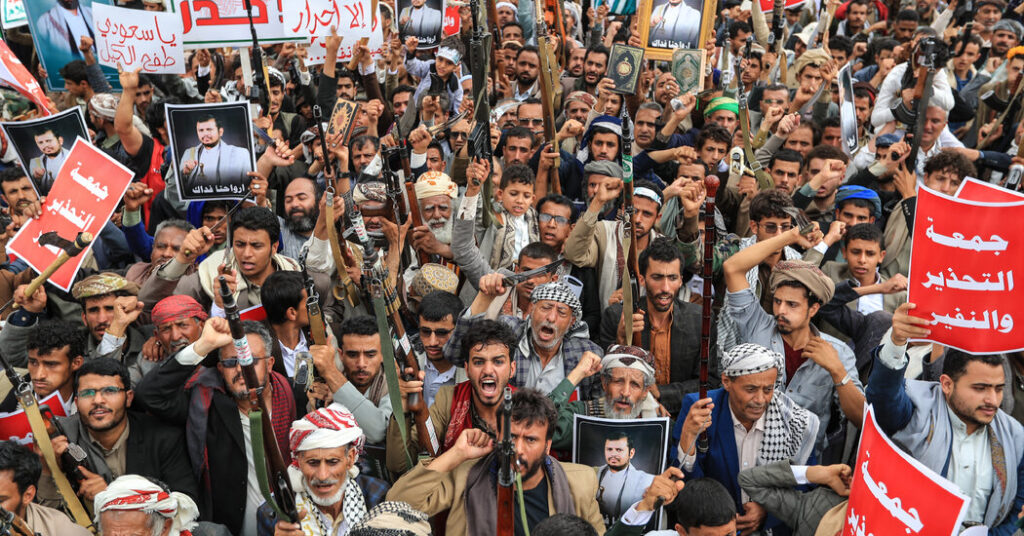
After months of relatively minimal involvement in the U.S.-Iran war, the Iranian-backed Houthi militant group in Yemen is making a delayed but potentially consequential entrance.
The Houthis claimed to have launched missile and drone strikes on two Saudi oil tankers in the Red Sea on Wednesday, just days after the group declared a naval blockade on shipping linked to Saudi Arabia.
The group has long portrayed itself as a frontline member of Iran’s so-called axis of resistance and has publicly tied itself to Iran’s fortunes. But while the Houthis are close to Iran, analysts describe their partnership as one shaped by both coordination and constraint.
Here’s what to know about the Houthis and their relationship with Iran.
Who are the Houthis?
The Houthis are Shiite militants who have been fighting Yemen’s internationally recognized government for about two decades. They overran the Yemeni capital, Sanaa, in 2014, forcing the government to flee to the southern city of Aden.
The following year, a Saudi-led coalition launched a bombing campaign to oust the militants but failed, leaving the Houthis in power in northern Yemen. Hundreds of thousands of people died from the violence, famine and disease that ensued in one of the world’s worst humanitarian crises.
The Houthis oppose Israel and the United States. The group is part of the so-called axis of resistance led by Iran, along with Hamas in Gaza, Hezbollah in Lebanon and armed groups in Syria and Iraq.
Fighting between the Houthis and the Saudi-backed Yemeni government subsided in recent years, and the United Nations helped broker a cease-fire in 2022.
Since then, the group has continued to launch attacks on its adversaries in the region. In the wake of the Hamas-led Oct. 7, 2023, attack on Israel that killed over 1,200 people and Israel’s subsequent bombardment of the Gaza Strip that has killed more than 73,000 people, the Houthis disrupted international shipping by firing on passing vessels in the Red Sea.
Crucial to the Houthis’ power is the Bab el-Mandeb Strait, a narrow waterway on Yemen’s southwest tip. The strait connects the Red Sea to the Gulf of Aden and is one of the world’s most important shipping routes.
Have the Houthis been involved in the war?
Until recently, the Houthis’ involvement in the broader Iran war had been halting and cautious. Experts said the group had been weakened by last year’s weekslong bombardment by the United States and Israel in Yemen — and forced into a careful calculation about how much of its dwindling arsenal it could afford to spend.
The new front in the war started to crack open earlier this month, when Houthi authorities accused Saudi Arabia of attacking Yemen’s main international airport in Sanaa in a dispute over an Iranian plane that tried to land there.
Analysts say Iran may have also urged the Houthis to disrupt shipping in the Red Sea. With the Strait of Hormuz effectively closed for months, the Red Sea has become a vital alternative export route for the transportation of Saudi oil and gas.
What is the Houthi relationship with Iran?
The Houthis are neither a direct conduit for Iranian interests in Yemen, nor a fully independent entity free of the Islamic Republic’s influence.
Analysts have said Iranian support helped the Houthis evolve from a group of poorly organized rebels to a powerful armed presence in the region, with an arsenal of cruise and ballistic missiles and long-range drones.
But the group has had to weigh its loyalty to Tehran alongside domestic calculations. It may have delayed engaging in full-scale confrontations in the current regional conflict because it could risk inviting renewed strikes on Houthi leadership and infrastructure — or even emboldening rival Yemeni factions.
The post What to Know About Iran and the Houthis appeared first on New York Times.