I’ve had a hand in killing around six people. Maybe seven. I don’t know if one man bled out on the side of the road or was taken to a doctor. I think about him often.
The killings occurred in the winter and spring of early 2010, during one of the largest operations of the Afghanistan war: the battle of Marja. I was the 22-year-old leader of a scout sniper team of seven Marines and one Navy corpsman.
It is a strange thing, having killed people in a conflict that spanned 20 years and was ultimately lost. The sum of such an intense expenditure of human lives and trauma left Afghanistan much as it was in 2001, before any American boots touched the ground.
Killing in war often boils down to an us-or-them mentality, a defensible position common to infantry combat. But we were also directed to “win hearts and minds,” the U.S. strategy meant to earn the population’s trust and isolate the Taliban. Trying to build good will while engaging in gunfights beside people’s homes was profoundly confusing. The killing wasn’t detached; it felt deeply personal.
Patrols required a constant assessment of friend or foe, and long hours staring through high-powered optics trying to determine the intent and mannerisms of our enemies. Rarely did we see them with a rifle in their hands. Killing fell on our own instincts and an ever replenishing set of fears. Should we shoot this man? Should we not? What if we don’t? Will our friends die because of our hesitation?
We also had a twisted culture in which killing earned you respect, as if shooting Afghans was the ultimate proof that you were competent. So we killed people. I killed people. These decisions to pull the trigger were the final steps of our part in a strategy that was doomed before I even deployed.
The Taliban, with their exclusion of women from public life and violent treatment of ethnic minorities, fractured Afghan society. During its 20-year occupation, the United States often used this as a justification to prolong the war, even as it rarely addressed its strategic and moral failures or the pain and loss it was causing so many Afghans.
My journalism career — which began after I left the Marine Corps — revolved around trying to understand why this bloody cycle continued. Reporting was a way to roll back time and understand what I had done and what role I played in a conflict that was far from over. The more I saw, the more I learned, the more my contribution to this mess in my early 20s left me with a sense of shame.
Covering war also meant sustained proximity to violence, victims and trauma, and from time to time the public dishonesty that all but inevitably accompanies conflict. I had lived through enough in the Marine Corps. I was already past my fill of that. I resigned from my job, exhausted.
But in May, with a little over two weeks remaining at The New York Times before returning to school to become an English teacher, I landed in Afghanistan. I had come to speak with the people I once fought against: the Taliban.
My thinking was straightforward. Even if the Pentagon would not undertake any significant reflection for these recent decades of war, I could, at a minimum, hold myself accountable for my part in a half-baked strategy that left tens of thousands of Afghans and Americans dead.
I brought souvenirs from a gift shop near my home in Rhode Island, which I would present to a few Taliban officials whom I have known for nearly a half decade now. Hearts and minds, after all, though this time as a guest not an occupier.
Ultimately, I wanted to talk to Mullah Abdul Rahim Gulab, a Taliban commander whom I met by chance in 2021, just months after Kabul fell to the Taliban. But we had also fought against one another in February 2010 in southern Afghanistan.
I knew he would have a version of the battle in Marja that was different from mine. Maybe he had stories with his own heroes and dead friends that I could appreciate and respect, ones that he also couldn’t stop thinking about. Maybe I could feel bad for him and not just feel bad for living while my friends died.
The Right Side
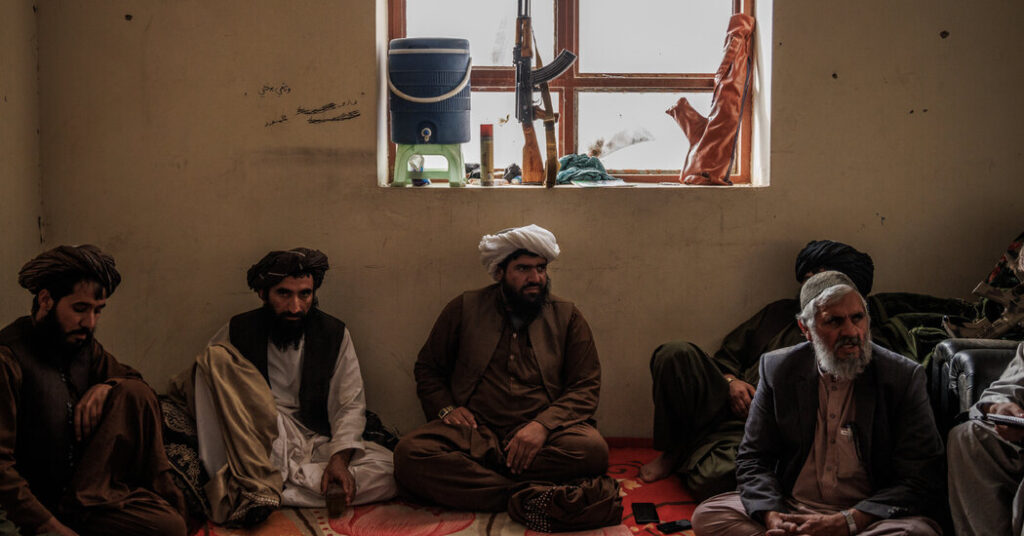
When I landed in Kabul in May, a Taliban deputy minister at the ministry of information and culture named Muhajer Farahi wanted to talk to me after he saw the request I submitted to speak to Mr. Gulab.
We had not met before. But sitting across from me in his office, Mr. Farahi told me his reasons for fighting the United States were simple: He wanted the Americans out of his home.
He spoke slowly and quietly, and avoided eye contact. His English was good. He made clear that his time in Farah Province in southwestern Afghanistan during the war, or jihad, as the Taliban refer to their 20 year military campaign, was difficult.
“We were on the right side,” he said. “We were fighting for our faith.”
I apologized for his dead friends and the innocent people killed in the war. He looked at me and thought for a moment before reminding me that I was a soldier, a cog in a machine that decided to invade his country and stay. It was as close as I would get to a pardon.
He wanted to discuss other things. Mostly he was curious about the number of Americans he had killed, and was still perplexed that even though he watched roadside bombs detonate under our armored vehicles, our casualty announcements from the Pentagon were relatively low. He assumed the United States lied about its death tolls.
I explained the complicated web of emergency care that was a quick helicopter flight away. He didn’t seem convinced. Instead he said something that most Talibs have echoed when discussing my time as a Marine: Don’t try to invade again.
I assured him that the United States appeared to have moved on, but he raised the latest wars in which the country had embroiled itself.
“You haven’t learned,” he said. “Look at Iran and Gaza — you are fighting for the Israelis. You don’t care about human rights.” He blamed the American people for voting a long line of presidents into power who started and continued the so-called forever wars.
As I walked into the blinding light of downtown Kabul, I felt what could only be described as a strange sense of relief. I had been lectured, yes, but on the edges it felt as if there was some acknowledgment of our humanity.
That felt like enough, for now. It was time to talk to Mr. Gulab.
Hard Facts
When I interviewed Mr. Gulab in 2021, I didn’t disclose that I had been a Marine. I questioned him as a reporter about his fighting days. He confirmed things I knew: how he and his peers would drop their weapons and greet us as friends on the streets, and that they relied on children to track our footprints to our makeshift outposts.
These had been hard facts for me to confront back in 2010, and still resonated when spoken in hindsight by a victorious insurgent, a hometown fighter who leveraged cunning to defeat us, even though we were far better armed than his band of 20 men. His tactics had formed a puzzle I navigated on every patrol so that I could survive the day. Some of my friends didn’t.
When I first met Mr. Gulab, I walked to a mud brick wall in Marja as a journalist. As a Marine more than a decade before, I had shot a young man in the head in this exact spot. I remembered the last glimpse of his face before the crack of my bolt-action rifle. My brain didn’t compute that I had killed him until later, when someone told me they had found his body dragged behind a corner with his weapon.
Mr. Gulab and I are roughly the same age, in our late 30s. He joined the Taliban because two of his brothers were killed fighting. One of them is his WhatsApp profile picture.
I joined the Marines because my dad was a Vietnam veteran who rarely spoke about the war, and because I was a short kid who grew up in a nice town and went to a nice public high school and wanted to prove myself.
In May, when I reached Mr. Gulab again, this time by phone, I told him the truth about my background: I wasn’t just a journalist, I had fought in Marja as a Marine. He said he had realized that when we first met, given the specificity of my questions.
He wondered what I wanted now: “What’s the point in talking again?”
Mr. Gulab had won his war, and closed that chapter with the United States long before I did. Now he was preparing to fight another conflict, this time against Pakistan. He led a large Afghan Army unit from a base that is still known as Camp Dwyer, where I had flown from in 2010 to fight him and his mujahedeen troops.
The base was named after a British soldier: Lance Bombardier James Dwyer, who was 22 years old when his vehicle ran over a mine two days after Christmas in 2006.
Our conference call began with pleasantries before his reticence lifted, and he was willing to talk about the beginning of the Marja operation. I was curious about his side of our shared experiences, including the fate of a Taliban sniper whom Mr. Gulab would have known, or at least heard about.
That sniper had shot two of my Marines, including my assistant team leader, on the first day of the battle. It was dusk. We were on the roof of a two-story building, the only structure that high for miles. I remember what sounded like a baseball bat hitting uncooked meat. I looked up to see my friend Matt screaming. He had been shot in the arm. A week or so later we drove that sniper into an orchard, where a drone strike presumably killed him. But 16 years later, I still wanted to know for sure.
Mr. Gulab started to speak but was cut off by his minder, who said curtly that sharing such details was illegal. Instead, Mr. Gulab had questions of his own, involving that same sniper. He said he was nearby when my teammates were hit and remembered reports that two “foreigners” had been shot on that roof and fallen off.
“Did they die?” he asked.
I explained that both Marines had survived their wounds but that Matt died in a motorcycle accident back home a little over a year later.
“Why do many American soldiers who fought in Afghanistan and later returned to their country commit suicide?” Mr. Gulab asked. “I have heard this many times. What is the reason?”
It was a question that haunts many of us. I tried to explain how we carried the crushing weight of our own shattered expectations: We had grown up on the nostalgia of World War II, then done something we were supposed to be proud of. Instead, what we got from our politicians and generals were evasions and lies. Our commanders could never articulate how our deployments, and all the violence we committed and the losses we suffered, made anyone safer in the United States.
We were left to figure everything out on our own while they landed lucrative jobs at defense companies and collected big fees on speaking circuits. For some people, it was too much to handle.
Mr. Gulab’s years after the war had been nothing like that, he said. “Our mujahedeen are the opposite, because of the jihad they carried out and because of the friends they lost, they are very happy, because our jihad had a clear goal.”
While the Taliban had won the war, winning the peace had brought its own difficulties: Afghanistan remained in an economic crisis and isolated from much of the world.
“Regarding your apology,” he said, “I should say that at that time our jihad was for the sake of Allah, and we were not worried about being killed or wounded. We are also not upset about our friends who were killed or wounded, because all of us wished to be martyred or injured on the path of jihad. Since the conditions at that time were wartime conditions, civilians were often killed or wounded.”
I wished that I, too, could accept the deaths of my friends and the results of my own actions instead of inhabiting a fog of anger and bitterness over wasted youth. Mr. Gulab let me know that such sentiments existed in Afghanistan, too.
“Regarding the mujahedeen who were killed by your side, I do not know whether they or their families would forgive you,” Mr. Gulab said. “Those civilians may not forgive the foreign forces, but for me personally, I have my own authority and I have forgiven you.”
I first set foot in Afghanistan as a 20-year-old lance corporal in 2008. The Taliban were shadows in a tree line then, and characters that appeared in my nightmares as I tried to stay alive. In August 2021, I watched them shake hands with a squad of U.S. Marines as the Afghan Army evaporated, Kabul fell and my war was finally, fully lost.
Now my one-time enemy generously offered a kind of coda to a line I wrote in my journal on that first deployment 18 years ago: “It’s hard to explain this place and I feel it’s going to take the rest of my life to figure out what happened here.”
Boarding my flight back to the United States, I realized a pervasive sadness lingered in the corners of my mind. I was tired, as if litigating my war again had somehow restarted it. Mr. Gulab and I were, at one point in our lives, two people, barely men at the time, fighting for vastly different reasons. Maybe it was enough that I saw him now more, in some twisted way, as a friend than my enemy.
Some days later in Rhode Island, as I walked my dog on a muggy New England night, my phone vibrated.
Mr. Gulab had texted me in Pashto: “Have you arrived at your home?” he asked.
I said I had.
“It’s good to hear that you arrived safely.”
Yaqoob Akbary and Safiullah Padshah contributed reporting.
The post Why I Sought Out a Taliban Commander I Had Fought appeared first on New York Times.