On a typical day, many of the people lined up outside the grand National Archives building in Washington are there largely to see one thing: the faded parchment Declaration of Independence, which, despite the best efforts of Nicolas Cage in the movie “National Treasure,” remains safely housed in the central rotunda.
But the National Archives — a sprawling network of 40 facilities across the country — is home to more than 13.5 billion pieces of paper along with millions of maps, photographs films and other artifacts. And a new $40 million flagship exhibit that opened last month aims to bring more of them than ever into view.
That exhibit, “The American Story,” housed in nine galleries off the rotunda, includes treasures like George Washington’s annotated draft copy of the Constitution, the original Louisiana Purchase treaty and rare photographs by Ansel Adams.
But it also uses interactive technology and artificial intelligence to let visitors follow their own curiosity and call up a seemingly endless stream of digitized documents from the collection. They can even use a QR code and their phone to assemble and leave with a portable mini-archive of their own.
“We were thinking about the swimmers, the skimmers and the deep divers,” Patrick Madden, the executive director of the National Archives Foundation, a private group that provides financial and other support, said on an opening-day tour last month. “People who come here want to have different kind of experiences, and mixing the original documents with the different media lets us hit all of them.”
The new exhibit, timed to the 250th anniversary of the Declaration in 2026, has been in the works for seven years. But it is landing at a moment of continuing uncertainty at the National Archives.
In early February, President Trump abruptly fired the archivist of the United States, Colleen J. Shogan, a Biden appointee who had served since 2023. No reason was cited. But the National Archives had been in a struggle with Mr. Trump over classified documents he kept after his first term ended.
Mr. Trump then appointed Secretary of State Marco Rubio as acting archivist. The president also named Jim Byron, the chief executive of the Richard M. Nixon Presidential Foundation, a private organization, as senior adviser to Mr. Rubio charged with running the archives on a day-to-day basis.
Mr. Byron spoke briefly at a ribbon-cutting ceremony at the opening, where he praised the new exhibit’s presentation of “the unique and exceptional American story.” But he was unavailable for interviews, archives officials said.
The archives also said that no curators of “The American Story” were available to speak, citing staff departures that have left the institution with only two curators, neither of whom had a substantial role in the exhibition.
Since returning to office, Mr. Trump has exerted pressure on federal cultural institutions like the Smithsonian, seeking to bring them into line with his vision of patriotic history. And “The American Story,” while covering issues like civil rights, immigration and westward expansion, sticks to factual language and an emphasis on progress and possibility.
But Mr. Madden, in an interview at the opening, said there had been no political interference with the new exhibition, which had been largely completed before Dr. Shogan was ousted.
“There has been no input from White House officials or the President about the exhibit,” he said. “It’s all been through our curators and leadership.”
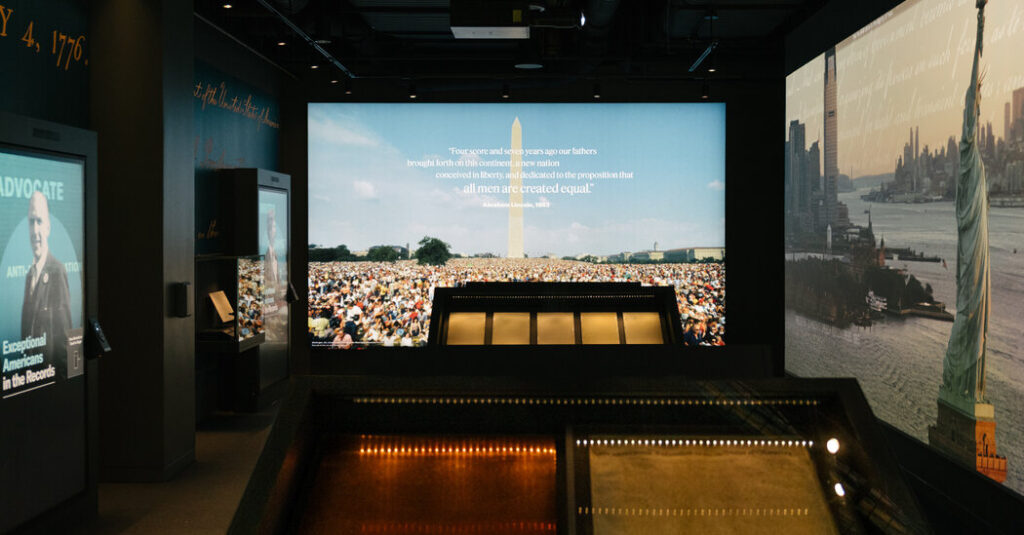
Leaving the rotunda and stepping into “The American Story” feels like leaving the 18th-century and entering, well, the 21st. In the introductory gallery, storms of documents (each with its filing number) swarm across the screen-covered walls.
Beyond it, nine main galleries take visitors on a thematic tour through American history, from the founding to westward expansion to space travel and beyond. The idea is not to tell a narrative story, but to open keyholes into different topics and kinds of materials, mixing physical artifacts with digital displays that let visitors dig deeper into curated document collections — or spelunk into a vast sampling of two million digitized items with help from an A.I. tool.
Planning for the exhibit started in 2018, under David Ferriero, who led the National Archives from 2009 until his retirement in 2022. There have been some political bumps in the road.
In October 2024, an article in The Wall Street Journal detailed complaints from anonymous archives employees accusing Dr. Shogan of trimming discussions of difficult topics to promote a rosier image of the past.
In a blog post at the time, Dr. Shogan called the article “misinformed,” and posted a longer statement from the National Archives, emphasizing its nonpartisan mission.
“To be successful, it is imperative that the National Archives welcomes — and feels welcoming — to all Americans,” it said. “We are not activists for anything but the records themselves.”
In a telephone interview, Dr. Shogan, who now leads a bipartisan presidential history project, said she had not yet seen the completed exhibition, but felt “vindicated” that it appeared to have gone forward largely unchanged.
“My job was to plan an exhibit for National Archives that doesn’t just last for a moment,” she said. “My job was to plan an exhibit that would last through many different presidential administrations and political changes.”
One gallery that did evolve significantly during the planning process, both Mr. Cordes and Dr. Shogan said, was the Constitution gallery, called “A More Perfect Union.” Originally, it had focused mainly on the amendment process. In the finished exhibit, visitors can still explore each amendment on an interactive table. But the gallery also focuses on the basics of democratic government laid out in the Constitution: the separation of powers, checks and balances, the principle of federalism and so on. (Recent surveys, Dr. Shogan noted, show that only 22 percent of 8th graders are proficient in civics.)
Documents, which will rotate every few months, highlight the ways in which citizens have petitioned the government, and the ways they have vehemently disagreed with each other.
First up, in a case called “Different Viewpoints,” two 1974 letters about Title IX, which prohibited sex-based discrimination in educational programs, including sports: one from a woman’s sports advocate urging President Gerald Ford to support the proposed law, another, from the Purdue football coach, warning that it would bring about “the destruction of college athletics and college football as we have known it.”
Veterans records are among the most heavily used collections at the National Archives. And the next gallery, called “The Common Defense,” highlights war and diplomacy, from the grunts up to the commander in chief.
One display lets visitors call up records from every war since the American Revolution. Another uses records from the 13 federally run presidential libraries around the country to explore presidential decision-making, from Harry S. Truman’s decision to drop the atomic bomb to George W. Bush’s response to the Sept. 11 attacks.
The exhibition largely stops short of our own polarized moment. Barack Obama, Joseph R. Biden and Mr. Trump are represented mostly in a carefully bipartisan presidential photomontage and in a case of gifts bestowed on various chief executives (including a long red tie given to Mr. Trump).
And to some eyes, “The American Story” may seem to tread lightly when it comes to post-World War II social and civil rights movements, whose legacies are still contested.
The first gallery, dedicated to foundational documents, includes a draft page from the Civil Rights Act of 1964, which is displayed near an 1823 copperplate engraving of the Declaration and a handwritten draft of the Emancipation Proclamation. An interactive panel featuring “Exceptional Americans in the Records” discusses the early 20th-century anti-lynching activist Ida B. Wells and the gay rights pioneer Frank Kameny, who was accused of “immoral conduct” and fired from his job as an Army astronomer in 1958 during the Lavender Scare.
But the only individual figure relating to the 1964 act itself is William McCulloch, a Republican congressman from Ohio known as “Mr. Civil Rights of the GOP.” (Largely forgotten today, McCulloch played a crucial role in passing the law.)
Both Dr. Shogan and Franck Cordes, the campaign project director at the National Archives Foundation, said a decision had been made early on not to repeat too much material from “Record of Rights,” a permanent gallery below the Rotunda that chronicles the ways African Americans, Native Americans, women, immigrants and others have fought to realize the promises of equality in the Declaration.
Politics seem far away in the last section of the exhibit, which explore creativity and innovation. “Uncle Sam Presents” runs a loop of clips from the more than 450 million feet of film in the collection, from footage of a 1908 Wright Brothers flight to now-kitschy public service announcements from the 1960s and 70s.
The next gallery, dedicated to records of the National Aeronautics and Space Administration and the everyday technologies its research seeded, is tricked out to evoke the experience of being on the moon, complete with a spongy floor.
In the last room, “Your National Archives in Action,” visitors can use interactive kiosks to search for ancestors in census records. Lining the walls are vignettes about people who found parts of their own history — a father’s childhood letter to Franklin Delano Roosevelt, a great-grandmother’s Pueblo pot — in the collection.
The American story, Mr. Madden emphasized, is something we are all still writing.
“OK, you’ve got this,” he said, gesturing back toward the rotunda and the Declaration. “What does it all mean? What did it turn into?”
Jennifer Schuessler is a reporter for the Culture section of The Times who covers intellectual life and the world of ideas.
The post At the National Archives, a Deep Dive Into the American Story appeared first on New York Times.