In hindsight, the contours of President Trump’s plan to steal the 2020 election were almost painfully obvious.
First, there was demonization. By casting Democrats as an existential threat to the nation (and to the evangelical church), Trump activated both the fear and the religious zeal of his most loyal supporters.
Second, once he’d cast his opponents as evil (or “demoncrats,” to use a term from the extreme religious right), it was easy to persuade his base that their enemies would stop at nothing to seize power, including cheat any way they could.
Third, when he lost, he responded by — to politely paraphrase Steve Bannon, one of Trump’s former senior advisers — flooding the media with sewage.
Trump and his supporters made wild claim after wild claim (it was exhausting writing piece after piece rebutting his conspiracy theories) so that even more normal and sensible Republicans began to get the impression that something was wrong in 2020, even if they couldn’t quite put their finger on what it was.
But none of those tactics would have mattered if there was no actual mechanism for reversing the election, and that was the final, most dangerous element of the Trump plan. Trump had a legal theory — that he could abuse and exploit the procedures under the Electoral Count Act of 1887, to either reverse the election outcome outright or delay certification of the election while Trump’s allies worked to change enough state certifications to reverse the outcome.
The entire scheme was laid out, in black and white, in John Eastman’s infamous memo that argued that Mike Pence could simply hand the election to Trump. Eastman was a former dean of Chapman University’s Fowler School of Law and a prominent member of the Federalist Society.
His legal argument was so specious that it got him disbarred, but he wasn’t arguing to a court, but rather to politicians — Donald Trump and Mike Pence — and the MAGA public. The fact that Pence rejected Eastman’s advice and certified the election for Joe Biden was the primary reason that the United States avoided a potentially catastrophic constitutional crisis on Jan. 6, 2021.
The same playbook is unfolding now, and I’m concerned, to put it mildly, that Mike Johnson is no Mike Pence. Johnson, in fact, filed a ludicrous brief at the Supreme Court in support of Trump’s challenges to the 2020 election outcomes in Georgia, Michigan, Pennsylvania and Wisconsin.
In the days and weeks before Jan. 6, all too many of Trump’s opponents suffered from a failure of imagination. We did not foresee his attempt to use the Electoral Count Act to stay in power until it was almost too late.
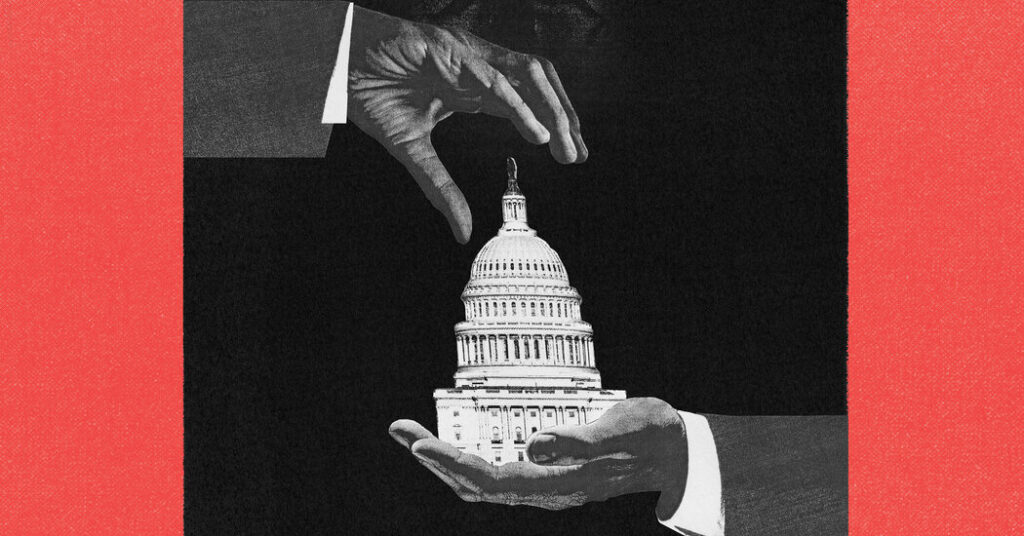
That’s exactly why we have to be creative now, to see around the corners into the possible future abuses of the law, and I’m worried that a largely forgotten constitutional provision (combined with a relatively vague federal statute) provides House Republicans a legal loophole to abuse — with no one clearly ready (or willing) to assume Pence’s role as the guarantor of American democracy.
Article I, Section 5 of the Constitution says that “Each house shall be the judge of the elections, returns and qualifications of its own members.” In plain English this means that the House and Senate make their own decisions regarding who belongs in each chamber of Congress, and those decisions are not reviewable by any other branch of government, including the courts.
Or, as the Supreme Court put it in a 1972 case called Roudebush v. Hartke, “Which candidate is entitled to be seated in the Senate is, to be sure, a nonjusticiable political question.”
The actual process for contesting an election to the House is governed by the Federal Contested Elections Act of 1969, a law that revised and updated previous legal procedures governing contested House elections. The law is detailed about process but largely silent about substance. The actual grounds for overturning an election are left to the discretion of the House (the Senate is governed by different rules).
The law gives a losing candidate, which it calls the “contestant,” 30 days after the certification of the election by state election officials to file a challenge with the House. The challenge is then referred to the Committee on House Administration, which investigates the contestant’s claims.
The contestant is supposed to bear the burden of proving that the election result should be reversed. But the matter is ultimately decided by a simple majority of the House, and the House can refuse to seat any member while the contestant’s challenge is pending.
The refusal to seat a member ought to happen only under exceptional circumstances, but those circumstances are up to the House, not the courts.
In fact, as a congressional explainer outlines, even apart from the Federal Contested Elections Act, “a member-elect may challenge the right of another to be sworn in, usually when the House convenes for a new Congress.”
This means that even if Democrats win a House majority after all the votes are counted this fall, one or more defeated Republican candidates could try to persuade the lame-duck Republican majority not to permit their Democratic opponents to take office while the challenge is pending.
And as the 2020 election conspiracies illustrate, the challenges could be based on virtually anything. A contestant could use the Senate’s refusal to pass the SAVE Act to claim that illegal immigrants voted for his opponent in large numbers. Or he could claim that a state’s refusal to turn over voter rolls to the Trump administration meant that the election was corrupt. Or he could go right back to the 2020 playbook and cast doubt on mail-in ballots.
I am not arguing that such an approach would be legally sound. But remember 2020 — the point isn’t to be legally sound, but rather to create a legal pretext. MAGA is just as happy to abuse a law as it is to use a law, and a congressional election contest of this kind is extraordinarily vulnerable to abuse.
If you think such a scenario is too far-fetched to be real, you should know that it’s happened before, and each time (including once in the heightened circumstances of the Depression), it has disrupted American politics.
As Jeffery Jenkins, a political scientist at the University of Southern California, outlined in a fascinating 2004 paper, in 1839, 10 candidates — five Democrats and five Whigs — contested five races in New Jersey. The New Jersey secretary of state had certified that the Democratic candidates had won, while the governor had certified a Whig victory.
The Democratic-majority Committee on Elections — surprise, surprise — ruled in favor of the Democratic candidates. The rest of the chamber adopted the committee’s recommendation, and the Democratic Party gained a majority of the House.
A similar situation unfolded in 1931 and 1932. The election left the House extremely closely divided: After Election Day, Republicans held 218 seats, Democrats held 216 seats, and there was one member of the Farmer-Labor Party. Between Election Day and the opening day of the new Congress, however, 14 representatives-elect died, leading to a series of special elections that would ultimately decide who ran the House.
As the parties battled for control, an Illinois Democrat named Stanley Kunz challenged his apparent loss to Peter Granata, a Republican. Granata had won the Election Day count by 1,171 votes, but after Kunz contested the tally, the Democratic board of election commissioners — in another surprise — found that Kunz, the Democrat, had actually won by 1,288 votes.
Once again the issue went to the House, and Kunz won on a voice vote, Granata was unseated and Democrats (who had won a number of special elections) solidified their hold on the House.
I raise these historical episodes not because they’re identical to our present situation, but rather because they demonstrate that it is ultimately the House and the Senate that decide who sits in Congress — not the courts, not the president, and not even the voters.
We’re accustomed to voters having the final say, but America’s messy history indicates that this has not always been the case. In his paper, Jenkins found that there were 601 election contests in the House between 1789 and 2002, an average of around 5.6 per Congress.
Unsurprisingly, election contests increased in the late 19th century, as white Southern Democrats and Lincolnite Republicans battled for control in Congress, and dozens of those contests were successful. In many cases the contests were necessary, as white Southern Democrats tried to ruthlessly suppress Black representation in the postwar South.
If the Trump administration is good at anything, it’s good at resurrecting some of the worst ideas of the American past. Racist immigration policies, brutal federal violence, McCarthyite censorship of political opponents, destructive tariffs, fruitless foreign wars — the Trump administration is bringing it all back.
I want to sound an alarm, but I don’t want to be alarmist. For House Republicans to defeat the voters, they’d have to maintain near-total party unity, and the Democratic margin of victory would almost certainly have to be modest (just a few seats). But I am highlighting the House because it has been the chamber most devoted to Trump, and Mike Johnson might be the least independent speaker of my lifetime.
In the hours after a violent mob stormed the Capitol, a majority of House Republicans — 139 in total — still voted not to certify Biden’s election. That’s far short of the majority needed to reverse an election. But this time around they would be making their decision after Trump has had six more years to remake the party in his image. He’s had six more years to purge reasonable Republicans from the party.
We should be under no illusions about MAGA intentions. Already, MAGA politicians are raising the stakes of the election. On Tuesday, Steve Scalise, the Republican House majority leader, said, “The Bolshevik takeover of the Democratic Party is in full swing, and communism is on the ballot this November.”
Two days earlier, Johnson posted, “The question before Congress is whether we will preserve our constitutional republic OR chart a fundamentally different course that leads us down the ROAD TO COMMUNISM.”
The talking points have gone out. Even while I was typing up this newsletter, a friend of mine sent me an example of a fund-raising text his father had just received. “A Communist Plot unearthed 4 mi from your home,” it read. “Trump begged the Pentagon for $350B to respond.”
There they go again, raising the electoral stakes beyond reason. And there they also go again, making wild claims about vote fraud and even wilder demands about voting. Senator Tommy Tuberville of Alabama told Newsmax last week: “We probably have four or five senators that didn’t legally win. They shouldn’t be up here.”
Markwayne Mullin, the secretary of homeland security, said that state election officials who do not meet the Trump administration’s demands regarding election security could face prison time. Bannon has proposed sending ICE agents to the polls to stop a mythical wave of illegal immigrants from voting (perhaps the same mythical illegal immigrants who Trump believes kept him from winning the popular vote in 2016).
All of this is downstream from a president who is so focused on his deranged election conspiracy theories that he dedicated a prime-time address in the middle of a war to rehashing his discredited complaints. Our only consolation is that he won’t be on the ballot in November, but he also doesn’t want to face congressional investigations, much less potential impeachment. He will use all the tools in his toolbox to avoid any accountability from a hostile Congress.
After more than 10 years of Trump, two things are clear. First, most Americans don’t like him, and second, his opposition has never been united enough to drive the man or his movement all the way out of electoral politics.
Yet the longer that Trump remains in power, the more I’m convinced that it is only an unambiguous electoral landslide that will rebuke Trump and his movement. Make the outcome so overwhelming that it’s beyond any conceivable doubt.
That’s what ousted Viktor Orban from power in Hungary, and a similar landslide could oust MAGA from power in America. There is, however, no real sign that a landslide is imminent in the United States. The Cook Political Report lists 18 truly tossup races in the House, out of 435. A further 19 races lean Democratic or Republican. Even taken together, that’s less than 10 percent of the House races this November.
Cook lists only four tossup races in the Senate. Three other races lean Democratic and two races lean Republican. A vast majority of seats are securely in Republican or Democratic hands.
In other words, it is entirely possible that we will run a repeat of 2020, when the outcome of a narrow election was clouded by accusations of fraud, and MAGA was hellbent on retaining control. In 2026, however, we face a president who has surrounded himself with sycophants and yes men, with years left in a term that has already been marked by grotesque lawlessness and abuses of power.
I hope come January this newsletter ends up looking silly. I hope that I’m describing a scenario that not even this Republican House would truly contemplate. But there is no rational reason for optimism.
After all, will Kash Patel restrain the president? Will Todd Blanche? Who can play the role of Mike Pence or Bill Barr in frustrating Trump’s plans? In the absence of a landslide, we are left to hope and trust that men like Johnson can find enough dignity and integrity to keep our nation from returning to the darkest days of the Republic, when partisanship trumped democracy and elections meant nothing when power was on the line.
Some other things I did
Last week I didn’t write or podcast all that much, but for a very good reason — my oldest daughter Camille gave birth to our third grandchild. Rose and her mom are happy, healthy and doing well.
For those readers who aren’t grandparents, I can tell you that everyone who tells you that being a grandparent is wonderful is actually underselling it. Being with those little ones — and helping their mom and dad navigate all the challenges of raising young children — is one of the greatest blessings of my life.
I did, however, podcast a little, and I had a great conversation with my friend Sarah Longwell, founder of The Bulwark, about the importance of character in politics. We tried to answer the question: Did character ever really matter to the Republican Party?
Thanks for reading. You will soon start to get my columns emailed to you too.
If you’re enjoying what you’re reading, please consider recommending it to others. They can sign up here.
Have feedback? Send me a note at [email protected].
You can also follow me on Threads (@davidfrenchjag).
The post This Is What’s Keeping Me Up at Night appeared first on New York Times.