What a nothing burger the whole “woke” controversy over “The Odyssey” turned out to be.
Many thousands of people lined up to see the movie this past weekend, selling out IMAX screenings — so many people, in fact, that the film made $264 million globally on its opening weekend, an astounding result for a three-hour epic about Bronze Age warriors. Critics have called the film a classic, and the online rabble-rousers, egged on by Elon Musk, who dismissed the film over so-called woke choices — like the casting of Lupita Nyong’o as Helen of Troy and the transgender actor Elliot Page as the warrior Sinon — have all pretty much shut up, or been shut up by the film’s overwhelming success.
Thankfully, a livelier and smarter debate has emerged in its place, one that’s a lot more relevant to Western society in the midst of an identity crisis. When is war justified? What moral boundaries do we owe our enemies? What transgressions merit the ultimate punishment? And who, in the end, determines civilization’s common set of values?
Suddenly, there’s an actual conversation worth having.
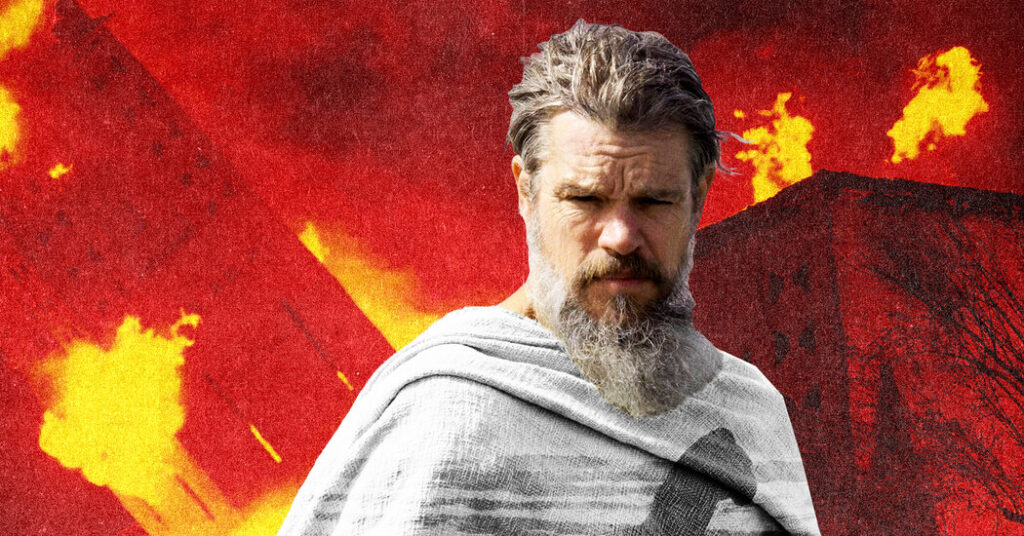
“The Odyssey” tackles these questions through an examination of the abuse and neglect of xenia, the Greek gods’ sacred code of hospitality that requires treating strangers as honored guests. Odysseus’s clever Trojan Horse trick, which led to the fall of Troy, violated xenia by misleading the city’s residents into believing they were receiving a gift. In Christopher Nolan’s retelling, this deceit metastasizes for his hero into a larger moral failing — one that haunts Odysseus as he makes his treacherous, 10-year journey home.
Odysseus’s betrayal of xenia is not the only failing that plagues him. He’s also consumed with shame over abandoning his family and losing the lives of all of his men. In Mr. Nolan’s film, these issues weigh on Odysseus in a way that many scholars and historians say is scarcely found in Homer’s original.
“The Odyssey” isn’t woke, wrote the conservative commentator Michael Brendan Dougherty on X. “Its view of war and the gods is closer to mine than it is to Homer’s.” The Odysseus portrayed in the film, he pointed out, “is morally horrified by war,” while in Homer’s version “war is a normal and potentially glorious enterprise.”
According to the classicist Emily Hauser, “Here is a modern-day Hollywood hero who learns remorse for the atrocities he commits and spends much of his time trying to excuse having lost all his men, and retrospectively (with a final journey, not in Homer, to pay homage to them) earning their forgiveness.”
This mapping of contemporary Western values onto the plot of a Greek epic poem is the true artistic project of Mr. Nolan’s film, and it makes for a better political debate than anything about colorblind casting or imagined D.E.I. Today, all the prerelease noise around the film’s ostensible wokeness seems predictable and tiresome, the kind of drivel that drives our exhausting culture wars, a ritual of the online mob that insists on rehashing the same right-versus-left, Hollywood-versus-Main Street argument that film audiences clearly ignored.
In an interview with Jon Stewart, Mr. Nolan discussed the link between his vision of Odysseus and Robert Oppenheimer, the subject of his previous, Oscar-winning film. “What so stayed with me in that movie,” said Mr. Stewart, “was the weight that Oppenheimer must have felt when he saw the reality of what he had created.”
Mr. Nolan readily agreed, explaining how he deliberately brought the gravity of “Oppenheimer” into his new project by exploring the question of what happens when a man participates in something too destructive to be fully understood.
This doesn’t make the film woke. It makes it worthy of thoughtful discussion.
In the months before the film’s release, Mr. Musk gleefully fed the culture wars by accusing Mr. Nolan of “desecrating Homer,” and by affirming an online post that claimed “The Odyssey” was part of a left-wing plan to “destroy Western Civilization and everything that helped create it.” This week, Mr. Musk announcedthat, before year’s end, there will be another full-length version of “The Odyssey,” created using his artificial intelligence program Grok, which he promised would be “true to the art of Homer.”
None of us are holding our breath. We’re all too busy engaging in the much more interesting debate that Mr. Nolan’s film has already inspired.
Sharon Waxman is the founder, chief executive and editor in chief of The Wrap.
Source photographs by Melinda Sue Gordon/Universal Pictures.
The Times is committed to publishing a diversity of letters to the editor. We’d like to hear what you think about this or any of our articles. Here are some tips. And here’s our email: [email protected].
Follow the New York Times Opinion section on Facebook, Instagram, TikTok, Bluesky, WhatsApp and Threads.
The post Let This Be the Final Word on Culture War Feuding appeared first on New York Times.