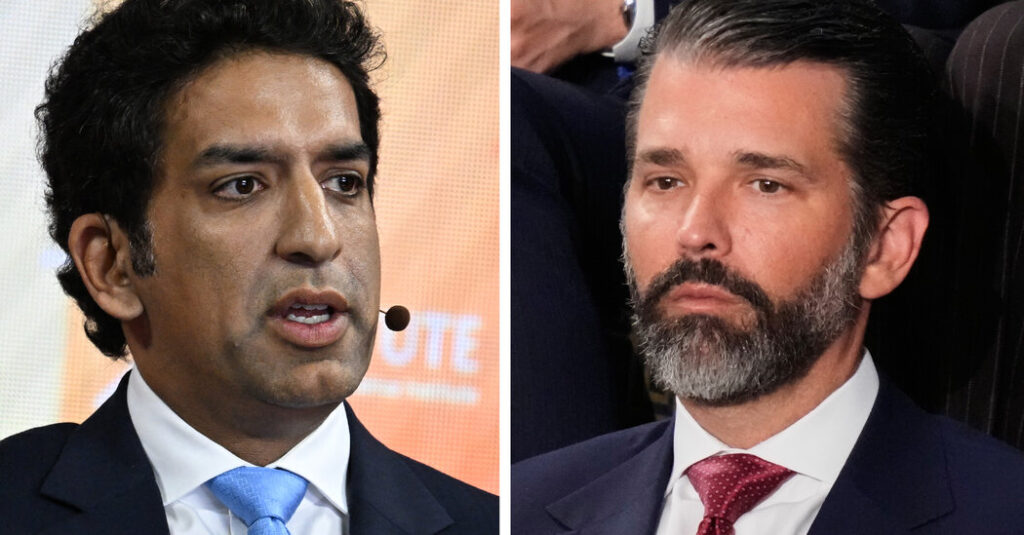
As the Republican National Convention was wrapping up in July 2024, Republican heavyweights crowded into a rooftop bar with views of the Milwaukee skyline. In a sea of suits, Donald Trump Jr. made a beeline for a man in a black T-shirt: Shayne Coplan, the 26-year-old founder of Polymarket, the prediction market betting site.
The president’s son told Mr. Coplan he was impressed with Polymarket and how its results, not the polls, reflected what he was hearing from voters about his father’s prospects of returning to office. That rooftop meeting marked the start of a lucrative relationship, showing how Donald Trump Jr. and his business partner Omeed Malik invested in a company whose fortunes would be affected by President Trump’s policies — a scenario that has played out repeatedly as their investment firm, 1789 Capital, has grown.
In the case of Polymarket, the government had banned it from taking monetary wagers from U.S. residents, but last year a federal regulator granted it an operating license in the United States. Worth $300 million when 1789 invested, the platform is now valued at $15 billion.
“He just took sort of the approach that we did, which is like, ‘Fuck all you guys,’ ’’ Donald Trump Jr. said of Mr. Coplan and of his own critics in an interview with The New York Times about investments he’s worked on during his father’s second term.
Dating back to the first Trump administration, members of the Trump family have faced criticism for mixing business with politics. But what sets apart the latest moves by Donald Trump Jr. is how he and Mr. Malik, through 1789 Capital, are cashing in on the policies of the current administration openly and without apology.
Many of the companies 1789 has invested in have large government contracts while others, like Polymarket, have benefited directly from new Trump policies or rollbacks of existing laws. The firm bought shares in some of the most coveted private companies before many went public, including SpaceX, Anduril, Cerebras and Reflection AI, often by leveraging their political and business connections to secure a stake or to help boost the companies’ sales.
Just two years ago, 1789 managed a few hundred million dollars. It now oversees more than $3 billion. Its main investment fund generated returns of roughly 200 percent as of June 30, according to a person familiar with the firm’s performance. While still early in its investment cycle, those returns eclipse the average returns of about 21 percent from venture capital firms started in 2023, according to PitchBook, a provider of financial data.
Angela Lee, a venture capital professor at Columbia Business School, said she’s never seen a firm started by first-time fund managers raise so much money. “Any way you cut it, it’s unprecedented,” she said. One plausible explanation for the firm’s rapid success, she said: “People are paying for proximity to power.”
Mr. Trump and Mr. Malik, a former Democrat and banker, openly embrace their connections to President Trump’s broader circle of donors, influential supporters and high-ranking officials, but they scoff at questions of whether any of their success comes from direct access to the president.
As a private citizen, the president’s son said, he is free to invest however he wants and is doing nothing illegal. He said he talks to his father only “every few weeks,” never discusses business with him, and holds “no policy position and no role within the administration whatsoever.” Mr. Malik frequently mentions that he’s never even “set foot in the White House.”
In interviews, executives at companies 1789 is invested in said they have never seen the firm seek special treatment from the administration, but said they view being involved with 1789 as a way to get close to the Trump orbit.
Mr. Malik said both he and Mr. Trump know the people involved in the administration “on a personal basis” and that helps them position their investment strategies to benefit from White House policies.
Their approach is distinct from that of Mr. Trump’s brother-in-law, Jared Kushner, who had been involved in early peace negotiations with Iran while his private investment firm was seeking to raise funds from U.S. allies in the Middle East. (His firm later said it would not seek additional money from allies while Mr. Kushner was volunteering for the administration.)
Jessica Tillipman, the associate dean for government procurement law studies at George Washington University School of Law, said there are few actual rules for family members of the president, though many of them have gone to great length to avoid even the appearance of cashing in on the Oval Office. (Hunter Biden’s overseas business dealing were a recent exception.)
“A lot of this is based on norms,” she said. “The challenge we have is that when there’s no interest in kind of respecting the norms and from an optics perspective, that is troubling.”
A Former Democrat Goes for Trump
Mr. Trump and Mr. Malik first met at a barbecue in the Hamptons during the summer of 2018. They were introduced by Kimberly Guilfoyle, Mr. Trump’s former fiancée and the current United States ambassador to Greece.
Mr. Malik was in the middle of starting a new broker-dealer firm after a messy departure from his job at Bank of America.
A former corporate lawyer, Mr. Malik joined the bank in 2012 and within a year, at age 33, had become the bank’s youngest-ever managing director. He worked in the prime brokerage department and built a roster of hedge fund clients, including George Soros, Scott Bessent and Marc Lasry’s Avenue Capital.
In early 2018, the bank said in a regulatory filing that Mr. Malik was “discharged” for “personal conduct in violation of firm standards.” Mr. Malik filed an arbitration claim against Bank of America alleging defamation and discrimination. Within a few months, Mr. Malik settled with the bank for more than $10 million, according to a person familiar with the undisclosed deal.
While on Wall Street, Mr. Malik had been an active fund-raiser for Democratic candidates, including Hillary Clinton and Joe Kennedy III.
During their first meeting in the Hamptons, Mr. Trump said he found common ground with Mr. Malik politically. “I can play the radical on Twitter,” he said in an interview in Miami. “But I’m pretty reasonable. I grew up in New York City. I see all sides.”
By 2020, Mr. Malik started attending Trump re-election events and donated roughly $100,000 to the campaign. Together, the two men hashed out a set of shared ideals, they said, that would eventually form the basis for some of their investment strategies at 1789.
Trump Administration: Live Updates
Updated
- The House narrowly passes a stopgap spending bill, but a shutdown fight still looms.
- Trump threatens to impose steep tariffs on generic drugs.
- Trump lifts a decades-old ban on direct flights to Lebanon.
In their opinion, much of the infrastructure that makes America work, including banking and the mainstream media, were excluding conservative viewpoints. They also worried about China’s growing influence.
Ahead of the 2020 election, they coauthored an opinion column in The Daily Caller, a conservative online publication, about the need for the United States to take back control of its manufacturing supply chain and prevent American firms from investing in China-controlled companies like TikTok.
In early 2021, with the Biden administration in power and frustrated by Covid restrictions, both men moved from New York to Palm Beach, Fla., with their families. Mr. Malik became a member of Mar-a-Lago.
A Firm in Overdrive
Within a year of his move, Mr. Malik pitched his deepening network of Republicans on starting a new investment firm called 1789 Capital, named after the year the Bill of Rights was written.
His two co-founders and investors were Rebekah Mercer, a top donor to Republican causes whose father once ran the hedge fund Renaissance Technologies; and Christopher Buskirk, a co-founder of the Rockbridge Group, a secretive network of wealthy Trump supporters. (Vice President JD Vance is also a Rockbridge co-founder.)
By late 2023, 1789 Capital had raised roughly $100 million from investors, including more than $15 million that Mr. Malik, Mr. Buskirk and Ms. Mercer had put in. Mr. Malik set up an office a few miles down the road from Mar-a-Lago.
Less than a week after his father’s re-election, Mr. Trump took the stage at a Rockbridge event in Las Vegas and told several hundred donors that he was joining 1789.
With the president-elect’s son on board, the firm went into overdrive.
The two men met potential investors in South Korea and the Middle East. They became regular speakers at major investor conferences in Qatar and Saudi Arabia.
Flush with new investments, 1789 quickly deployed money into a wide range of companies, including many that are now benefiting from Trump administration policies aimed at ensuring that military weapons, raw materials and critical technologies are developed in the United States and not in China.
Among them are defense contractors Anduril and Hadrian and Axiom Space, a company that’s looking to build a commercial successor to the International Space Station.
Last fall, 1789 invested in Vulcan Elements, a rare earths magnet manufacturer, then valued at about $200 million. A few months later, the company landed a $620 million loan commitment from the Defense Department. The company is now worth roughly $2 billion.
The timing of 1789’s investment prompted an inquiry by Democrats in Congress about whether the firm exerted any influence in the decision to extend the federal loan. A spokeswoman for the Democratic members on the House Natural Resources Committee, which is scrutinizing the deal, said the inquiry is ongoing.
But Mr. Malik said he learned about Vulcan Elements’ federal loan from a company news release issued after 1789 made its investment; Mr. Trump said he has never met or spoken to anyone at the company.
The two men say they made the reasonable assumption that Vulcan Elements, one of the few private American producers of rare earth magnets used for cellphones, cars, and planes, would be a winning investment during an administration focused on promoting U.S.-based companies in critical sectors. (Their firm invests only in private U.S. companies and doesn’t take controlling stakes.)
“It’s not like it takes a genius to figure this out,” Mr. Trump said. “I don’t have inside information.”
‘Good for America’
For companies looking to leverage their ties to the Trump administration, an investment from 1789 is seen as a stamp of approval.
On a recent investor call, the chief executive of the 3-D printing company VulcanForms repeatedly invoked 1789 Capital’s investment, implying that the financial firm’s political proximity could help bring about opportunities for the start-up, according to one person on the call.
Mr. Malik was unaware of that investor call and said he can’t police what companies he invests in say about the firm.
The reality is that 1789’s connections can transform a company’s fortunes dramatically — as it did for a small artificial intelligence developer called Reflection AI.
Last year, 1789 invested in the little-known company, which builds so-called open source systems. These systems allow Reflection’s clients to create their own A.I. models rather than rely on ones created by the likes of OpenAI and Anthropic.
Building a successful and enduring open source A.I. system is a priority for Silicon Valley. Reflection A.I., 1789 believed, had the potential to become an American-made alternative to DeepSeek, an open source system developed by China.
The company made its first investment in Reflection AI in the summer of 2025, when it was valued at $3.5 billion.
Mr. Malik then tapped his network to find Reflection AI one of its first customers: the large South Korean conglomerate Shinsegae Group.
When the Rockbridge Group opened an international outpost in South Korea last year, it named Shinsegae’s chairman, Chung Yong-jin, as one of the founding board members. A few months later, he attended a Christmas party at Vice President Vance’s house in Washington. Shinsegae is also an investor in 1789.
In March, Reflection AI and Shinsegae jointly announced a plan to build a multibillion-dollar data center in South Korea that will house the tech company’s open-source models.
The data center, which would be used by Shinsegae and also the Korean government, was described in a joint news release by the two companies as pivotal moment in U.S.-Korean relations. The Commerce Department designated the data center as the first flagship project under its new “American AI Exports Program.”
This spring, 1789 hosted an online webinar for Reflection AI’s executive team and dozens of potential investors. Participants were told they had a week to write checks, which had to be larger than $5 million. As is common in private investments, investors would pay a fee to 1789 for access to the deal.
With a current $25 billion valuation, Reflection AI is now worth seven times more than when 1789 made its original investment last summer.
In a prerecorded video for that webinar, Donald Trump Jr. described Reflection AI as “good for America.”
The post How Donald Trump Jr.’s 1789 Capital Is Cashing In Without Apology appeared first on New York Times.