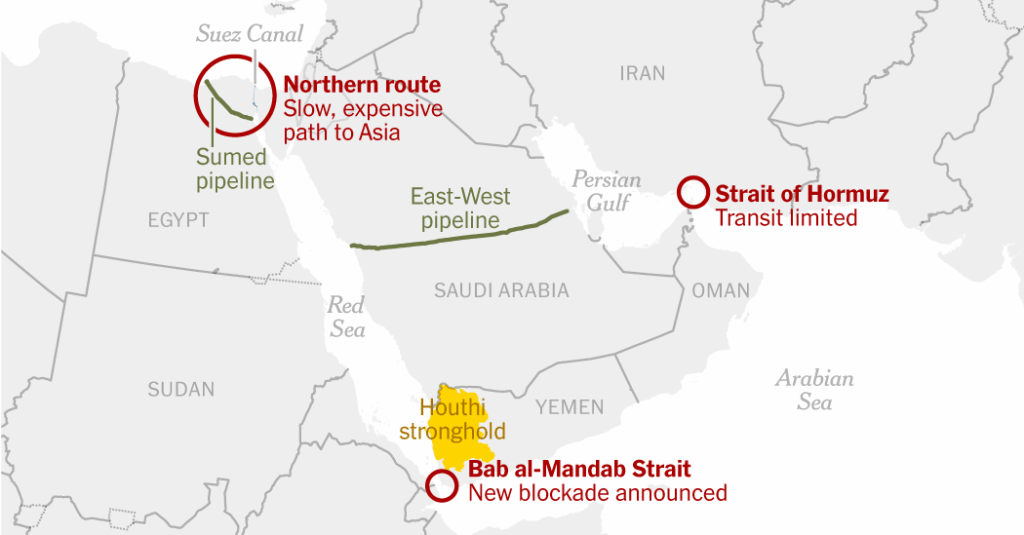
If the Houthis make good on their threat to blockade ships traveling to and from Saudi Arabia via the Red Sea, it would yet again upend global oil markets by compromising a crucial fallback for the Strait of Hormuz.
Since the early weeks of the war with Iran, Saudi Arabia has been relying on a pipeline that bisects the country to reroute millions of barrels of oil from the Persian Gulf to the Red Sea.
Most of that oil gets to market via the Bab al-Mandab strait at the southern end of the Red Sea, off the coast of Yemen and near territory controlled by the Iranian-backed Houthi militia. A smaller portion goes north to the Mediterranean Sea, via a pipeline that crosses Egypt or, in the case of oil-derived fuel, via the Suez Canal.
Any disruption to those alternatives would further restrict the supply of oil and fuels to a market rattled by renewed attacks on vessels in the Persian Gulf. The threats already appear to be having an impact. Two oil tankers, the Rodos and the Xin Long Yang, that were headed toward the Bab al-Mandab made U-turns on Tuesday, according to the maritime data firm Kpler.
The market is starting to show some anxiety, but the moves have been muted. Oil traded around $95 a barrel on Wednesday, up a few dollars since the militia made its threat.
The risks are grave, however. If the Houthis manage to completely block Saudi Arabia from using the Red Sea, they would take roughly 4 percent of the world’s oil off the global market. That estimate, based on shipping data from Kpler, would be in addition to the current loss of supply through the Strait of Hormuz.
Given the Houthis’ proximity to Bab al-Mandab, it would presumably be easiest for them to disrupt shipping there. Saudi Arabia has been using that choke point to export roughly 3.6 million barrels a day of oil and fuels, mostly to Asia, according to Kpler. That is up from very low levels before the war, when almost all Saudi exports passed through the Strait of Hormuz.
Now, the United States and Iran are both policing that waterway, which has become much more dangerous and less reliable.
While the pipeline across northeast Egypt and the Suez Canal present alternatives for transporting Saudi oil and fuels, they aren’t as appealing as Hormuz or Bab al-Mandab.
There are a few reasons for that, namely that it would take much longer and be much more expensive to send oil to Asia that way. Very large ships used to transport crude oil cannot use the Suez Canal, at least not when they are full and heavy. Sumed, the Egyptian pipeline, on the other hand, cannot accommodate all of the oil that Saudi Arabia has been moving through Bab al-Mandab. Plus, it would take an additional four weeks to reach Asia via the Mediterranean Sea because ships would have to go around Africa.
Sources: Pipeline routes from Global Energy Monitor. Area of Houthi control via the Critical Threats Project at the American Enterprise Institute. Ship paths from Kpler.
The post See How Houthis Put the Red Sea at Risk as an Alternative Oil Route appeared first on New York Times.