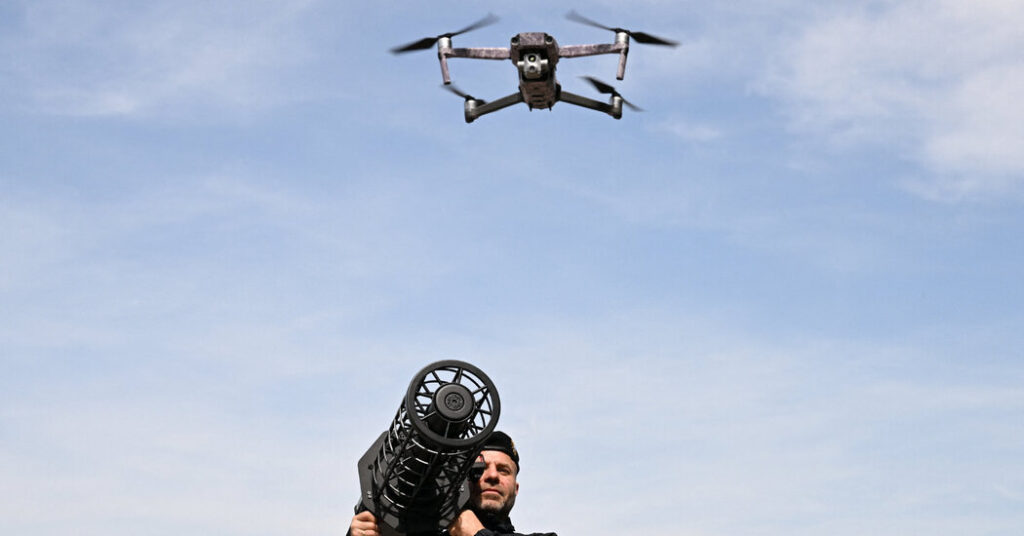
When a swarm of prototype drones swooped over a military test site in southern Germany earlier this year, it marked a potentially transformational moment for the German armed forces.
The site was a new hub at a repurposed military airfield in Bavaria. The military was opening it that day in February in an effort to shake up how it develops weapons, and with whom.
Parts of the swooping drones were designed by a two-year-old tech start-up — the kind of unproven and unconventional arms manufacturer that the German military leadership used to avoid.
“It’s just a huge difference,” said Lukas Köstler, the chief executive of the start-up, SE3 Labs.
Germany’s effort to rearm, prompted by rising threats from Moscow and dwindling support from Washington, has forced its military to try to change how it researches, funds and wields the weapons of 21st-century warfare.
For decades, the country worked slowly and methodically with traditional manufacturers to test, commission and build conventional military hardware like tanks, frigates and fighter jets. The military was barred from using public research funds to develop weapons, which reflected a desire across society, after the fall of Nazism, to limit its role in society.
Now, the German military is buying weapons that are not yet fully tested from a new generation of manufacturers with whom it had no prior relationship. It is too early to judge the success of that shift, and it is unclear whether Germany — which, like the rest of Europe, remains relatively unprepared for a new era of warfare — can overhaul its methods fast enough.
When Russia invaded Ukraine in 2022, a parliamentary ombudsman reported that nearly a quarter of Germany’s heavy combat equipment — like jets and tanks — was inoperable, and some soldiers lacked basic gear like underwear, boots and walkie-talkies. The day of the invasion, a top general used LinkedIn to complain about the shortfalls — setting the stage for Germany to invest billions in rearmament, even changing its Constitution to do so.
Germany’s dash exemplifies a broader struggle across Europe to catch up with the technological and tactical changes supercharged by the war in Ukraine, and to rely less on American weapons in the face of an increasingly dangerous Russia.
Spending power puts Germany at the forefront of the shift, experts say, even if smaller countries — like Estonia, which shares a border with Russia — are leading the way in specific areas like drone innovation.
Outside Europe, militaries across the world are making a similar push; the United States has a comparable program to work with small tech and drone companies.
In Germany, officials moved to bolster the country’s defense quickly after the 2022 invasion of Ukraine. The budget rose and could cover more weapons. But the shopping lists looked traditional: tried-and-tested, off-the-rack weapon systems — fighters, artillery and tanks that they could test before ordering.
Since then, warfare has evolved, forcing Germany — woefully underprepared for that evolution — to change its military planning. Autonomous weapons, drones and artificial intelligence have become increasingly important. To catch up, the German military has not only to use different products but to adapt the way it develops them.
“Large-scale arms programs alone are no longer enough,” Boris Pistorius, the German defense minister, said during the opening day of the test site in February. “What is just as crucial — and will become even more so in the future — is how quickly new technologies are adopted by the military.”
That has led to a gold rush, of sorts, among German defense start-ups. Procurement officials have had to find ways to buy weapons that are still in development, from weapon makers they didn’t previously work with.
Earlier this year, lawmakers approved contracts worth a total of nearly a billion dollars for “loitering munitions,” a type of drone used by both Russia and Ukraine that can linger in the air for hours until its target appears. It’s the kind of weapon the German Army has never needed before, bought from a new kind of supplier. Three drone makers have the contract; two of them have existed for less than a decade.
Germany is also working with Ukrainian firms to develop long-range weapons to replace those being pulled by the United States.
The government has invested in Fire Point, a Ukrainian company that makes the Flamingo, a missile with a 1,900-mile range that surpasses that of the American-made Tomahawk. In Ankara this week, Mr. Pistorius signed an agreement with Ukraine to start the joint production of a jet-powered drone.
Separately, the federal government has encouraged state administrations, which oversee Germany’s universities, to retire rules that forbid public research funds from being used for dual-use research. One state, Bavaria, already has. Others are working on it.
Some critics worry that some of these changes might make it harder for lawmakers to properly scrutinize what the military gets for its money. Billions of euros are being spent on unfinished weapons that may not survive the development phase, designed by foreign-owned start-ups.
In a sign of that skepticism, Mr. Pistorius had to personally appeal to lawmakers to get them to approve more than $300 million for loitering munitions made by Stark Defence, a company part-owned by Peter Thiel, a Trump donor.
Some of the new drones have had setbacks during early testing, underscoring the trial-and-error nature of drone development and fueling critical media coverage. Stark’s drones crashed during some early trials, the company itself has acknowledged, though it said those crashes were teething problems that ultimately helped it build better products.
Another drone firm, Helsing, denied reports that the Ukrainian Army had stopped buying its drones after setbacks in their development, saying that the weapons had performed well in tests.
To try to stay closely involved with new weapons development, the military has opened its innovation hub in Bavaria and is building another for naval technology.
It is here that you can find a scene once unthinkable in the staid German military: sneaker-wearing start-up bros with engineering doctorates working as equals alongside with uniformed officers. The officers have experience in military tactics or leading soldiers, but may not know the very latest on GPS-jamming technology.
Dozens of companies are hosted at the base, according to the defense ministry, which does not release exact numbers. The government subsidizes the firms’ development of new weapons, though it does not promise to buy those weapons once they are completed.
Emil Archambault, a drone expert at the German Council on Foreign Relations, a research institute in Berlin, says that such close collaboration benefits both sides. Start-ups gain the opportunity to pursue military contracts, while the military can begin reshaping its strategies around these emerging tools.
“What you need is to have the innovation both in tactics and in technology move hand in hand,” he said.
In a recent test in the field, Mr. Köstler, the head of SE3 Labs, found that soldiers were confused by the style of longitude-latitude grids that the drone software offered. Mr. Köstler and his team reprogrammed the software in their hotel room overnight.
“The next morning, the soldiers were besides themselves with joy.” he recounted. “Never in the army had they experienced something changing so quickly.”
Andrew E. Kramer contributed reporting from Kyiv, Ukraine.
The post After Decades of Caution, Germany Is Shaking Up How It Makes Weapons appeared first on New York Times.