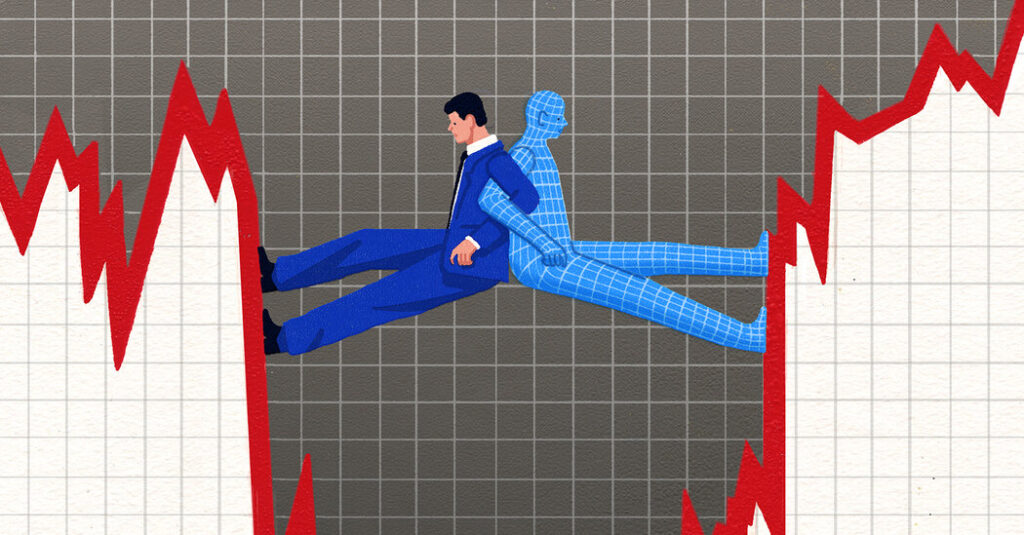
There is an adage in the financial world: The stock market is not the economy.
Except that, right now, maybe it is.
Major stock indexes have set record after record in recent years, fueled by seemingly boundless appetite among investors for anything connected to artificial intelligence. The total value of the U.S. stock market has more than doubled over the past decade to over $75 trillion, roughly two and a half times the annual output of the entire U.S. economy, itself a record ratio.
Much of that value exists only on paper, bets on future profits that may or may not materialize in the years ahead. But the boom is supporting real economic activity today, pumping trillions of dollars of investment into semiconductor factories, data centers, power plants and transmission lines. And the wealth it is creating is helping to drive consumer spending, particularly among affluent Americans, whose appreciating stock portfolios make them more willing to shell out for luxury vacations, pricey electronics and meals at high-end restaurants.
That spending and investment have helped carry the U.S. economy through a tumultuous period of inflation, tariffs and geopolitical uncertainty. But it also creates a vulnerability: If investor confidence in A.I. falters, the economic activity built atop it could come crashing down. Bank of America’s monthly global fund-manager survey for July reported a bursting of the A.I. bubble as the key risk to financial markets. It’s also now the key risk to the economy.
“The thing that has been holding everything up is the A.I. story,” said Torsten Slok, the chief economist at Apollo Global Management.
A.I. related stocks account for roughly half of the rise in the S&P 500 this year, said Adam Turnquist, the chief technical strategist for LPL Financial, adding that growth in the economy is also increasingly dependent on A.I. infrastructure spending.
“It’s becoming one big A.I. trade,” he said.
Stock markets have wavered in recent weeks in a sign of investor worry over so much dependence on one sector’s ability to continue outperforming expectations. But this isn’t the first instance of investors’ flinching during the A.I. run-up. Several times over the past few years stock prices have dropped steeply in response to a piece of bad news, only to rebound within days. Even many analysts who believe an A.I. bubble is still inflating are reluctant to predict that this is the moment it pops.
Declines in stock prices, even drastic ones, don’t necessarily have much impact beyond the world of finance — hence the adage about the market not being the economy. On “Black Monday” in 1987, the Dow Jones industrial average fell more than 20 percent, still the record for a one-day decline. Yet broader measures like the unemployment rate and gross domestic product barely wobbled.
What could make this time different is the sheer scale of the stock market. Economic research has found that for every $100 investors gain in their stock portfolios, they spend about $3 more on goods and services, a phenomenon known as the wealth effect.
The wealth effect also operates in reverse: When stock prices fall, investors become less willing to spend. At its present valuation, a 30 percent decline in the stock market could lead to a nearly $700 billion pullback in consumer spending. That could be enough to set off a recession on its own, or at least come close.
“Times when the market seems like it’s highest are times when that wealth effect can have the biggest bite,” said Gabriel Chodorow-Reich, a Harvard economist who has studied the wealth effect.
The other distinguishing factor of the current market is how concentrated it is in a handful of companies. The Magnificent Seven group of companies of Meta, Alphabet, Amazon, Apple, Tesla, Nvidia and Microsoft account for roughly a quarter of the value of all publicly listed stocks in the United States.
Because so much real-world activity is also being driven by the A.I. boom, a stumble by one of the big A.I. companies could have much larger economic ripples.
“It would spill over to the rest of the economy,” said Roger Aliaga-Diaz, the chief economist for the Americas for Vanguard.
Mr. Aliaga-Diaz and other economists described one scenario for how that could happen. If companies find that their A.I. investments aren’t paying off as quickly as they hoped, they might pull back their spending, forcing the A.I. labs and their suppliers to trim their growth projections. Such a disappointment could incite a market sell-off, which would make it more difficult or more expensive for companies to raise the capital they need to fund the A.I. build out.
That, in turn, could lead companies to delay or cancel plans to build data centers, power plants and related infrastructure, giving way to layoffs in the construction industry. And at the same time, the drop in the market would push wealthy consumers to pare their spending, leading to wider job losses and, ultimately, a recession.
“The consumer spending growth is not nearly what A.I. growth is, but it is such a large portion of the economy,” said Kristina Hooper, the chief global strategist at Man Group. “And growth there is being driven by high-income consumers who are tied to the fortunes of the stock market, and A.I. being such a big part of that.”
A turn in those fortunes is not inevitable. Many of the biggest A.I. players have already raised vast sums of capital, which could allow them to keep spending even if new sources of cash dry up. And companies won’t necessarily stop using and paying for A.I. tools just because the market enthusiasm for them dims.
A bursting of the A.I. bubble could also free up cash for other investments that have struggled to attract capital in recent years. That is, at least in part, what happened in the 2000s, when the end of the dot-com boom led investors to redeploy cash to housing and other sectors. The economy did experience a recession in 2001, but it was brief and relatively mild.
One factor that helped insulate the economy in 2001, however, was that the Federal Reserve cut interest rates aggressively, which helped contain the crisis mostly to the tech sector. This time around, inflation has been elevated for five years, which might leave policymakers more reluctant to cut rates.
“Monetary policy has a huge role in determining whether a decline in investment demand in one sector spreads more broadly or not,” Mr. Chodorow-Reich said. “The fact that monetary policy is a little bit more constrained weighs in on that.”
It could be years before policymakers are forced to deal with such a scenario. Economists are notoriously bad at identifying bubbles, and even worse at predicting when they pop. Alan Greenspan, the former Fed chairman, warned of the risks of “irrational exuberance” in the markets in 1996. The dot-com bubble didn’t burst for over three more years.
“I am of the view that it is very hard to predict recessions or recession timing,” Mr. Chodorow-Reich said.
But he and many other economists think the risks of a market-induced recession are real and growing. That is partly because investors are betting on such spectacular growth from the A.I. companies that even a fairly mild disappointment — an earnings release that falls short of expectations, a project that takes longer to pay off than initially assumed — could lead them to re-evaluate their assumptions and produce a steep drop in the markets.
“If investors are told, well, actually, instead of five to seven years, it’s going to be 15 to 20 years to pay off, that’s a very big difference,” said Ryan Cummings, the chief of staff for the Stanford Institute for Economic Policy Research, who recently published an article warning about the risks of an A.I. bubble.
“Right now, the burden of proof is on the skeptics,” he added. “Once you have this slow trickle of disappointing information, then the burden starts to be on the optimists.”
The post A.I. Is Lifting Markets and the Economy and Raising Risks for Both appeared first on New York Times.