The expected announcement of a U.S. agreement with Saudi Arabia to develop a civilian nuclear program has raised concerns in Israel, with critics saying it could prompt a regional race for nuclear power or even lead to the development of a bomb.
The agreement, first reported on Tuesday, could enable Saudi Arabia to enrich its own fuel for nuclear reactors. It took many by surprise in Israel, which has its own secretive nuclear weapons program, as well as a publicly acknowledged nuclear research reactor.
While Saudi Arabia has long lobbied for access to U.S. nuclear technology, the Biden administration had conditioned that in part on Riyadh agreeing to open diplomatic relations with Israel, one of Prime Minister Benjamin Netanyahu’s central goals.
Now, President Trump is forging a deal with Saudi Arabia that appears to sidestep Israel entirely. Analysts say it could embolden other countries — like Turkey, which has been increasingly at odds with Israel — to develop their own nuclear enrichment programs.
Opposition figures and former officials in Israel said it was the latest sign of how the country’s stature in Washington had eroded. Mr. Trump has increasingly sidelined Mr. Netanyahu, cutting him out of talks with Iran to end the war that began in late February. He also curbed Israel’s retaliation for a major Iranian attack, concerned that it could derail peace talks.
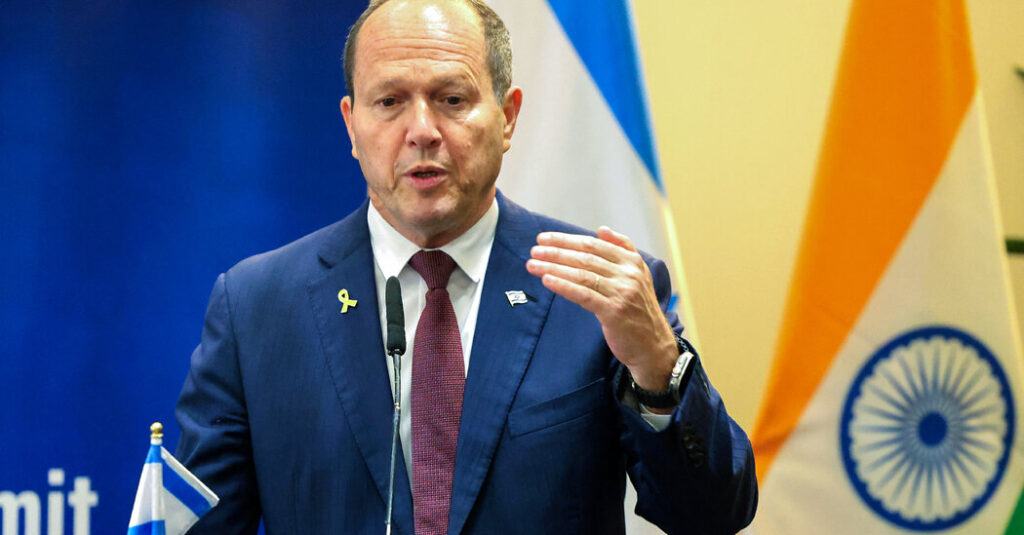
The office of Mr. Netanyahu did not immediately comment on the U.S.-Saudi nuclear deal. At least one Israeli government minister sought to soothe public concern, arguing that the country could live with a Saudi nuclear program for civilian purposes.
“If they want it for peaceful purposes, for energy needs, we can manage it,” said Nir Barkat, Israel’s minister of economy, the most senior government official to comment on the issue so far, in a radio interview on Wednesday.
He added that normalizing ties with Saudi Arabia was “still on the table,” and that Mr. Netanyahu and Mr. Trump would “not take risks for the state of Israel.”
Israeli opposition leaders quickly denounced the prospect of a U.S.-backed Saudi nuclear program.
“Every military nuclear program begins with a civilian one,” said Avigdor Liberman, an Israeli politician who served as defense minister from 2016 to 2018. He added that Israel should lobby Congress to protest the deal, which he said could lead to a regional arms race to develop a nuclear bomb.
Benny Gantz, another opposition leader who served as defense minister from 2020 to 2022, called the U.S.-Saudi deal “a huge missed opportunity” and pointed the finger at Mr. Netanyahu’s government.
“Time and time again, this extremist government misses chances to change the Middle East,” he wrote on social media.
Many of the details of the U.S.-Saudi deal remain unclear. For Israel, much depends on whether the agreement has safeguards that could prevent Saudi Arabia from using nuclear fuel for military purposes, said Michael Herzog, a former Israeli ambassador to Washington.
“The fact that it’s not tied to normalization, nor is it clear what guardrails are in place to prevent Saudi Arabia from breaking out to a military program — both of these are sources of concern in Israel,” Mr. Herzog said.
Allowing the Saudis to make their own nuclear fuel domestically would be a major concession, analysts said. The United States imposed stringent restrictions on a 2009 nuclear deal with the United Arab Emirates, which agreed to inspections and to forgo the right to enrich its own uranium, severely limiting its path to a bomb.
As part of the nuclear deal envisioned by the Biden administration, the United States would have handed Saudi Arabia a formal defense treaty. U.S. officials had also sought Israeli concessions to the Palestinians, albeit far short of an independent state, in return for normalization.
Those hopes receded after the Hamas-led attack on Israel on Oct. 7, 2023, and the subsequent war in Gaza. The political mood in Israel soured on granting any accommodations for the Palestinians, while the devastating Israeli campaign in Gaza prompted heavy criticism in Saudi Arabia.
Heedo Abu Laban contributed reporting from Jerusalem.
The post U.S.-Saudi Nuclear Deal Stokes Israeli Concerns of Mideast Arms Race appeared first on New York Times.