Republican primary elections in Arizona on Tuesday elevated a former N.F.L. kicker in a key House race, a hard-line Trump loyalist trying to win the governorship and an election denier aiming to become the state’s top election official.
As President Trump’s preferred candidates comfortably won primaries, Democratic voters sided with a moderate incumbent over a left-wing challenger. One closely watched Democratic primary race had not been called as of late Tuesday night.
Here are six takeaways from Arizona’s primaries.
A former N.F.L. kicker scored an endorsement victory for Trump.
Jay Feely, a former journeyman N.F.L. kicker who was endorsed by Mr. Trump, won the Republican primary in a battleground House district that includes Scottsdale, Ariz., and a chunk of Phoenix.
Mr. Feely, who says he was inspired to run for office by the 2024 assassination attempt against Mr. Trump in Butler, Pa., had planned to run in a deep-red district southeast of Phoenix.
But Mr. Trump asked Mr. Feely to switch to the First Congressional District, which experts in both parties say could host the most expensive House race in the country in November. Representative David Schweikert, a Republican who currently represents the district, decided to give it up to run for governor.
Mr. Feely’s path to primary victory was complicated by Joseph Chaplik, a former state lawmaker who ran to his right. The race was ugly: The two men traded cease-and-desist letters and built dueling attack websites.
Mr. Trump, who once owned a franchise in the short-lived United States Football League and has long sought to bridge the worlds of politics and sports, worked to lift Mr. Feely this month, describing him as “a friend of mine.”
In an interview on Tuesday night, Mr. Feely said he “very much” appreciated Mr. Trump’s support, but he did not dwell on the president. “As we look forward, this race will be about the economy,” he said, “and this race will be about who best is going to represent this district and the people of this district.”
The hotly contested Democratic House primary in the district had not been called as of late Tuesday night. That race pitted Marlene Galán-Woods, a former Republican who received support from House Democrats’ campaign arm, against Dr. Amish Shah, an emergency physician who was the Democratic nominee in the district in 2024.
In 2008, Dr. Shah was a sideline physician for the New York Jets and Mr. Feely was the team’s kicker.
A Trump loyalist dominated in the primary for governor.
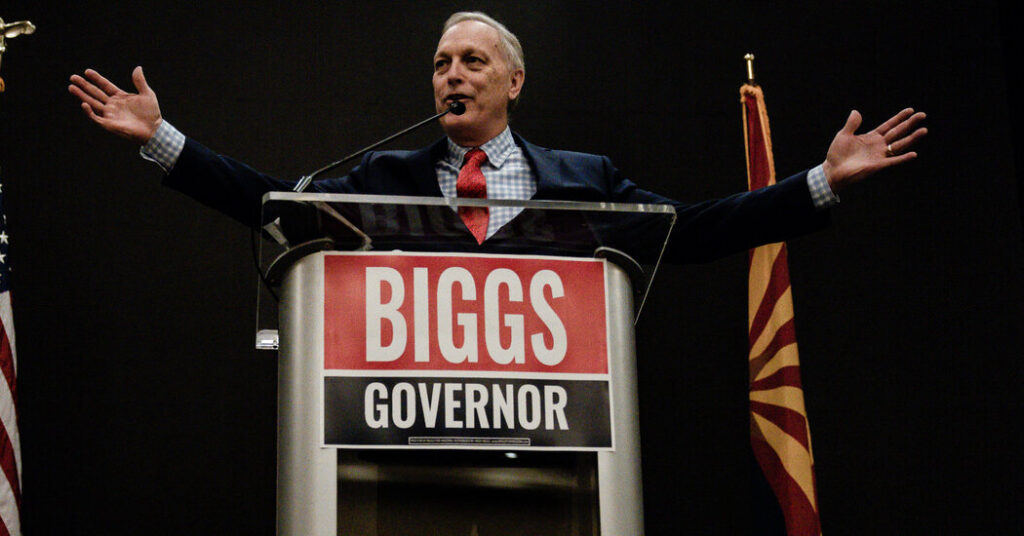
Representative Andy Biggs, in part powered by an endorsement from Mr. Trump, thundered past another sitting congressman, Mr. Schweikert, to win the Republican nomination for governor.
Mr. Biggs, a former leader of the ultraconservative House Freedom Caucus, built such a large lead over Mr. Schweikert in opinion polls that he appeared to start turning his focus to the general election weeks before the primary.
He downplayed his vote to overturn the 2020 presidential election, still a highly sensitive topic in Arizona, and emphasized his ability to work with Democrats.
In the general election, he will face Gov. Katie Hobbs, a moderate Democrat and former election official who in 2022 narrowly dispatched a far-right opponent, Kari Lake.
Governor Hobbs did not face a Democratic challenger this year.
A sex scandal didn’t stop one Republican.
The solidly Republican, deeply religious congressional district that Mr. Biggs is vacating has offered a test of voter attitudes on allegations of sexual impropriety.
Mark Lamb, a Trump-endorsed former sheriff running to replace Mr. Biggs, faced accusations, surfaced by The Arizona Republic, that he had sent sexual messages to women outside his marriage and threatened to deploy law enforcement to prevent a recipient of one of the messages from speaking out. A campaign spokesman denied the allegations, describing them as lies.
Daniel Keenan, Mr. Lamb’s leading opponent, tried to used the allegations to attack him. Mr. Keenan said they would imperil Republicans’ chances of keeping the seat if Mr. Lamb advanced to the general election.
Still, Mr. Lamb won the primary comfortably.
An election denier won the G.O.P. primary for Arizona’s top elections post.
In 2020, Alexander Kolodin, a Phoenix-area lawyer, went to court to try to overturn Mr. Trump’s narrow loss to Joseph R. Biden Jr. in Arizona. He helped to lead a lawsuit — along with Sidney Powell, a lawyer for Mr. Trump — that falsely claimed there had been “massive election fraud.”
A federal judge rejected the complaint, saying that it was built on “baseless claims” and could leave many Arizona voters “utterly disenfranchised.” In 2023, Mr. Kolodin was penalized by the Arizona state bar for his efforts to reverse the 2020 election result.
Now Mr. Kolodin is one election away from becoming Arizona’s top election official.
He won the Republican primary for Arizona secretary of state on Tuesday, defeating Gina Swoboda, a former state party chair who argued that Mr. Kolodin was too conservative to win the general election.
Mr. Kolodin, who has served in the Arizona Legislature since 2023, was aided in the primary by support from Turning Point USA, the conservative activist group founded by Charlie Kirk, who lived in Arizona before he was assassinated last year.
Mr. Kolodin is challenging the sitting Arizona secretary of state, Adrian Fontes, a Democrat who defeated another vocal election denier in 2022.
A Democratic incumbent glided past a democratic socialist.
Some democratic socialists, emboldened by recent upset primary victories in New York and Colorado, had hoped for another over Representative Greg Stanton, a moderate fourth-term Democrat whose district includes Tempe and Mesa.
But on Tuesday, Mr. Stanton handily defeated his left-wing challenger, Kai Newkirk, a first-time candidate who identified as a democratic socialist. Mr. Newkirk framed the race as a front in a battle for the future of the Democratic Party, and argued that Mr. Stanton was a “corporate Democrat” who would “never flip the tables of our corrupt status quo.”
But in Mr. Stanton’s suburban Phoenix district, voters seemed happy enough with the status quo represented by their centrist congressman.
Another high-profile House clash is set in southeast Arizona.
Neither Representative Juan Ciscomani, a vulnerable Republican incumbent in a Tucson-area district, nor the Democrat challenging him, JoAnna Mendoza, faced competition in their primaries on Tuesday. But their uncontested victories set in motion another hotly competitive general-election race.
Democrats hope that Ms. Mendoza’s personal biography will help her topple Mr. Ciscomani. She is a Mexican American who grew up poor and later became a Marine Corps drill instructor. The district is home to many veterans and has a large Hispanic population.
But Mr. Ciscomani has also leaned on his own life story as a Mexican immigrant. And he has overcome competitive Democratic challenges in the last two election cycles.
Kellen Browning and Sejal Govindarao contributed reporting.
The post 6 Takeaways From Arizona’s Tense, Trump-Dominated Primaries appeared first on New York Times.