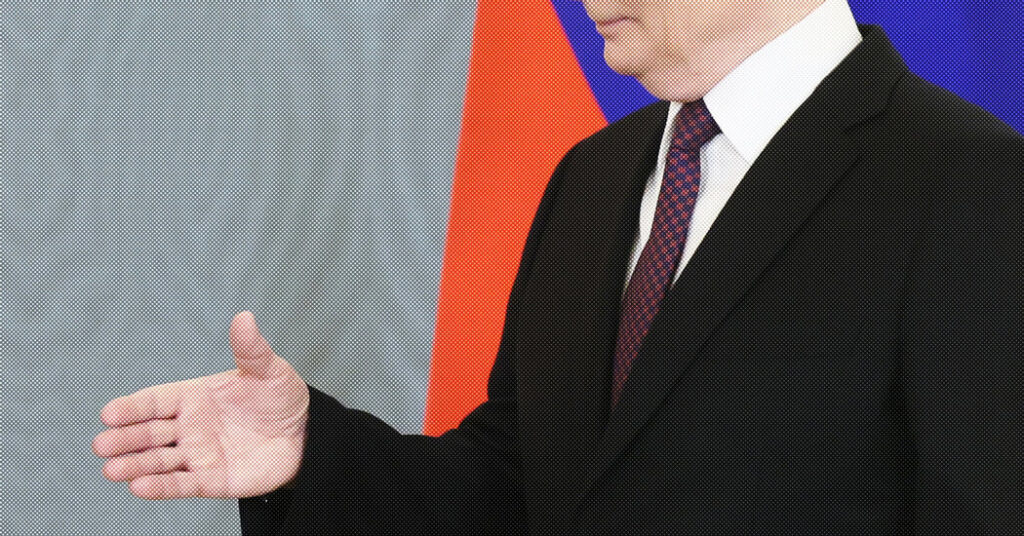
“Putin is now isolated from the world more than ever,” President Joe Biden proclaimed in his State of the Union address in March 2022. One week before, President Vladimir Putin of Russia had ordered his tanks into Ukraine, prompting Western nations to sever ties with Russia and throw their support behind Kyiv. The shock over Mr. Putin’s brazen land grab reverberated across the globe. Many expected Russia to turn into a bête noire.
But it soon dawned on Russia’s adversaries that the country wasn’t going anywhere. Forced to prepare for a long war, the Kremlin instructed its diplomats, intellectuals and operatives to secure support in the non-Western world. Many countries proved receptive to Russian overtures, refusing to be forced into a binary choice between Russia and the West. Russia soon became something curious: the most sanctioned country in the world, yet more than able to stay afloat. Estrangement from Europe was offset by ever closer relations with the global south.
To make sense of this turn of events, I set off on a journey around the globe. Traveling to over a dozen countries, I spoke with the politicians and people who support Russia, and I interviewed Russians who propel the Kremlin’s agenda from Moscow and those who operate on the periphery. The question was simple: How has Russia managed to weather its rejection by the West? What I found was testament to the country’s relentless adaptation. No matter what the West does, Russia will not yield.
In Dubai, the successes of Russia’s economic maneuvering were unmistakable. After the invasion, the United Arab Emirates became the epicenter of Russia’s wartime strategy: a haven for Russia’s rich relocating their businesses, a conduit for Russian traders importing Chinese goods and a hub for Russian banks settling nondollar payments. For Russia’s shadow tankers, ferrying Russian oil to willing buyers across Asia, the U.A.E. became a place to shapeshift and camouflage. In the netherworld of shell companies and obliging professionals, Russia was able to sidestep Western sanctions.
Other Russian schemes were more sinister. In the Alabuga Special Economic Zone, some 600 miles east of Moscow, sits a hub for the assembly of Iranian-origin drones used to pummel Ukraine. Central to the effort is a pseudovocational program that has targeted young African women to work there, with administrators making false promises of career advancement and a life filled with love and marriage. Sprawled across social media platforms, the recruitment spree represented just a tiny fragment of Moscow’s information campaigns in Africa, which scored points by framing Russia as an antidote to the “neocolonial” West.
In Vienna and New York, I witnessed the loftier forms of Russia’s power plays. At the United Nations, Russian diplomats worked hard to corral non-Western countries to support their positions, including on the war in Ukraine. Russian diplomats also used newer formats to woo friends. Chairing the BRICS alliance in 2024, the Kremlin impressed its partners with hundreds of events, among them a fashion show, a sports tournament and a grand summit in the city of Kazan. A formidable host, Russia made clear that it would not be isolated.
In South Africa, there was little need for persuasion. When Russia invaded Ukraine, the African National Congress — the country’s dominant political force, which led the fight against apartheid — blamed Western nations for the war. Meeting with A.N.C. veterans, I saw how gratitude for Soviet support during the anti-apartheid struggle combined with antipathy toward a West that, to them, appeared both hypocritical and hyperdominant. The result was a reflexively pro-Russia stance that tended to dismiss Ukraine’s distinct identity and agency.
I also met individuals whose affinity for Russia was more idiosyncratic. The journalist Paula Slier grew up in an affluent Johannesburg suburb in the 1980s, immune to the kind of pro-Russian sentiment that the A.N.C. underground cultivated. After joining Russia Today, a state-funded news channel, on a whim in 2005, she slowly internalized its news culture. Even as the channel’s propaganda grew shriller over the years, Ms. Slier continued to consider her work necessary and right. In the global information war, she told me, Russia was the “underdog.”
Others have aligned with Russia more out of self-interest than affection. In Georgia, the ruling party, Georgian Dream, followed Russia’s lead in cracking down on civil society. Ahead of parliamentary elections in October 2024, Georgian Dream warned that the “global war party” — its political opponents and their Western supporters — sought to drag Georgia into conflict with Russia, as had happened in Ukraine. Georgian Dream’s goal was simple: to entrench the party’s own hold on power. In the process, it advanced Mr. Putin’s agenda of discrediting Western-style democracy and building up fellow travelers in the region.
If Russia could count on converted and circumstantial abettors alike, its war against Ukraine also generated new, even improbable resistors. The young, urban Kazakhs with whom I mingled in Almaty worried that their country, sharing the second-longest border in the world with Russia, could become the next victim of Mr. Putin’s aggression. These Kazakhs spearheaded efforts at “decolonization” from Russia, advocating the use of the Kazakh language over Russian in everyday life alongside a reckoning with the ugly dimensions of imperial Russian and Soviet policies in their country.
In Armenia, locals felt abandoned by Russia, rather than fearful of its encroachment. In September 2023, with the Kremlin preoccupied by Ukraine, Russian peacekeepers stood by as Azerbaijan took over the disputed territory of Nagorno-Karabakh. Azat Adamyan, a pub owner I met in Yerevan, was among the tens of thousands displaced from the enclave. Mr. Putin’s portrait no longer hangs in his pub, reopened in the Armenian capital. Other Karabakh Armenians blamed the Armenian government — which has since scrambled to diversify its foreign partners — for their predicament. Either way, Russia’s prestige took a blow.
Armenia’s story hints at a broader phenomenon, which the Kremlin’s success in securing support has been unable to mask: Russia’s global power is steadily eroding. I sensed this most strongly during my travels in the Middle East in early 2025. In Majdal Shams, a border town in the Israeli-occupied Golan Heights, I sat down with local Druze who were celebrating Bashar al-Assad’s recent ouster in neighboring Syria — a major defeat for the Kremlin, a decades-long supporter of the al-Assad dynasty until it was unable to protect its client.
Mr. Trump’s return to the White House has generally worsened Russia’s predicament. His campaign promises of an anti-interventionist foreign policy have given way to U.S. military operations against Iran and Venezuela, both Russian partners. Having boasted that he could settle the Ukraine war “within 24 hours” — and hinted he might do so by caving to Russian demands — Mr. Trump has since grown tired of the conflict, distracted by the aftershocks of his military gamble in the Persian Gulf. The prospect of a new bilateral relationship, meanwhile, remains unfulfilled.
Without Trumpian intercession, Russia must fight on in Ukraine. The cost is mounting: an estimated 1.4 million Russian battlefield casualties, Ukrainian drones that now reach deep into Russia and a sputtering economy. Yet having made the whole country subservient to the needs of his calamitous war, Mr. Putin understands that its result will determine Russia’s global reputation. “Our friends, neighbors and our adversaries and enemies are all keeping a close eye on the way it unfolds,” his foreign minister, Sergey Lavrov, recently reminded an elite gathering in Moscow.
For all the jeopardy of the war, Mr. Putin has gambled on outlasting the West. In a world that harbors a seemingly undepletable well of admirers and adherents, along with countless enablers and facilitators, his bet may yet pay off.
Hanna Notte is the director of the Eurasia Nonproliferation Program at the James Martin Center for Nonproliferation Studies in Monterey, Calif., and the author of the forthcoming book “We Shall Outlast Them: Putin’s Global Campaign to Defeat the West,” from which this essay is adapted.
The Times is committed to publishing a diversity of letters to the editor. We’d like to hear what you think about this or any of our articles. Here are some tips. And here’s our email: [email protected].
Follow the New York Times Opinion section on Facebook, Instagram, TikTok, Bluesky, WhatsApp and Threads.
The post Russia Will Not Yield appeared first on New York Times.