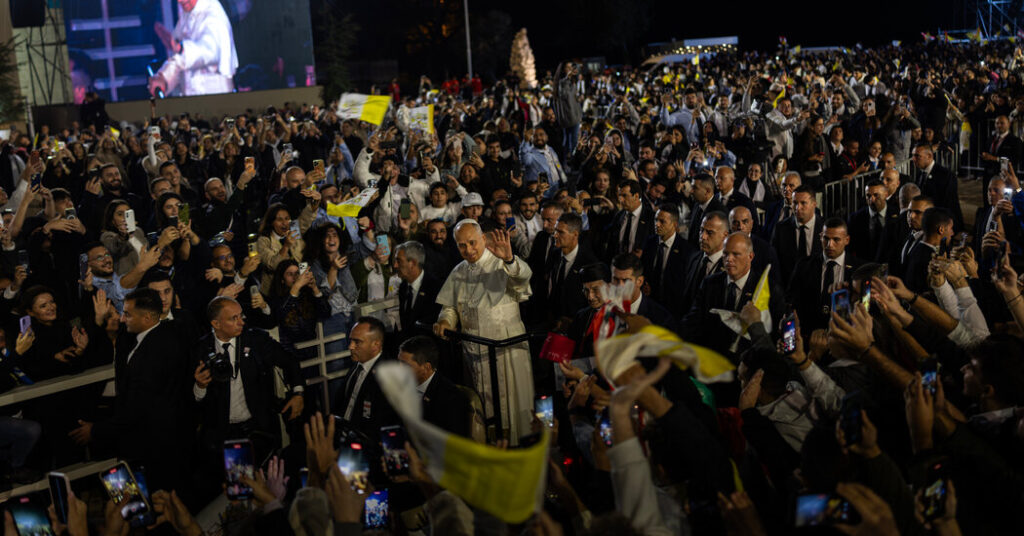
Almost every time Pope Leo XIV spoke publicly during his six-day trip to Turkey and Lebanon, he appealed for unity and an end to violence in a region often ruptured by conflict.
Perhaps less expected during the trip, which concluded on Tuesday, he echoed one of the themes he set out in the first days of his papacy, calling out the risks of artificial intelligence and other rapidly advancing technologies.
“Even artificial intelligence simply reproduces our own preferences and accelerates processes that, on closer inspection, are not the work of machines, but of humanity itself,” the pope said in an address just a few hours after he landed in Turkey last week. “Let us work together, therefore, to change the trajectory of development and repair the damage already done to the unity of our human family.”
Leo, the first pope from the United States and the first baby boomer (he was born in 1955), is keenly aware of the promise and threat of the digital age. Even before this trip, he had spoken of the benefit of being able to connect with other Catholics around the world through social media and on streaming platforms.
Pope Francis, Leo’s immediate predecessor, had also warned about the perils of artificial intelligence and called for the ethical use of technology. Leo amplified those concerns from the start of his tenure, calling in his first address to Roman Catholic cardinals for the church to grapple with the risks that A.I. poses to “human dignity, justice and labor.” Since then he has reminded lawmakers, A.I. developers, and filmmakers and actors that technology could not substitute for the creativity and individuality of humans.
Leo’s Mideast trip — his first since be became pope more than six months ago — cemented his status as the first pope to fully embrace the technology of modern life. His predecessor, Pope Francis, rarely carried a phone and preferred traditional mail.
Referring to the new pope, Stephen Bullivant, a professor of theology at the University of Notre Dame Australia, said, “You have a sense that this is a man who got his smartphone when everybody else got it and it’s an embedded part of his life.”
For now, Leo’s public pronouncements on technology are lacking in depth. Even if his emphasis on A.I. suggests that it is one of his primary preoccupations, Leo has yet to flesh out a vision of how the technology could be harnessed to, for example, deepen spiritual connection or protect the vulnerable from harm.
“He keeps talking about it and everyone is getting more and more excited for something more to happen,” said Brian Patrick Green, director of technology ethics at Santa Clara University in California.
Time and again in Turkey and Lebanon, Leo either used technology to amplify his broader call for greater unity or cited its mishandling as a potential obstacle to human connection.
Building a rapport with reporters on the plane on the trip’s first morning, he said he had begun the day playing Wordle, an online word game. Speaking more soberly to Christian worshipers later in the week, he warned of how the misuse of technology might exacerbate inequality. The pope called on religious leaders to promote the responsible use of new technologies so that “their benefits are not reserved to a small number of people or the interests of a privileged few.” The pope’s social media account sent out a similar message on Sunday.
Leo’s discussion of technology came within a wider call for human connection. As might be expected from a pope whose first word after election was “peace,” Leo repeatedly emphasized unity and mutual acceptance as a path to overcoming conflict.
He called for a two-state solution in Israel, Gaza and the West Bank; spoke with President Recep Tayyip Erdogan of Turkey about resolving the war in Ukraine; and met with President Joseph Aoun of Lebanon, during which the pope, addressing the Lebanese people, said, “remaining in our homeland and working day by day to develop a civilization of love and peace remains something very valuable.”
Raising the issue of technology even as he confronted familiar religious and geopolitical challenges suggested that Leo was looking for international allies in his quest to hold the developers of new technologies ethically accountable, Mr. Green of Santa Clara University said.
“He sees this as an issue where hopefully he can make a difference,” Mr. Green noted. “But making a difference entails getting everybody to think about these issues and how it applies to them in their particular context.”
Leo’s attention to technology makes him an ideal pope, said Thomas Libeau, 32, a web designer originally from New Zealand who traveled from his home in the Spanish city of Melilla, on the North African coast, to see Leo in Turkey.
“We have this pope who is going to guide us through this incredibly turbulent technological time,” Mr. Libeau said. “We have the first American pope when we’re dealing with, for better or for worse, the challenges of the offspring of Silicon Valley.”
For Mr. Libeau’s girlfriend, Irati Aguirre, who grew up in the Basque Country of Spain and who converted to Roman Catholicism a year and a half ago, Leo has shown that he knows how to communicate with younger people, using social media to meet them on the screens where they spend so much time.
“I think that’s a great entry point with Gen Z,” Ms. Aguirre said. The night before in the hotel, she said, she and Mr. Libeau had watched the pope’s stop in Ankara on Instagram.
In Lebanon, the pope’s message about the risks of such technology also resonated.
“As a mom with two kids in school, I actually appreciate that the pope is speaking up about A.I. because fast technology is changing everything nowadays,” said Nada Obeid, 39, a bank teller in Beirut, the Lebanese capital, who joined the crowds to see Leo on Monday. “It reminds me how important it is for us parents to really pay attention to what our kids are doing,” she added.
Dayana Iwaza contributed reporting from Annaya, Lebanon; and Josephine de La Bruyère from Rome.
Motoko Rich is the Times bureau chief in Rome, where she covers Italy, the Vatican and Greece.
The post With A.I. and Wordle, Pope Leo Proves to Be a Pope of the Digital Age appeared first on New York Times.