On Friday, the buildup to the 2026 World Cup begins in earnest. The leaders of the tournament’s host countries — President Donald Trump, Mexican President Claudia Sheinbaum and Canadian Prime Minister Mark Carney — are set to appear at the Kennedy Center in Washington for a draw to allocate the 48 participating teams into groups.
Once that’s done, soccer pundits get a picture of the exciting matchups ahead and fans can start planning their itineraries for what will be the biggest tournament of its kind yet.
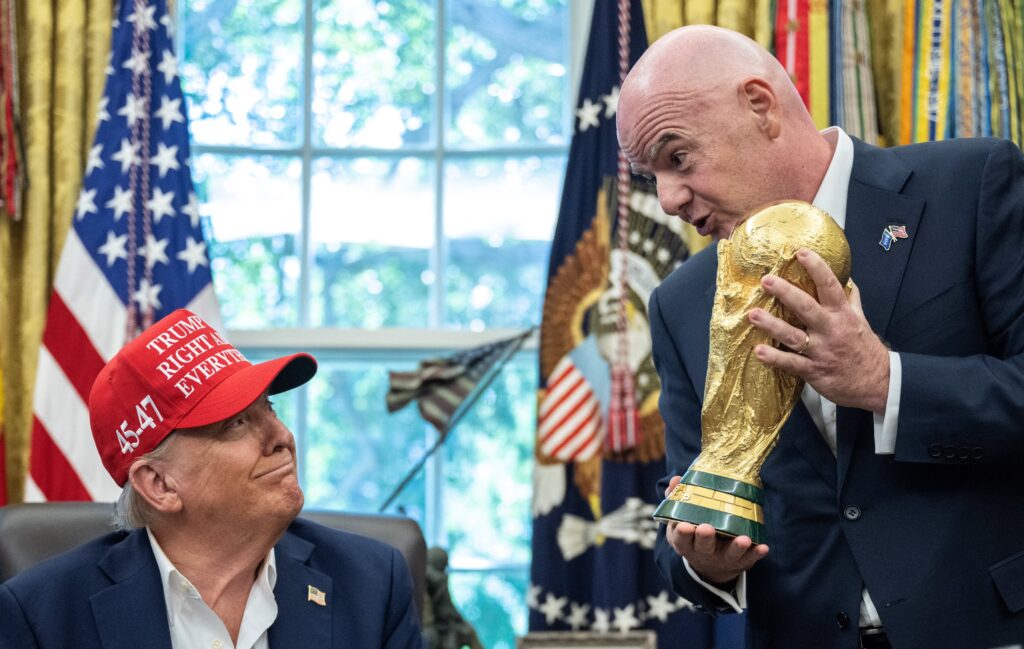
But the event is about more than just the game. FIFA, the sport’s governing body, will be awarding its own “peace prize” and Trump, who has spent months clamoring for a Nobel recognition, is expected to receive this newly-invented bauble. Trump is expected to tether himself to the tournament, and like the Emir of Qatar, the 2022 host, will be on the field of the final next July, handing out the famous trophy to the victors. The prestige he could soak up in the moment might well obscure other concerns that loom over the tournament, including the staggering costs of tickets in many stadiums and the difficulties and obstacles that U.S. immigration authorities may place for foreign fans hoping to attend.
The World Cup has always been embedded in national and global politics, as acclaimed soccer writer Jonathan Wilson sketches in his new book, “The Power and the Glory: The History of the World Cup.” The tournament played a role in early 20th century nation building, helped both buttress and undermine autocratic governments, and always reflects the shifting politics and culture of a globalizing world.
I spoke to Wilson about what makes the tournament unique and his thoughts about the months to come. Our conversation was edited for length and clarity.
What distinguishes the World Cup from an event like the Olympics, which also draws on countless millions of casual fans?
The Olympics has different sports and different countries take different sports with a different degree of seriousness. The World Cup is the one global event where everybody is focused on the same thing. Everybody’s focused on it, and it’s pretty much the only sport that pretty much all of the world plays and cares about.
And that simplicity perhaps makes it a greater vehicle for societal meaning?
When you have the eyes of a world on you, then political actors will try to take advantage of that. And you see that in quite grotesque ways, in terms of how [Italian dictator Benito] Mussolini used it in ’34, the Argentinian junta used it in ’78. And it’s not just the hosts: You look at how the Brazilian military dictatorship used it in 1970.
But there’s even quite benign ways: Consider Uruguay 1930. Why did they want to host it? They wanted to host it to show off, to say, “Look, we’re really good at football. We are the best in the world at this global sport, and also we’re playing it in the Centenario stadium” — 100 years since they signed their [first] Constitution. It’s about a projection of Uruguay: “We’re not just a sort of northern state of Argentina. We are important in our own right.”
After Uruguay came fascist Italy. Can you tell us more about what the 1934 World Cup meant for Mussolini?
Mussolini didn’t particularly like football, like a lot of dictators. He found it too unpredictable. He liked cars. He liked cycling. He preferred individual sports. It’s easy to predict who’s going to win in an individual sport. But you recognize that football had this power. And then he thought: “What’s the best way to ensure we win it?” So they win the bid [to host the World Cup] against Sweden, and then it suddenly becomes not just about winning the tournament, but about putting on a great show.
And so he essentially invents, certainly from a football point of view, sports marketing or merchandising: That you can buy your Italy World Cup tea tray or whatever, and it’ll be made incredibly well, by top Italian craftsman, because he wants to show off Italy as this country that does things properly. The tickets were printed on really high quality paper because he wanted people to keep them as a souvenir. And they are all branded with the fascist logo.
The Jules Rimet trophy is quite small, so he invents the [unofficial] Copa del Duce, which is six times as large, because he wants to be there presenting this big, glorious trophy to the Italy captain. And sure enough, he does so, and he’s at every Italy game, and he makes sure loads of his close allies and leading political figures are also there.
To fast forward to the present, we see a different status quo, with the sport awash with money and influence from the wealthy Arab kingdoms, controlling everything from lucrative television contracts to major European clubs. How much of the main story now is the Gulf capture of the sport?
A huge amount: The way that things were arranged so Saudi Arabia could host in 2034; the fact that Qatar was allowed to host in 2022 despite, I think, a huge number of reasons it shouldn’t have. But FIFA seems to be hooked on Middle Eastern cash.
Is that something we should gnash our teeth about or is it just part of the natural evolution of the game?
I think it behooves us to be cautious. I guess I’m speaking particularly with an English hat on here, that we can’t think the game is ours. We can’t think that it should never change. Personally, I think in an ideal world, the World Cup would sort of alternate between an established power and an emergent power, and that would be a good way of paying tribute to the traditions of the game, but also of expanding the frontiers. However, you’ve got to look at the countries you’re going to, and if they are so evidently in breach of FIFA statutes, then those FIFA statutes, by definition, are not worth the paper they’re written on.
Would you apply the same scrutiny to a World Cup hosted in the U.S.?
Every World Cup host deserves scrutiny. And we saw it in Russia [in 2018] that North Korean workers were used at certain stages. You can certainly look at [the state of] gay rights in Russia. You look at Brazil in 2014, at the land claiming system to build stadiums. There is a similar story in South Africa [in 2010] — people forcibly evicted from their homes. All of that deserves scrutiny.
And the U.S., Canada, Mexico deserve scrutiny as well. I think the obvious concern from the point of view of the U.S. is the way it stands apart from I think every previous World Cup. Every other World Cup host has essentially said to most of the rest of the world, “please come to our country.” Whereas the U.S. appears actively hostile to outsiders. And I think a lot of people feel pretty uncomfortable just about the idea of going to the U.S.
I am old enough now to be jaded by nostalgia. World Cups from childhood in the 1980s and 1990s seem more potent and meaningful to me, not least because back then the World Cup was one of the main ways you could watch all the best players in the world on television. Now, soccer is ubiquitous and there’s less of a mystique around the players.
If you showed me a still shot of any World Cup up to 2006 or maybe 2010 and blurred out the players, just from color of the footage, the look of a stadium — I could tell you which tournament it was, and I think a lot of fans could do that. And it’s partly to do with the grain of the tape, but it’s also to do with how stadiums looked, they had their uniqueness. Whereas now it is very much a commodified, homogenized. Does that make it less of an event? Viewing figures are still massive.
Sign up to receive WorldView, a free, thrice-a-week email newsletter from the international desk of The Washington Post.
The post The World Cup has always been about politics appeared first on Washington Post.