Three times in recent months, Secretary of Defense Pete Hegseth has absolved military aviators caught on camera busting flight regulations. The message to pilots is clear: As long as what you do looks cool and puts on a show for the public, you can break flight rules without consequences.
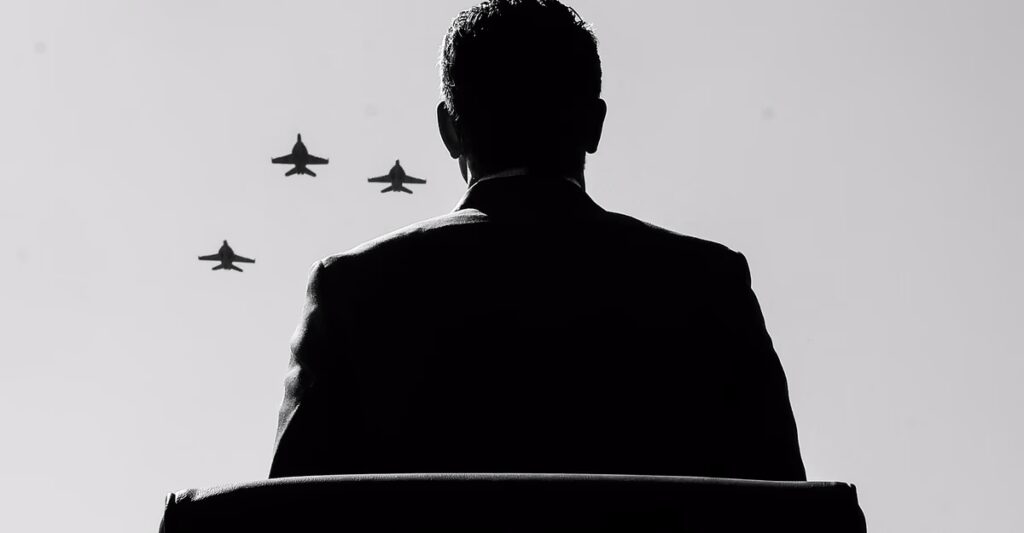
Just Friday, a member of the Blue Angels, the Navy’s flight-demonstration team, buzzed Pensacola Beach at extremely low altitude and a high angle of bank, close to throngs of spectators. Captain Adam Bryan, the Blue Angels’ team leader, conceded on camera that the aviator in the video had put himself and the crowd in an unsafe situation. The aviator admitted that he’d miscalculated a turn. He was apparently taken off the flight schedule. Hegseth, however, posted on X before the facts had come in that “the flyovers will continue until morale improves.” His statement seemingly implied that even if the stunt was intentional, all was forgiven because it looked awesome. Acting Secretary of the Navy Hung Cao said that a “flight debrief” had been conducted and there would be no investigation.
In March, two pilots pulled off an unauthorized low-altitude flyover near the singer Kid Rock’s estate in Tennessee. The Army suspended the airmen and launched a formal safety investigation—but the Pentagon overrode Army leadership, immediately lifting the suspension and terminating the safety review. Hegseth declared on X, “No punishment. No investigation. Carry on, patriots.”
[Tom Bartlett: Pete Hegseth wants YOU to test your testosterone]
Earlier this month, the South Carolina National Guard suspended eight Apache-attack-helicopter pilots who had executed a low-altitude flyover during the Salute From the Shore event celebrating America’s 250th anniversary. Hegseth posted, “We’ll fix this. Carry on, Patriots.” Again, the military removed the suspensions and ended its investigation.
Hegseth seems to believe that hotdogging and showboating improve morale. I can tell you from personal experience as a military aviator that nothing destroys morale as completely as having one’s commanding officer call a meeting to announce that Cutlass 470 was lost with all hands. At that funeral—for the crew of an aircraft that went down not because it was showing off for an audience but for unknown reasons during a routine maintenance flight—the coffins were empty because the bodies were unrecoverable at the time. Such tragedies devastate the units they leave behind, and the antics that Hegseth now promotes make them likelier.
What we do know is that tragedies happen when the military tolerates daredevil behavior. Past air shows have gone horribly wrong when military aviators have cut their margins too close. In Ukraine, 77 people were killed and 543 injured in a 2002 air show where a fighter jet didn’t pull up in time. A crash at the Farnborough Air Show in 1952 killed 29 and injured 60, leading the British government to adopt strict regulations to protect people on the ground.
The job of U.S. military flight-demonstration teams is inherently dangerous. In 1973, three Blue Angels collided, resulting in a crash so catastrophic that no identifiable human remains were recovered. In 1982, four members of the Thunderbirds Air Force demonstration team were killed when they were unable to pull up in time from a loop. One of the most common causes of mishaps for these teams is called “controlled flight into terrain” and occurs when an aircraft fully under its pilot’s control collides with water, the ground, or an obstacle. If the Blue Angel aircraft in last week’s video had clipped its wing on the water below, it could easily have become flaming wreckage tearing through the crowd the pilot had been performing for.
Perhaps the most famous such incident in the United States was the crash of a B-52 at Fairchild Air Force Base in 1994. The pilot pulled a showboating stunt and killed everyone on board. The flight was a final run before the pilot’s and co-pilot’s retirement, so both of their families were watching as the bomber stalled at a high angle of bank at low altitude, hit the ground at high speed, and exploded in a fireball that could be seen for miles.
One of the first things you learn as a military aviator is this: Rules are written in blood. They exist for a reason, even if you don’t know what it is. When I went through flight school, the Fairchild Air Force Base tragedy was the case study on the importance of speaking up about safety concerns and the lethal price of ignoring the rules. Virtually every regulation came into being because people died, and the military wants to prevent that from happening again.
I have spent almost 30 years in military and civilian aviation, most of them in helicopters. Along the way, I’ve buried six friends lost in military-aviation accidents. I’ve flown with a senior instructor whose son had died in a utility-helicopter accident six months earlier. I cannot begin to describe what it is like to find out that one of your best friends hit the water so hard that she was decapitated on impact.
Helicopter pilots doing low-altitude work have one of the most dangerous jobs in the United States. This is true for military pilots using night-vision goggles and flying in bad weather in aircraft built 40 years ago as well as for civilian pilots working in the air-ambulance, logging, and utility fields. These jobs are why aviation is considered dangerous: Helicopter mishap rates are consistently much higher than those for fixed-wing aircraft are.
Aviation accidents also pose a risk to people on the ground, especially in formation maneuvers like those the Apache pilots were doing in South Carolina. When two helicopters operate in close proximity, their rotors risk colliding in flight and then coming apart explosively, which would lead the aircraft to fall to the ground with the aerodynamics of a lawn dart. This creates a spray of shrapnel from the rotor tips that had been traveling hundreds of miles an hour.
For this reason, formation flights were always my biggest “white knuckle” events during my time in the military: The room for error is minuscule, and the consequences can be deadly. A mishap over the spectators in South Carolina could easily have killed some of them, either with the body of the helicopter or with the high-velocity-debris created when it came apart in midair.
[Listen: The military Pete Hegseth wants]
The message that Hegseth is sending to young aviators contradicts everything we have learned the hard way about aviation safety over the years. He’s telling them that if they break the rules and get caught, upper management will circumvent the disciplinary process to bail them out.
The Pentagon instead should have let the investigation continue and reviewed the results at the end without putting a finger on the scale. These processes have been developed over decades in the effort to ensure a thorough and fair process. I know them firsthand because I have served on safety boards. If punishments are excessive or the results biased, pilots can appeal. Pentagon leadership could more appropriately weigh in at that time, when an investigation is complete and the facts are in.
The military has spent decades trying to build a professional cadre of pilots who operate in a safety-oriented culture that meets or exceeds commercial standards. This is sensible, given the potential for tragedy among not only military aviators but civilians, as well as the cost and scarcity of military assets. But now that reputation is being tarnished. Thanks to Hegseth, military aviators have learned that rules are optional as long as top leadership thinks your stunt looked cool.
The post Pete Hegseth’s Reckless Message to Helicopter Pilots appeared first on The Atlantic.