Adam Michel is the director of tax policy studies at the Cato Institute. He writes the Liberty Taxed Substack.
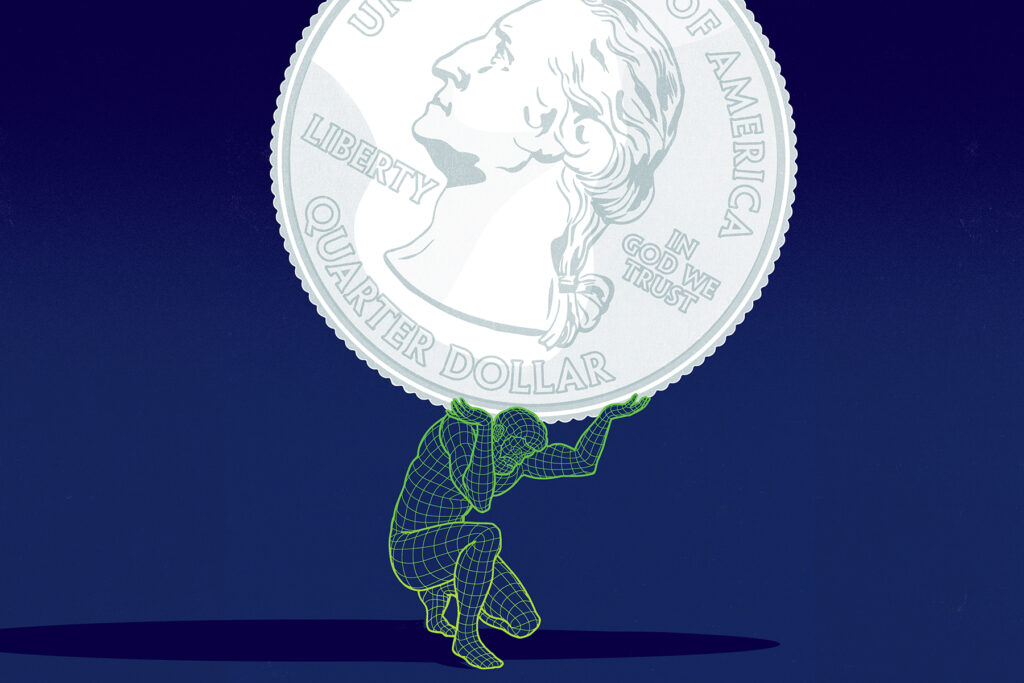
Washington at last seems to have hit upon a revenue idea that both Republicans and Democrats like: taxing artificial intelligence to help the American worker. Too bad it would do the opposite.
On the right, President Donald Trump wants AI companies to give “something back to the public,” while Sen. Josh Hawley (R-Missouri) has expressed openness to taxation to make sure AI companies “are actually working for the public good.” On the left, Sen. Bernie Sanders (I-Vermont) wants the public to own half of the biggest AI companies, and Rep. Ro Khanna (D-California) has called for a tax on AI tokens, the basic data unit processed by large language models.
The various tax proposals rely on different mechanisms, but the same story motivates them.
It’s a story based on a zero-sum assumption — that gains for capital automatically means losses for labor. Before becoming treasury secretary, Scott Bessent bought into it, arguing that since the 1980s, “capital has gotten treated better to the detriment of labor.” OpenAI CEO Sam Altman linked the story to AI, claiming that he can “imagine” all the ways AI “breaks capitalism” by further shifting economic leverage from labor to capital. (The Washington Post has a content partnership with OpenAI.)
A third piece of the narrative is the belief that work is taxed at higher rates than capital — that is, that workers’ taxes are higher than those applied to the income from the investments used to create the AI systems and hardware supplanting them.
All three parts of this story are wrong.
Start with labor’s share of national income. If capital were dominating workers to their detriment, it would be clear in the data. Wages would stagnate. Capital’s share of economic output would climb. But this hasn’t happened. Measured properly, labor’s share of national income has fluctuated around 70 percent for almost a century. Workers are doing well by other measures, too, despite claims to the contrary. Real wages are up more than 40 percent since the 1990s. And a middle-class life has gotten cheaper over a similar period.
The more fundamental mistake is the setup. There is no existential tug-of-war between capital and labor. New tools such as AI make workers more productive, increasing their value and their ability to command higher wages. The digital spreadsheet didn’t wipe out accountants; it freed them from manual tabulation so they could focus on more valuable analysis that, in turn, led to higher pay. New investments expand the economic pie so both capital and labor can win.
The final misconception is that capital is undertaxed relative to labor. The statistics that give this illusion are mostly acts of accounting timing. Labor and capital both face top marginal federal tax rates of about 40 percent and average tax rates close to half that. Workers pay income and payroll taxes. Taxes on capital are usually levied at two levels, first through the corporate income tax and again through taxes on capital gains and dividends.
So, if new AI taxes are not the way to help workers, what should Washington do instead?
First, if the goal is to help workers directly, let them keep more of each paycheck. Congress can cut income and payroll taxes, paired with spending cuts. Spending cuts can have the additional benefit of shedding government programs that discourage work, crowd out private savings and divert capital from investments that actually raise wages.
Second, if the worry is about huge AI fortunes going untaxed in the loophole-riddled tax system, the answer is to tax wealth when it’s spent by reforming existing levies, not adding new ones. Rather than burdening electricity, machines, wages or investment when they are being productive, tax the consumption they fund. Tax the AI fortune when it’s spent, not the investment that builds tools that benefit everyone.
Finally, don’t tax AI, but don’t subsidize it, either. Letting companies immediately deduct their investments is equal treatment, not a handout. But there are plenty of handouts to repeal: transferrable energy credits for the nuclear, geothermal and storage projects built to power data centers. Chips Act money for the circuits inside the data centers. And the cash grants, construction-wage credits and property-tax abatements some states offer data centers. End them all.
Taxing the machine to help the worker gets the economics backward. The story getting traction in Washington is exactly wrong: Capital, and the AI it funds, is more likely to be workers’ road to a raise than to their replacement.
The post The AI tax movement is built on a myth appeared first on Washington Post.