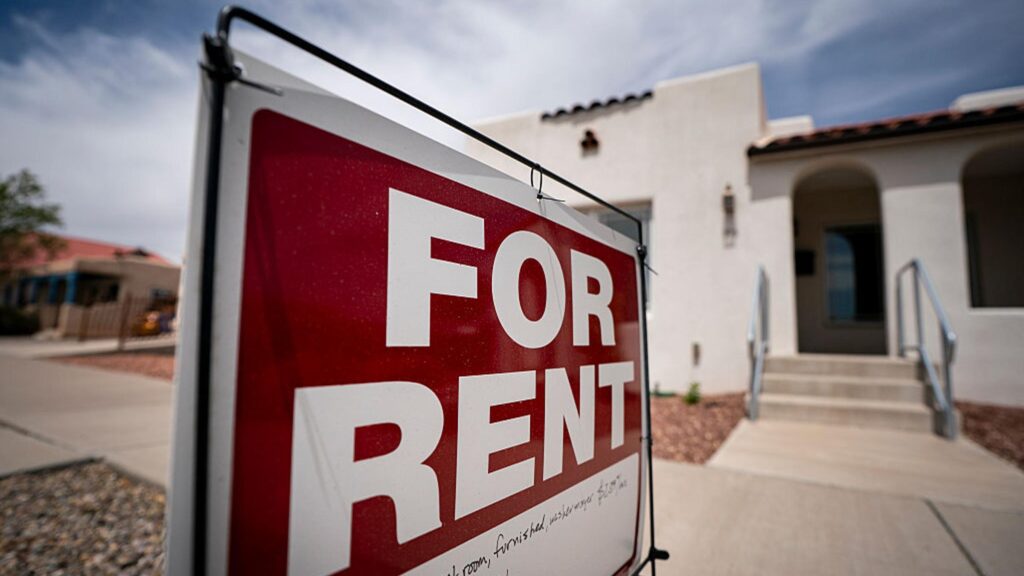
Every year, millions of renters get the same bad news: the rent is going up, again. Most people assume they know why—inflation pushed costs up, there isn’t enough supply, or the landlord is just greedy. Those assumptions aren’t entirely wrong. But they are incomplete. The reason the rent is too damn high is because Wall Street is counting on it.
From the stock market to the labor market, much of our economy is based on expectations.
Your rent is more than a monthly bill. It is a financial projection. Rental housing in the United States is increasingly organized as a financial asset class. Apartment buildings are bought, sold, and borrowed against on the expectation that rents will keep rising. Apartment loans can then be bundled into commercial mortgage-backed securities and sold on the open market. The people who live in these buildings become assumptions in financial models designed to hit yield targets for distant investors.
The dominant story about the U.S. housing affordability crisis has a seductive simplicity: we don’t build enough, so prices rise. Cut regulations, accelerate permitting, let supply meet demand, and affordability will follow. This frame has united mayors, governors, and even Congress in a deregulatory agenda that often treats tenant protections as obstacles. This narrative is not wrong about scarcity. We do need more homes. But it leaves out a crucial part of the problem: the housing crisis is not only a supply problem. It is also a financial regulation problem.
When an apartment building goes up for sale, buyers compete for it. To bid, they go to banks with projections of how much income the building will generate in the future. The lender then determines the size of the loan based on that projection. Typically, the buyer with the most aggressive rent-growth assumptions can borrow more and offer the highest price. Once that buyer wins, the building has to produce the income promised on paper. That means before your rent even goes up, Wall Street has already promised it would.
Landlords have always charged as much as the market allows. What Wall Street’s financing changes is the amount of rent growth a given loan requires. When a building is purchased at a price that only makes sense if rents rise quickly, rent hikes stop being incidental. They become the business plan. If current tenants’ wages cannot keep pace with that plan, something has to give: either tenants pay more than they can afford, or they are pushed out so someone who can pay more can take their place.
Forcing tenants out is not a regrettable side effect of a broken housing system. In too many markets, it is the system. Displacing people is just part of the math.
This is why we need to change the equation. Rent regulation is usually treated only as a tenant protection measure. But it is also something more powerful—a form of financial regulation that reins in speculative housing finance.
Rent regulation, as I would argue, forces investors and lenders to underwrite to stabilized income, not speculative rent spikes, tenant churn, or displacement strategies. It tells investors they cannot build a financial product on forcing people out, or on rent hikes that renters’ wages cannot sustain.
Rent regulation has divided economists for generations. The textbook objection is that capping rents distorts markets and discourages construction. But that objection starts from the wrong baseline. The market is already distorted when homes are valued based on how much more tenants can be squeezed. Rent regulation is a guardrail against an already-distorted market.
Well-designed rent stabilization does not mean freezing rents forever or ignoring maintenance costs. It typically exempts newly built housing, and it allows reasonable increases while blocking the speculative spikes that make buildings attractive to overleveraged investors. It protects tenants from sudden displacement while also preventing lenders from capitalizing future extraction into today’s property values.
The stakes reach well beyond any single tenant. Roughly half of America’s renter households already pay more than they can comfortably afford, and the burden is not evenly distributed. Black renters face eviction filings at nearly double the rate of white tenants, and Black and Latinx renters are disproportionately exposed to repeat filings and eviction pressure, often in neighborhoods where years of disinvestment have made housing cheaper for speculative capital to acquire.
The stakes for the broader economy are real, too. Shelter costs make up about a third of the consumer price index. When housing costs run hot, so does inflation. A housing system organized around leveraged commitments to rent growth does not just hurt tenants. It creates stubborn, structural inflation that monetary policy struggles to address.
For years, interest rates were low, apartment prices climbed, and investors assumed renters could be squeezed indefinitely. Then rates rose, and the math stopped working. The loans backing large apartment portfolios recently became delinquent at their highest rate in nearly a decade, with the largest year-over-year jump of any major commercial property type. More than half of the roughly $100 billion in securitized commercial mortgages coming due in 2026 are projected to fail to pay off at maturity. People still need apartments. What broke was Wall Street’s assumption that renters could be made to pay more, forever.
We have already seen versions of this bet fail. In New York, loans tied to rent-stabilized buildings went bad once stronger tenant protections blocked the displacement they had assumed would occur, and the public was left to clean up Wall Street’s bet. In fast-growing Sun Belt markets, the same speculative logic is playing out: investors borrowed against rent growth that did not arrive, and tenants are being squeezed to make the numbers work.
This is why building more housing alone is not enough. We should build, and build a lot. But new supply added to a housing market organized around unrealistic expectations about how much renters can afford will not fix our broken system. For instance, in Dallas and Houston, new construction since 2010 made up roughly 22% of the housing stock, yet the share of homes serving lower-income renters stagnated or even declined. More homes are necessary. They just are not the whole answer.
Reining in speculative finance would normally fall to federal regulators, as it did after 2008. But this time Washington is moving the other way, with bank regulators easing capital rules even as commercial real estate stress builds. With federal oversight in retreat, the tools sit closer to home, in city halls and statehouses. Rent regulation is one of them.
The same lending that puts a family at risk of losing their home also loads risk into the financial system. When rents are pushed past what people can afford, the damage shows up first in eviction notices, forced moves, and impossible household budgets. Later, it shows up as distressed loans, failing banks, and public rescues.
A housing market that depends on renters being squeezed, displaced, and replaced is fragile by design. Rent regulation is more than a response to the last crisis. It is one way to prevent the next one.
Stabilizing renters, it turns out, can also stabilize the economy.
The post Why Rent Keeps Rising Because of Wall Street appeared first on TIME.