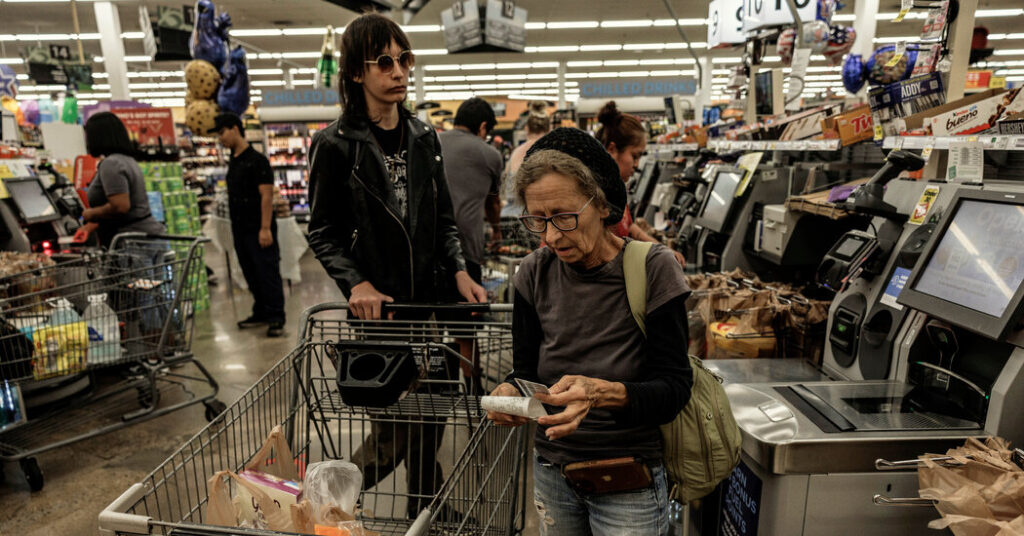
The number of Arizonans getting SNAP benefits has fallen by about half in less than a year, a remarkable drop in nutrition aid that may preview the program’s future nationwide following a landmark law to limit assistance that President Trump championed last year.
Many of the 440,000 Arizonans dropped from the Supplemental Nutrition Assistance Program — food stamps — remain eligible for help. But the new law establishes steep penalties on states that make too many mistakes when awarding benefits. To avoid those costs, which are so large that state officials say they could end the program, Arizona increased the paperwork that applicants must file, even as it cut the staff to review it.
The result, aid-seekers and officials both say, has been bureaucratic chaos.
It can take months to reach besieged caseworkers, and offices have gone as far as asking people with panhandling income for verification from strangers dropping cash in their jar. Arizonans losing SNAP say they are skipping meals, quarreling over food, and missing rent payments to restock pantry shelves. For the first time, monthly visits to the state’s food banks — private charities — have exceeded enrollment in SNAP, the government’s main nutrition safety net.
Arizona took especially quick and aggressive steps to combat errors, and its caseload declines may prove much larger than those elsewhere. But with other states facing the same penalties, Arizona’s experience as an early test case is being scrutinized for clues to future trends.
Among the Arizonans who lost SNAP is Dee McDonald, who is raising three grandsons in a trim cottage in Mesa with a list of family rules that include “Be Thankful.” Last October, Ms. McDonald, 65, tried to renew a $700 monthly SNAP benefit that supplements Social Security and provides a third of her income.
In November, no aid arrived. In December, a caseworker said to “hang in there” because renewals were months behind. In January, Ms. McDonald made 100 calls without reaching anyone, she said. In February, she discovered her case had been closed. She had submitted the wrong income statement, she later learned, and the state’s delays left her no time to fix it.
Four months into an appeal, Ms. McDonald, a cancer survivor who weighs 69 pounds, bustles to food banks, stretches ground turkey with oatmeal, and skips meals to feed three teenage boys. But grocery bills have left her behind on the rent, and she describes her worries as a mental tax, paid nightly on her pillow.
“I go to sleep thinking about what are we going to have,” she says. “I’m exhausted.”
Officials in Arizona, which has a Democratic governor, Katie Hobbs, acknowledge they have created large barriers to aid. But they blame last year’s law, which Congressional Republicans passed on a party-line vote, for forcing states’ hands.
Alarmed at the caseload decline, Arizona rehired some staff and relaxed some paperwork demands, and the rolls grew modestly in May and June. Still, Michael Wisehart, who runs the Arizona Department of Economic Security, which administers SNAP, said, “It’s frankly sickening to me the number of individuals that continue to struggle with the added bureaucracy.”
The penalties that the federal law can impose are so large, he said — up to $300 million in Arizona — that states that incur them could be forced to eliminate SNAP altogether.
“It’s an existential threat,” he said. “States are absolutely contemplating a world in which SNAP isn’t available.”
Washington’s War on Errors
The Republicans who passed last year’s law saw SNAP as a bloated program and cuts as a way to help finance the tax reductions, mostly for the wealthy, central to Mr. Trump’s agenda.
SNAP caseloads had more than doubled since the early 2000s, with about one American in eight receiving help, and the Biden administration unilaterally raised benefits by 25 percent. Annual costs exceed $100 billion.
While states (or counties) run the program and contribute to administrative costs, benefits historically have been paid by the federal government. Critics said the states’ insulation from the program’s cost encouraged lax oversight and fueled caseload growth.
Some pointed to the rise in “error rates,” which measure mistakes in the size of benefits paid. Error rates nationally have exceeded 10 percent in recent years, with more than 9 percent coming from overpayments and 1 percent representing underpayments. That is about three times the rate a decade earlier.
Some critics also argue that significant numbers of SNAP recipients commit fraud to get aid. But error rates mostly capture unintentional mistakes, often by caseworkers, in complex tallies of income and expenses, as detected in audits.
Last year’s law, the “One Big Beautiful Bill,” made the deepest cuts in SNAP history. It expanded work rules, cut in half the federal share of administrative expenses (which could lead other states to cut caseworkers, as Arizona has) and required states with high error rates to pay up to 15 percent of benefit costs.
Supporters said cost-sharing would encourage states to run better programs. But the Congressional Budget Office found that states forced to share the cost of SNAP benefits might “leave the program altogether.” While the cost sharing starts next year, it is based on error rates from 2025 and 2026, leaving states little time to reduce mistakes.
To avoid errors and the resulting penalties, Arizona quickly demanded proof of information it had generally accepted without documentation unless there was reason to doubt it. Previously, applicants could simply declare who was part of the household. Now many had to get signed letters from neighbors or friends. Caseworkers mostly stopped taking wage data from employers by phone.
Connor Erickson, who manages a Phoenix SNAP office, said the quest for audit-proof verification reached an extreme in the case of panhandling income, when the office asked for records of donated cash it knew most applicants could not get. In the end, it accepted their best-guess estimates, but “we had to make them go through these hurdles.”
“Yes, it’s ridiculous,” he said.
Processing the paperwork was especially hard since Arizona had just laid off a third of its caseworkers after losing a federal grant, and its computer technology is antiquated. At a Phoenix office last month, screens announced that wait times for clients had reached five hours.
Arizona’s rush to reduce errors may be explained in part by the unusual dynamic between Ms. Hobbs, a Democrat and former social worker who generally favors SNAP, and the Republicans who control the legislature and criticize its costs. If Ms. Hobbs fails to curb errors, the resulting federal penalties could bolster G.O.P. efforts to reduce aid.
Republicans have cheered the caseload declines. “Our massive decrease is caused by the fact that we had massive fraud,” John Kavanagh, the State Senate majority leader, told a local news outlet.
But Mr. Wisehart, the state official who runs SNAP, said the decline “is not an indicator of fraud at all” but a reflection of “really burdensome” paperwork prompted by federal law.
The Human Cost
Despite recent efforts to improve program access, hurdles abound.
Outside a Phoenix SNAP office on a recent morning, Alejandra Casillas pointed at a notice dated March. It gave her a February deadline to reply. “Do I look like I can create a time machine?” she said.
The state wanted a signed household composition letter. Ms. Casillas, 28, said she had submitted one but lost aid anyway.
Her $24,000-a-year job is not enough to keep her and two children fed, she said, and food banks offer less help than SNAP. She stopped breastfeeding because she fears she lacks nutrients, and after exhausting her cash on groceries, she sold her TV to pay the rent. She said she has lost 50 pounds and has fantasies about stealing food.
“Literally, I have been thinking about going into a grocery store — just put a whole bunch of food and run out’’ with the cart, she said.
Kiana Barroso 29, also received a “time machine” notice — an April letter with a March deadline to prove that her boyfriend had switched jobs. By then she had stopped receiving benefits. She skipped meals to feed six children and worked in a friend’s restaurant for food instead of pay. “They paid me by letting my kids eat there,” she said, until the family ate too much.
A low point came when her ex-boyfriend said their daughter complained that Ms. Barroso was not providing adequate food, a complaint she called unfair. Raised in foster care and distrustful of the child welfare system, Ms. Barroso feared the complaint could prompt a punitive investigation. “There were days we had to skip lunch, but we’d never go a day without food,” she said.
After three months her benefits were restored, but the lost aid put her behind on the rent and she is moving in with friends.
Jonathon Fleming, 48, turned to SNAP after a lymphatic disease left him hobbled with leg ulcers and unable to keep his job as a handyman. A letter last fall not only announced his aid was ending, it sought $2,500 for past benefits.
To qualify for SNAP, Mr. Fleming, who has a decade-old conviction for a drug felony, must agree to random drug testing. He did so twice, checking a box on two applications in three years. But his file lacked a separate testing agreement, which he said he never received.
After an appeal that took eight months, a judge erased the debt, saying Mr. Fleming had made clear his willingness to be tested. But Mr. Fleming still lacks SNAP benefits, saying his attempts to re-enroll have been thwarted by long lines and the challenge of documenting his disability.
“I need to focus on my health, not to be dealing with this,” he said.
Getting help has been especially hard for Melissa Klaman, who is deaf.
A single mother with five children at home, all with hearing impairments, she applied for SNAP last fall after losing a part-time job. While many applicants struggle to reach a caseworker, she faced the challenge of keeping a sign-language interpreter on a video screen. After eight months, she is still seeking aid.
A survivor of domestic violence, Ms. Klaman, 42, downplayed her difficulties. “I’ve been through worse,” she said. St. Mary’s Food Bank “takes a burden off my shoulder,” she said, and her 20-year-old daughter makes about $150 a week selling plasma, which Ms. Klaman, who is anemic, cannot do.
Then her stoic front cracked. “Inside I’m an emotional wreck,” she said. “I’m her mother — I should be the provider — and we’re using her blood.”
Strengthening SNAP or Crippling It?
Stories of lost aid can be interpreted in contrasting ways. Where some observers see hardship, others glimpse self-sufficiency: more people turning to work, family, and private charity rather than entitlements that critics say promote dependency.
Ms. McDonald, the Mesa grandmother, praised the feeling of “community” that food banks impart. Mr. Fleming, the handyman, said he lives with his father, who “wouldn’t let me starve.” Ms. Barroso said losing SNAP forced her boyfriend to “pick up extra work,” which she said hurt family time but welfare critics would call success.
Nationally, enrollment in SNAP has fallen about 10 percent, for reasons that likely include other parts of the new law, like expanded work requirements. Beyond Arizona, the states with the largest declines are Louisiana (21 percent) and Florida (20 percent). With the law still phasing in, the reductions are likely to grow.
Program critics are quick to highlight individual cases of fraud or abuse. Mr. Trump’s agriculture secretary, Brooke Rollins, cheered the national caseload decline on Fox Business this spring. “A lot of that is fraud,” she said. A White House spokeswoman, Anna Kelly, said in a statement, “President Trump is strengthening SNAP for the Americans who need it by ensuring these programs are sustainable for future generations.”
Angela Rachidi, a SNAP expert at the American Enterprise Institute, argued that Arizona is an outlier, not an omen. The reductions there are so much greater than elsewhere, she said, that they reflect problems with the state program, not the federal law.
“They need to do the work that other states have done” to reduce errors while keeping eligible households enrolled, she said.
But Elaine Waxman of the Urban Institute called the Arizona experience a warning sign, noting that other states face the same incentive to prioritize error reduction over competing goals like access to aid.
“The magnitude in Arizona may be greater, but a similar pattern is already unfolding in other states,” she said. “It’s likely to accelerate as the penalties draw nearer.”
A survey of state agencies found four of 38 that replied saw “withdrawing from SNAP as a potential risk.”
Eight months after losing SNAP, Ms. McDonald, the Mesa grandmother, oscillates between expressions of anger and empathy for others touched by the turmoil, including the caseworkers she described as uniformly polite and the patient landlord to whom she owes rent.
One episode stings: the time her grandson ate the chips she had set aside for a nacho dinner. She let fly some angry words and says he did, too. Now she keeps chips behind her locked bedroom door.
In talking to a reporter, she was puzzled by his reference to an obscure phrase. “Error rate?” she said. “I’ve never heard anyone speak of it.”
Then the events of recent months made sense. Told a high error rate could cost the state hundreds of millions of dollars, Ms. McDonald wore a look of sudden understanding. “It’s the pressure from the administration not to make a mistake,” she said.
“We’re feeling it,” she added. “Everything is just 10 times more difficult.”
The post Faced With Piles of New Paperwork, People Are Losing Food Stamps appeared first on New York Times.