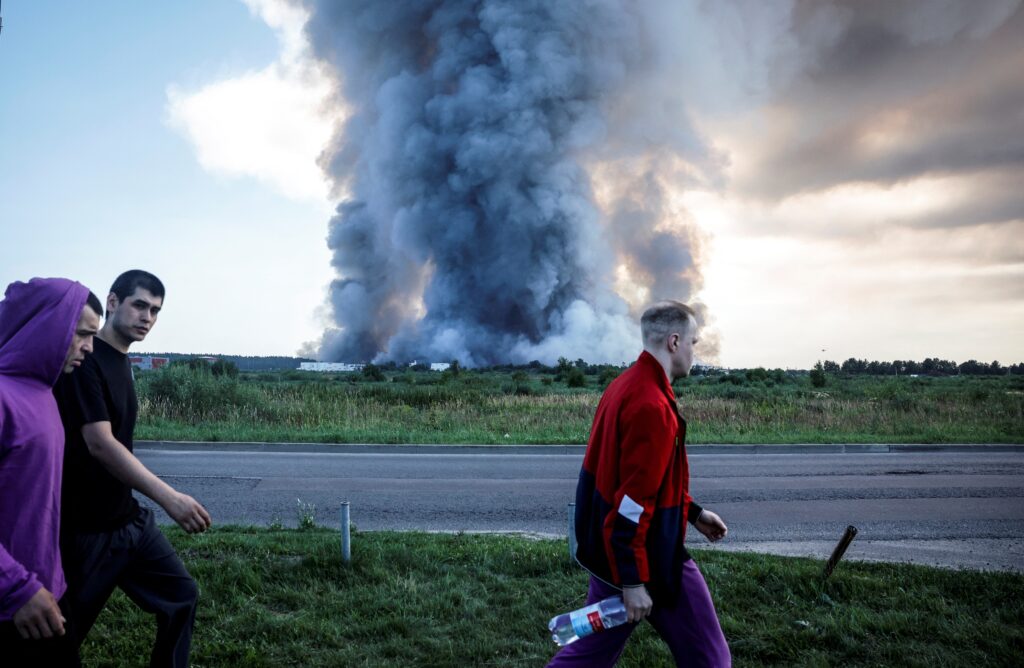
As Russia and Ukraine traded heavy airstrikes this weekend, Ukrainian forces hit warehouses run by Wildberries, Russia’s largest e-commerce marketplace, sparking a fire that raged for two days and was visible in satellite imagery from space.
The Saturday night strikes hit two large Wildberries warehouses in central Russia — in Elektrostal near Moscow and Kotovsk in the Tambov region. At least eight people were killed and more than 80 injured. In footage posted on social media, both facilities appeared to be almost entirely destroyed.
The attacks continued early Monday, with Russian officials saying more than 400 unmanned aerial vehicles targeted the capital and surrounding areas, igniting fires at a major logistics facility near Domodedovo as well as at an oil depot and a residential building.
A large Wildberries facility near Podolsk, in the Moscow region, may have been targeted, as well, though there was no confirmation of damage.
The aerial exchanges fit into a wider shift in the war, which is now raging in its fifth year: Ground fighting is moving at a glacial pace, while the air campaign on each side has intensified and expanded to hit major commercial and economic assets and key infrastructure.
Kyiv has expanded its strikes deep into Russian territory, hitting oil refineries that have caused fuel shortages, along with logistics hubs it says double as part of military supply chains.
The campaign has undercut the Kremlin’s efforts to shield most Russian citizens from the war, and it has earned Ukrainian President Volodymyr Zelensky rare praise from President Donald Trump.
The strikes, reaching far beyond the border areas with Ukraine, have also shifted Western perceptions of Kyiv’s long-term chances of success. Moscow, meanwhile, has stepped up missile strikes on Ukrainian cities and transport networks, leaning on its advantage in ballistic missiles.
Zelensky described this weekend’s attacks as retaliation for strikes on Ukraine’s civilian infrastructure, saying Wildberries warehouses had been used to store sanctioned components for drone production and navigation systems.
Russia has made similar claims against Nova Poshta, a Ukrainian postal and courier company, whose terminals Russian forces have been striking regularly.
“We see here this is self-sustaining spiral of vengeance, you hit our shadow tankers, we will hit your dry cargo ships in Odesa, you hit our oil refineries, we hit your gas stations,” said Ruslan Leviev, a military analyst with Conflict Intelligence Team, which monitors Russian military activity using open-source data.
Shoppers can find a wide range of military-related goods on Wildberries, including body armor, fiber optic cable used for navigation in FPV drones to bypass electronic jamming, radios, GPS signal jammers and other dual-use electronics.
These and other commercially available products are a key part of a volunteer effort that helps supply the Russian army on the frontline.
Russian officials and pundits called the strike on the Wildberries warehouses a “terrorist attack” — a label the Kremlin often attaches to strikes that Kyiv views as retaliation for Russia’s full-scale invasion and continuing occupation of about one-fifth of Ukraine’s territory.
A flagship Sunday television show, “Vesti Nedeli,” said in a segment that Ukraine deliberately targeted “civilian” businesses to pressure Russians on behalf of the West.
Yevgeny Pervushov, governor of Russia’s Tambov region, said it was “the largest and most inhumane terrorist attack on our region.”
“The main effect of these attacks is psychological,” Andrei Pivovarov, an exiled Russian opposition activist, wrote in a post on Telegram. “When Moscow and the Moscow region see a huge plume of smoke rising over a major logistics hub known to millions of people, it makes a much stronger impression than dry reports.”
“Especially when it becomes clear that such attacks cannot be prevented,” Pivovarov added. “This psychological effect is most difficult for the Kremlin to offset and this is largely why such a large-scale retaliatory attack on Kyiv followed.”
On Sunday, Russia launched one of the war’s heaviest missile strikes on Kyiv, using about 40 Iskander-M and Zircon hypersonic missiles, which targeted major logistics facilities — an Amtel distribution center and a Nova Poshta sorting hub.
The five-hour assault killed at least six people dead, injured dozens more, and caused fires and damage across the Ukrainian capital.
“Russia unleashed the largest number of ballistic missiles since the start of the war — around four dozen — in a brutal terrorist attack on the Ukrainian capital,” Ukraine’s top diplomat, Andrii Sybiha, said on X. “We need devastating pressure on Moscow to end this terror.”
The attack on Wildberries dealt a serious blow to the infrastructure of Russia’s version of Amazon, with at least 7 percent of its total logistics capacity wiped out during the weekend strikes alone, according to an estimate by Kommersant, the Russian business newspaper.
The Elektrostal warehouse was a key hub for Moscow and the surrounding region and one of Wildberries’ single largest logistics centers, spanning 250,000 square meters or about 61 acres. The Kotovsk warehouse, with 108,000 square meters or about 27 acres, served logistics for southern Russia.
Kommersant estimated the damage at between $270 million and $450 million, based solely on the cost of rebuilding the warehouse space, without taking into account the stored goods, for which sellers are now demanding compensation. The combined net profit of Wildberries in 2025 was around $2.2 billion.
The attacks wiped out the livelihoods of hundreds if not thousands of Russian entrepreneurs who relied on the Elektrostal facility for sales in the capital and the region.
Some took to social media to voice their anger and lament the strain the war had already placed on small-business owners squeezed by higher taxes imposed by Russia to fill depleting coffers.
Hair specialist Maria Nevskaya said in an Instagram post that most of her brand’s hair-care products had been stored at the Kotovsk and Elektrostal warehouses.
“In a matter of minutes, we lost almost everything. It wasn’t just the goods that burned,” Nevskaya wrote in her post. “Millions of rubles invested in production, raw materials, packaging, and logistics burned. Months of work by our whole team burned. And the illusion that an entrepreneur has any real protection in a crisis burned too.”
Formally, Wildberries has no obligation to pay.
Less than two weeks ago the company changed its seller policy to exempt itself from liability for goods damaged by “force majeure,” a category that now explicitly includes drone strikes and any damage from weapons or military equipment.
But looming parliamentary elections in the fall, which the Kremlin prepares to hold amid growing discontent over repeated attacks on Russian infrastructures and economic strain, may force the company to assist the angry sellers and avoid a major political headache
Wildberries CEO Tatyana Kim announced that the families of employees killed in the Ukrainian strikes will receive 2 million rubles each (about $25,500) and relatives of those who were seriously injured will get half of that.
The company said it would conduct an assessment of compensation amounts in the next 30 days and offered some technical relief to sellers in the form of loans, delayed debt repayments and faster revenue withdrawals.
The post Ukraine bombs warehouses, targeting Wildberries — Russia’s version of Amazon appeared first on Washington Post.