Shortly before Bastille Day, France’s July 14 national holiday, some of the country’s most prominent stage directors stood together at the Avignon Festival, the annual theater extravaganza. With several dozen colleagues by their side, Julie Deliquet, Julien Gosselin and Rébecca Chaillon addressed the audience for Gosselin’s play “Maldoror.”
“Repeated budget cuts — with more to come — force us to scream, because they’ve created an emergency,” Chaillon said. Christophe Rauck, the director of the Théâtre des Amandiers in Nanterre, added: “Is this the landscape of ruins you want to leave behind?”
Their appeal came in the wake of bleak news for French theater. In early July, the culture ministry announced that it was freezing part of its remaining 2026 arts funding. For 28 performing arts institutions, that means unexpectedly losing up to 12 percent of their yearly subsidy. Theaters, opera companies and orchestra say the news will force layoffs and canceled productions, if not worse: The recently renovated Théâtre des Amandiers, which stands to lose over $900,000, warned that it might have to file for bankruptcy.
In Avignon, where artists, programmers and theatergoers rub shoulders for a month every summer, the announcement has ignited fierce debates and protests. Last week, an estimated 1,800 people demonstrated in front of the Papal Palace, the festival’s biggest venue, amid threats of union strikes and occupied theaters.
For many, these cuts are not simply another round of belt-tightening, but a threat to a system of public support that has shaped French artistic life since World War II. The country’s dense network of cultural venues has long been the envy of artists around the world, but in recent years the intricate system of local, regional and national subsidies that sustains it has come under strain. Cuts to culture, previously a taboo in France, have become routine.
Onstage, the mounting pressure has also made productions more overtly political. France’s publicly funded theater has long had a reputation for activism: In 2024, for instance, the Avignon Festival rebranded as a “festival of resistance” when the far right came out ahead in the first round of French parliamentary elections. This year, a number of productions pushed conversations around current social issues.
Christiane Jatahy’s “A Trial — after An Enemy of the People” even brought the audience onstage to deliberate. Jatahy, a Brazilian director who is a frequent presence in France, has updated a classic play: Henrik Ibsen’s “An Enemy of the People,” from 1882, in which a doctor, Thomas Stockmann, discovers that the water of his town’s lucrative spa is contaminated. When he insists on making the truth public, local officials and much of the community turn against him.
Jatahy makes incisive theater out of the central conflict between population welfare and economic interests, reimagining the story as a court case set in contemporary Brazil. A group of audience members, drawn at random, are asked to sit onstage and ultimately vote on Stockmann’s guilt. In the lead role, the Oscar-nominated Brazilian film star Wagner Moura defended public health concerns with arresting intensity.
On the night I attended, seven jury members declared Stockmann not guilty and four deemed him “an enemy of the people,” won over by economic arguments in the face of environmental concerns.
Yet the festival’s international outlook — over half of the directors in this year’s lineup come from outside France, with a special focus on Korea — means that political concerns are often seen through a global lens. This year, it left space for Avignon’s fringe spinoff, known as “Le Off,” to step up and claim a political role of its own.
While Le Off is technically open to all artists and boasts 1,780 shows of varying scale this summer, it is coordinated by an association, AF&C, that oversees the Off Village, a central venue that acts as an open meeting place. This year, AF&C issued an open invitation to politicians: Anyone intending to run in France’s 2027 presidential election was welcome to come and talk about their plans for culture.
Eight presidential candidates, most of them from left and far-left parties, heeded the call. Last week, in front of a packed audience, François Ruffin, a journalist, filmmaker and National Assembly member who is running for the small left-wing party “Debout!,” answered questions for an hour from the culture journalist Marie Sorbier. Quoting Charles Baudelaire, “The Little Prince” and the philosopher Antonio Gramsci, he blamed globalization for “the growing distance between the French population and culture” and extolled public funding for the arts.
Although commercial theater in France has historically been more politically cautious than its state-funded counterpart, it has also been affected by the changing political landscape. In June, the far-right mayor of the Castres region of southern France canceled a scheduled performance next season of “Passport,” a play about a young migrant by the star playwright and director Alexis Michalik.
In that context, there were plenty of signs in Le Off that artists are asserting their political voice. Many shows took on recent political history, including Léo Cohen-Paperman’s underwhelming farce “SarkHollande,” about the presidencies of Nicolas Sarkozy and François Hollande, or “Doléances,” inspired by France’s Yellow Vests protests of the late 2010s.
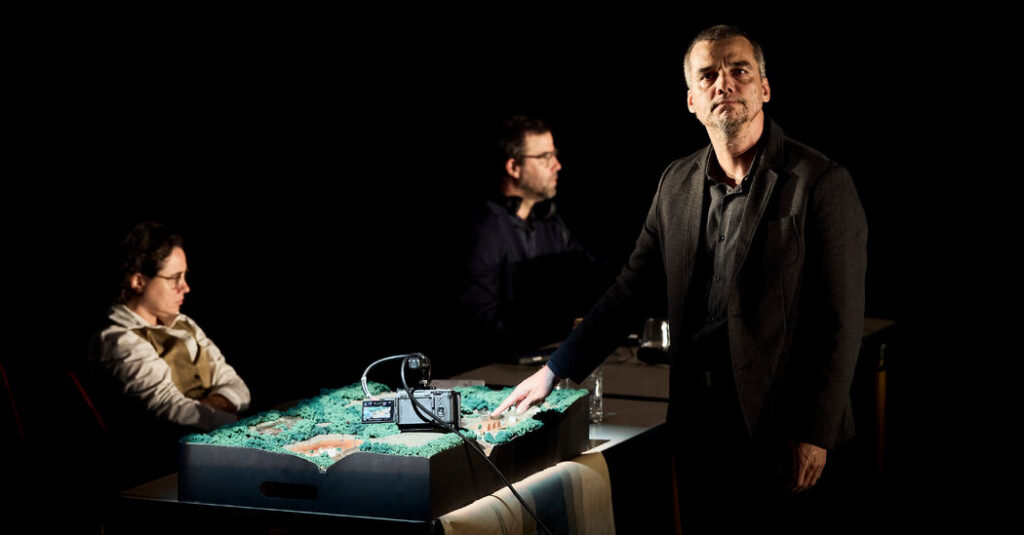
Like Jatahy, some directors also opted for the trial format, with a more local focus: “The Plea for Forests,” at the Buffon theater, imagines a court fight in a French town between an international property conglomerate seeking to cut down a centuries-old oak tree and its opponents. With just three actors, and the help of elegant drawings on a screen (by Amaury Brumauld), the directors Rémi Bichet and Françoise Cadol bring welcome poetry to the back-and-forth between legal proceedings and the folk legends surrounding the tree.
Some of the biggest names in commercial theater are joining in, too. Mélody Mourey, who has won awards and audience acclaim for her witty, fast-paced shows, took on the climate crisis and the rise of far-right populism and tech titans in “The Indigo Zone” at the Théâtre des Béliers. Mourey follows a team of scientists building a program to communicate with sperm whales, whose language seems remarkably similar to our own.
The twists and turns come at a dizzying speed as the team is confronted with a dictatorial regime in France and flees to a private island run by a tech billionaire — only to find that he is no benevolent philanthropist. Mourey sometimes throws in more than a single play can coherently explore, but “The Indigo Zone” packs an emotional punch and delivers a defiant final plea.
“Our voices can become dominant,” the cast intones at the very end. “Now, we interfere.” French theater, under attack, may just be on the warpath.
The post As Budget Cuts Loom, French Theater Turns Up the Political Heat appeared first on New York Times.