Good morning. It’s Monday. Today we’ll find out about the second life of corks from wine and champagne bottles served in Manhattan restaurants.
What does walking on the new pathways outside this Brooklyn housing project feel like?
“Slightly cushioned,” said David Rockwell, who has designed restaurants, hotels and sets for Broadway hits — and helped choose the material the new pathways were paved with.
“Feels really good on the feet,” said Alex Zablocki, the executive director of the nonprofit that paid for the pathways and other elements in a $500,000 project to remake open space at the 28-building Marlboro Houses complex in the Gravesend section of Brooklyn.
The project is part of a $3.2 million initiative for four housing projects around the city that the nonprofit, the Public Housing Community Fund, is coordinating with a cohort of other nonprofits and design firms.
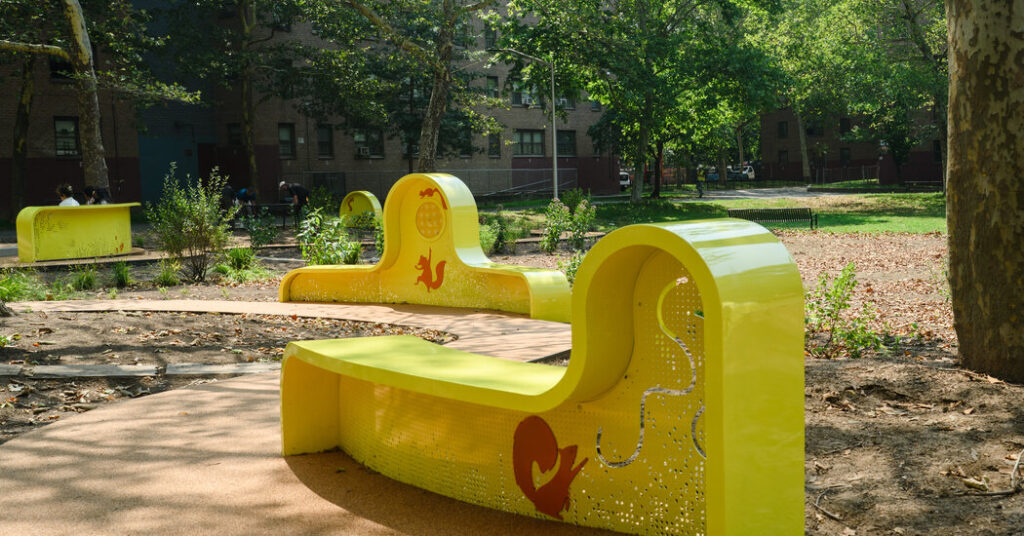
He said the changes at Marlboro Houses would make the public spaces “greener and more welcoming.” They have also made them more yellow, by installing bright yellow sculpturelike pieces and benches.
The pathways are paved with cork recycled from bottles of wine and champagne served in restaurants in New York City and other places. Some 450,000 corks were ground up in all. They were mixed with an adhesive compound and spread on the pathways and on playgrounds at the complex.
Rockwell said the recycled material was an environmentally sustainable, nontoxic alternative to conventional asphalt or to the rubberized surfaces often used on playgrounds and walkways. Cork is also cooler than asphalt or poured-in-place rubber, according to Rockwell, who has been promoting the advantages of cork since starting the nonprofit Cork Collective in 2024 to pick up corks from restaurants (after persuading the restaurants to save them).
It is popular at Marlboro Houses. “Everybody’s loving that cork,” Paula Jenkins, the president of the Marlboro Resident Association, the tenants’ group in the complex, told me. “The people don’t think it’s enough.”
She said residents wished that all the grass in the playground areas had been corked over because dogs were using the grass for what dogs use grass for. “It’s like an eyesore,” Jenkins said.
She said the “yellow things” were popular with children. “But the adults are like, What’s going on with the grass? It takes away from the beautiful project they put up,” she said, adding: “There are a lot of dissatisfied people in Marlboro.”
For Marlboro Houses, which has seen its share of storm water flooding, cork has another advantage: It is water-absorbent, unlike asphalt and rubberized surfaces. Many residents of the complex remember the damage from the rain that accompanied Hurricane Irene in 2011 and the storm surge that accompanied Hurricane Sandy in 2012, as well as the flooding after Hurricane Ida five years ago.
Rain isn’t the only water-related headache at Marlboro Houses. “What’s unusual about Marlboro is that it was built on top of a creek that led to Coney Island Creek,” Zablocki said, so water has somewhere to go after seeping through the cork and the soil below. With conventional poured-in-place materials, as asphalt and rubberized surfaces are known, the impermeable surface would displace water, Zablocki said. The result? Puddles and ponds on the pavement.
Zablocki said the project was “community-led design.” It evolved after workshops with a property management team led by the Urban Conga, a design group that found that public spaces at the complex were underused.
For Zablocki, the idea of recycling cork had a particular resonance. He worked closely with the Billion Oyster Project, which collects shells from restaurants and places them in reefs in and around the city, when he led a coastal resilience program on Staten Island in the temporary state agency that coordinated hurricane recovery efforts.
“If you eat oysters in restaurants that support that program, those shells are put back into the ecosystem,” he said. “I saw a similarity between opening a wine bottle in a restaurant in New York City, taking that cork and instead of tossing it into the landfill, putting it into an ecosystem that could make it part of our built environment.”
Weather
Expect a sunny day with a high near 81. Tonight, there will be increasing clouds and a low around 70.
ALTERNATE-SIDE PARKING
In effect until Thursday (Tisha B’Av).
QUOTE OF THE DAY
“The final is a different animal.” — Alex Lasry, the chief executive of the New York New Jersey World Cup Host Committee, on the last of the 104 matches played over the past five weeks.
The latest New York news
-
The world’s biggest game: Spain beat Argentina, 1-0, yesterday to win the World Cup, but there were moments when the game, played at MetLife Stadium in New Jersey, took on the tenor of a home match for Argentina.
Halftime: Madonna, Shakira, BTS and Justin Bieber were the headliners. Gustavo Dudamel, the incoming music and artistic director of the New York Philharmonic, led a tribute to Venezuela, where a 7.5-magnitude earthquake killed thousands of people last month.
Other news
-
Fearing political erasure: Longtime leaders in minority voting districts worry that victories by the Democratic Socialists of America in gentrifying neighborhoods could reverse their efforts to empower Black and Latino voters in choosing who represents them.
-
Tracing cyclosporiasis: New York City health officials explained how they traced a cyclosporiasis outbreak earlier this year, an effort that showed the difficulty of the task. That outbreak was smaller than the one that has sickened thousands of Americans this summer and that has now been connected at least in part to iceberg lettuce.
-
Two more people die in Legionnaires’ outbreak: The deaths brought the toll in the outbreak to three. City health officials said they believed that the source of bacteria that led to the outbreak had been eliminated after a cleanup of cooling towers on the Upper East Side.
-
Canadian wildfires continue to darken skies: Frank Pereira, a meteorologist at the Weather Prediction Center, said that winds might push another wave of smoke-filled air into the New York region.
If you like history …
-
… and solving clues: The New York Times is organizing a free, interactive exploration of the streets of Lower Manhattan to see how the city’s past quietly shapes the present. You’ll follow a trail of clues and be immersed in Times reporting while collecting custom postcards and stamps at each location during the event on July 25. R.S.V.P. here before all the spots are gone.
METROPOLITAN diary
Their Chinatown
Dear Diary:
When I was growing up on the Upper East Side in the 1960s and ’70s, Manhattan’s Chinatown was a faraway place offering highly exotic food.
American palates had by then had a couple of decades to get used to what we called “Chinese food,” but for many people, my family included, spare ribs, egg rolls and chicken chow mein were the outer limit of what we were brave enough to order.
Every few weeks, we would pile into the convertible and head to Chinatown. There, we ate only and always at a restaurant called Lin’s Garden. In time, I came to realize that every uptown family had “their” Chinese restaurant.
When I moved to the South Street Seaport in 2024, the first thing I did was time the walk to Chinatown: 11 minutes.
With such variety nearby, I decided to eat in every Chinatown restaurant, and for the past two years I’ve been working my way through a spreadsheet of nearly 200, from hole-in-the-wall dumpling shops to dim sum palaces.
It’s an illogical project, given my still very American palate and inability to eat spicy food. But I want to resist the temptation to return, Lin’s Garden-style, only to familiar places.
New York City, consumed as it is by its own forward motion, will always decline to respect our individual nostalgias, so it’s up to us to do the remembering. Lin’s Garden is long gone, but recently I unearthed the address, 53 Bayard Street.
Now, when I’m on the block, I make a point of looking inside, and into the back corner where the four of us — my parents, my sister and me — once adventurously ate those spare ribs and egg rolls, so far from the Upper East Side.
Today, the restaurant is called Yunnan Rice Noodle House, and it’s No. 65 on my Chinatown spreadsheet. I’ll get to it eventually.
— Jean Hanff Korelitz
Ms. Korelitz is a writer. Her most recent book is “The Sequel.”
Illustrated by Agnes Lee. Tell us your New York story here and read more Metropolitan Diary here.
Glad we could get together here. See you tomorrow. — J.B.
Davaughnia Wilson and Ed Shanahan contributed to New York Today. You can reach the team at [email protected].
Sign up here to get this newsletter in your inbox.
The post These Public Housing Pathways Are Made From Wine Corks appeared first on New York Times.