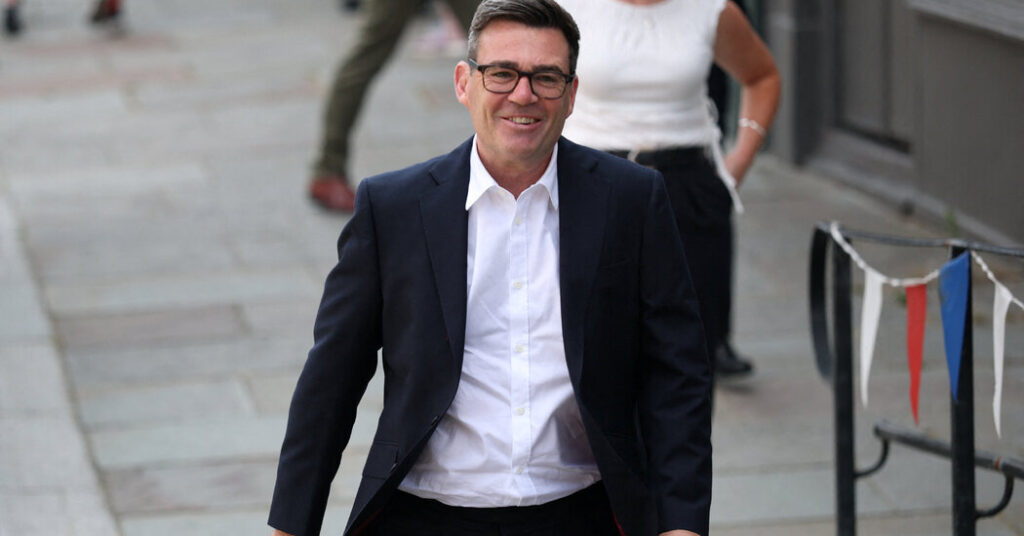
Andy Burnham is set to be the first lifelong Roman Catholic to become prime minister of Britain when he is appointed on Monday. At one point, that would have been a big deal.
For a time, until the early 19th century, Britain barred Catholics from even becoming a member of Parliament, let alone prime minister.
Modern Britain is notably secular — less than half of the people who described their religion in the most recent census of England and Wales said “Christian,” and 37 percent answered “no religion” — but the state retains deep historical ties with Protestant Christianity.
England has an established Protestant church, in which the king has the title of “supreme governor” and the prime minister traditionally advises on the choice of bishops. Such advice has been treated as largely symbolic for years, but a parliamentary research briefing suggests Mr. Burnham might have to formally delegate that part of his role even so.
The English church originated in King Henry VIII’s long-ago break with Rome. The story in other parts of Britain was different, but religious rivalry and fear were widespread.
English Protestants regarded a Catholic leader as a threat to their sovereignty, a fear that eventually led to the Glorious Revolution of 1688, which saw the overthrow of the last Catholic king, James II. Anti-Catholic laws followed. Legislation passed in 1829 and then 1858 removed many, but not all, of those legal barriers.
Mr. Burnham has spoken about Catholicism as part of his cultural identity, rather than describing it as a fervent religious faith. He is of Irish heritage and attended Roman Catholic schools as a child. His mother, Eileen, recounted in one 2015 interview: “You should have seen the fights he and his brothers had on Sundays. They were all altar boys, but Andy had to be the one at the front holding the Communion plate.”
In a 2009 interview with The Guardian, Mr. Burnham said: “Three things are important in my life, apart from family. Everton F.C., the Labour Party and the Catholic church — in that order.” (Everton, which is based in Liverpool, is the soccer club he has long supported.) “The reason I say that is, it all comes back to cultural identity,” he added.
After meeting Pope Francis at the Vatican with other regional leaders in 2023, Mr. Burnham told another British newspaper, The Telegraph: “Even though I’m not a Catholic in that full sense of the word, I felt the magnetic pull of the Vatican.”
He likened his religious identity to following a soccer club without regularly going to its matches at the stadium: “You’re still an Evertonian; you can stop going to church but you’re still a Catholic.” But he also said that his religious upbringing had shaped his political views: “I was brought up in the belief in Catholic social teaching and that was hugely formative. As I saw it, the closest thing to what I was told there was Labour politics.”
A little religious ambiguity is not new to the job of prime minister.
Boris Johnson, British prime minister from 2019 to 2022, was baptized into the Catholic church as a baby but mostly raised as an Anglican and eventually confirmed into the Church of England during his school years at Eton.
Tony Blair, prime minister from 1997 to 2007, has been married to a Catholic, Cherie Blair, since 1980; they raised their children in the faith, and he often attended Mass with his family. But he did not formally pass from Anglicanism to Catholicism until about six months after stepping down from leadership.
Britain has had one Jewish prime minister — Benjamin Disraeli — who first held the post in 1868 and was raised in the Church of England after age 12.
In 2022, Rishi Sunak became the first practicing Hindu to serve in the post.
The post Burnham Set to Become Britain’s First Openly Roman Catholic Prime Minister appeared first on New York Times.