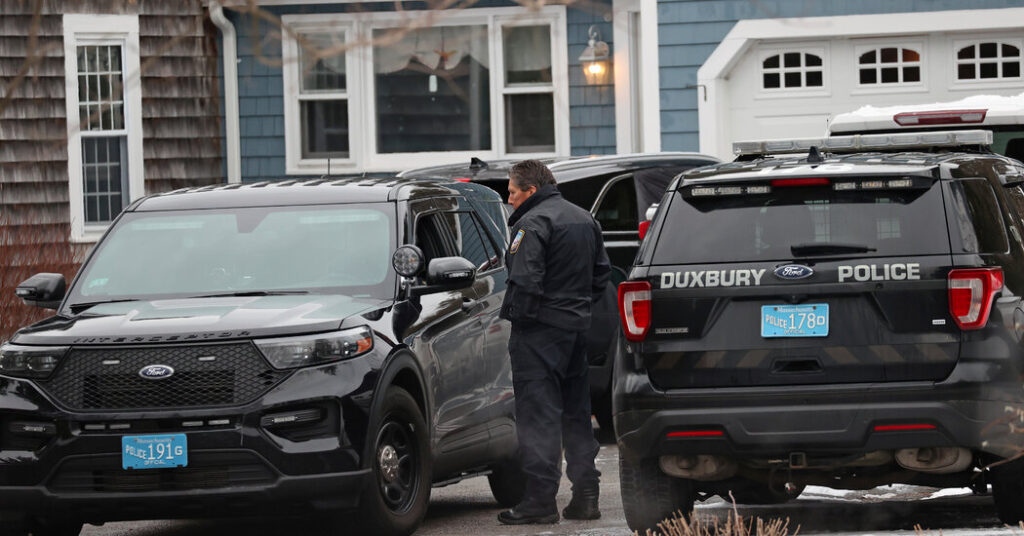
More than three years after the town of Duxbury, Mass., was shocked by an incomprehensible crime, its residents are bracing for the trial of Lindsay Clancy, a mother charged with murder for strangling her three young children at her home on Jan. 24, 2023.
At the trial, which starts on Monday in the Plymouth County Superior Court in Plymouth, Mass., lawyers are expected to present the actions of Ms. Clancy, 35, in starkly different ways.
Prosecutors say the woman carefully planned the killings of Cora, 5, Dawson, 3, and Callan, 8 months, plotting to get her husband out of the house that night before choking their children with resistance bands. Defense lawyers say she was in the throes of a mental health crisis, overmedicated for severe postpartum mental illness and hearing voices that were ordering her to kill herself and her children.
The case — set in an affluent Boston suburb of 16,000 people where murders of any kind had been almost unheard of — revived a debate about the legal system’s treatment of mothers who kill their children. Twenty years ago, Andrea Yates, a Texas mother who drowned her five children, was found not guilty by reason of insanity; the verdict was seen as a breakthrough in public understanding of postpartum psychosis, a rare and serious psychiatric illness.
In Duxbury, where “Duxbury Strong” signs lingered on well-kept lawns for months after the killings, the Clancy case left lasting psychological wounds. It also prompted painful questions about how the deaths could have been prevented and what justice should look like.
“Grief doesn’t simply go away because time passes,” said the Rev. Bill Ferguson of Pilgrim Church of Duxbury, who has helped some community members navigate despair since the tragedy. “I’m encouraging people to be gentle with themselves, to remember that healing is not a straight line, that revisiting pain doesn’t mean you’re not moving forward.”
Ms. Clancy has pleaded not guilty to three counts of first-degree murder. She faces a penalty of life imprisonment without parole if convicted. Judge William Sullivan said at a hearing last week that he planned to seat 18 jurors, including six alternates, for a trial expected to last six to eight weeks.
Kevin Reddington, the defense attorney representing Ms. Clancy, said at the hearing that her case ranked as “probably the most emotionally disturbing and challenging” of his decades-long career. He predicted it would have a “significant impact on jurors.”
Ms. Clancy, who worked as a labor and delivery nurse at Massachusetts General Hospital, had experienced anxiety after the births of her first two children. Her symptoms returned after the birth of her third child in 2022 and intensified as she prepared to return to work. She sought treatment from a psychiatrist who prescribed her a growing list of medications. In a lawsuit filed against the doctor earlier this year, her husband, Patrick Clancy, argued that clinicians had failed to monitor her reactions to the medications “or attend to her worsening psychiatric condition.”
While taking more than a dozen medications — including Ambien, Klonopin, Valium, Prozac, Ativan, Zoloft and Seroquel — over several months, Ms. Clancy experienced worsening insomnia, anxiety and depression. By December 2022, she was reporting panic, numbness, racing thoughts, suicidal ideation and a growing fear “that something awful might happen,” according to the lawsuit.
Late that month, she admitted herself to a day program for patients with postpartum depression. On Jan. 1, 2023, after the day program determined that she needed a different level of care, she admitted herself to McLean Hospital, a residential psychiatric campus outside Boston, where she stayed for five days.
According to the lawsuit and medical records, Ms. Clancy’s crisis came to a head on Jan. 24, 2023, when she heard “a compelling and unrecognizable singular male voice” telling her that “she should die, that this is her last chance, and that her children would suffer if she was gone.” That day, after ordering takeout food for dinner just after 5 p.m. and asking her husband to pick it up, prosecutors say, she killed Cora and Dawson and fatally injured Callan, who died three days later.
Ms. Clancy then cut her wrists and neck, jumped from a second-story window, and fell about 20 feet to the ground, where her husband found her when he returned home less than 30 minutes later. She suffered traumatic spinal cord injuries and remains unable to walk, according to her lawyer.
Prosectors say she acted with “deliberate, premeditated and extreme atrocity and cruelty.” Ms. Clancy consulted a mapping app before her husband left the house to determine how long he would be gone, they said in documents, and “gave herself the time and privacy needed to commit these murders.”
The searing horror of the events, unfolding in an idyllic suburban setting of picket fences and playgrounds in a coastal town south of Boston, stunned the public. Then Mr. Clancy delivered another unexpected emotional jolt, releasing a wrenching written statement four days later urging people to forgive his wife.
“My family was the best thing that ever happened to me,” Mr. Clancy wrote. “I took so much pride in being Lindsay’s husband and a dad to Cora, Dawson, and Callan.” He described the quirks and talents of each child, and added: “They gave me purpose and I never took it for granted. There is now a massive void where that purpose once was.”
Yet, Mr. Clancy wrote, his wife had been unfairly portrayed “by people who have never met her and never knew who the real Lindsay was.” Their marriage had been strong “and diametrically grew stronger as her condition rapidly worsened,” he said.
“I want to ask all of you that you find it deep within yourselves to forgive Lindsay, as I have,” Mr. Clancy added. “The real Lindsay was generously loving and caring towards everyone — me, our kids, family, friends, and her patients. The very fibers of her soul are loving.”
His appeal for empathy coincided with a surge of public support from other women who had experienced postpartum depression. About one in seven women are affected by the condition, but research has been slow to investigate the causes. Postpartum psychosis is a rarer, more severe illness carrying a high risk of suicide and infanticide. Few women describe their experiences with either condition publicly, fearing condemnation in a culture in which any deviation from maternal bliss has been taboo.
The legal system, too, has taken a harsh view, although some change has come in recent years. In 2018, Illinois became the first state to pass a law making postpartum illness a mitigating factor in sentencing. And more than two dozen countries have passed laws easing penalties and providing psychiatric care for mothers who kill infants.
The Duxbury case may drive further change.
It has already contributed to an uptick in outreach from attorneys seeking expert witnesses and from families seeking support, said Andrea Clark, deputy chief executive officer for Postpartum Support International, a nonprofit organization. The group has recently added new training programs for lawyers, judges and clinicians.
“We welcome the opportunity to teach people that this is a severe disorder, but it’s temporary and it’s treatable,” Ms. Clark said. “People have survived it and come out on the other side.”
In Duxbury, Mr. Ferguson, the Pilgrim Church pastor, said many residents had found solace in acts of kindness, including contributing to a new playground dedicated to the Clancy children’s memory and joining a walk organized by church members to raise awareness of postpartum depression.
“People have gathered together in tragedy, and found connectedness,” he said. “We forget our shared humanity, and then we’re reminded again.”
The post A Mother Strangled Her Children. Was It Mental Illness, or Murder? appeared first on New York Times.