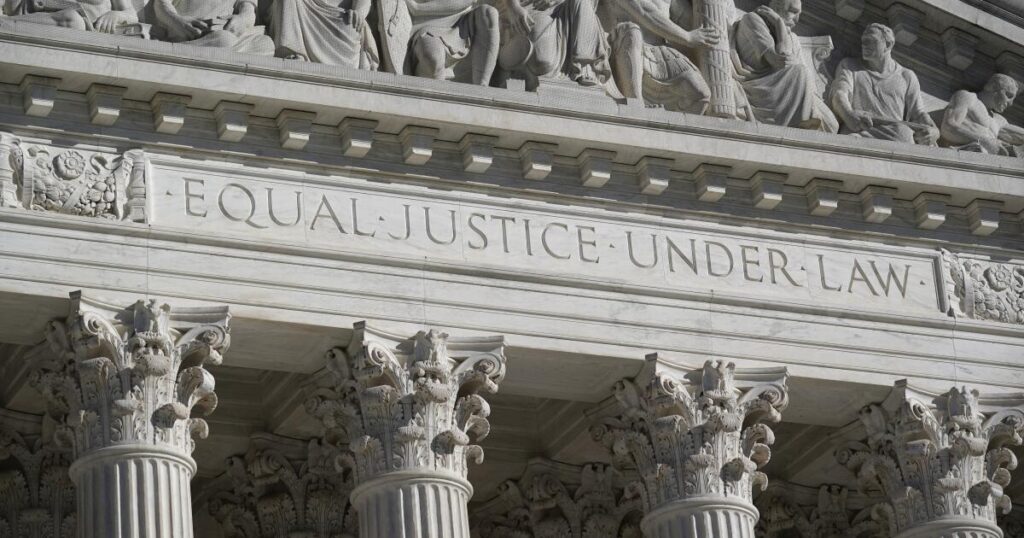
WASHINGTON — The Supreme Court ruled for Texas and its GOP leaders on Thursday, clearing the way for the state to use a new election map in 2026 that is expected to send five more Republicans to Congress.
The justices set aside, for now, a 2-1 ruling by district judges who called the state’s map a racial gerrymander. Thursday’s vote was 6-3 along the usual lines, with the conservative justices in the majority and the three liberals in dissent.
The court’s five-paragraph order said the district judges “failed to honor the presumption of legislative good faith by construing ambiguous direct and circumstantial evidence against the legislature.”
“The impetus for the adoption of the Texas map (like the map subsequently adopted in California) was partisan advantage pure and simple,” wrote Justice Samuel A. Alito Jr. in a concurring opinion.
Texas lawmakers had said they acted out of partisan motives, not racial ones.
“Today’s order disrespects the work of a District Court that did everything one could ask to carry out its charge — that put aside every consideration except getting the issue before it right,” wrote Justice Elena Kagan in dissent. “And today’s order disserves the millions of Texans whom the District Court found were assigned to their new districts based on their race. Because this Court’s precedents and our Constitution demand better, I respectfully dissent.”
She was joined by Justices Sonia Sotomayor and Ketanji Brown Jackson.
The decision bolsters Republicans in their bid to retain control of the House, and it’s a setback for Democrats and voting rights advocates.
It is consistent with the conservative majority’s view that drawing election districts is a “political question” left to state lawmakers, not judges. But in the past, the court also said racial gerrymandering is unconstitutional under the 14th and 15th Amendments.
In response to the Texas mid-decade redistricting, California Gov. Gavin Newsom won voters’ approval for redrawing his state’s congressional districts with the aim of electing five more Democrats in 2026.
On Nov. 21, Texas state’s attorneys filed an emergency appeal at the Supreme Court, urging the justices to act quickly to block the lower court’s ruling.
They argued the new election map for Texas was drawn based on partisan advantage, not the race of the voters. And they said a further delay would disrupt the next election because Dec. 8 is the filing deadline for candidates.
They cited the so-called “Purcell principle” as grounds for setting aside the district court ruling because it came to close to an impending election.
The Texas mid-decade restricting arose in July.
“Texas has also made a strong showing of irreparable harm and that the equities and public interest favor it,” the Supreme Court ruling said. “This Court has repeatedly emphasized that lower federal courts should ordinarily not alter the election rules on the eve of an election. The District Court violated that rule here.”
Acting at the behest of President Trump, Texas Gov. Greg Abbott called for a special session of the Legislature to redraw its 38 congressional voting districts with the aim of ousting five Democrats from the House of Representatives.
As justification, he cited the “constitutional concerns” raised by Harmeet Dhillon, the head of the Civil Rights Division at the Department of Justice.
She contended the state had several unconstitutional “coalition districts” which had a “non-White” majority made up of Black and Latino voters.
Voting rights advocates said Texas Republicans followed her view and redrew districts near Houston, Dallas and Fort Worth to erase those where Latino and Black voters formed a majority.
U.S. District Judge Jeffrey Brown said the evidence showed the Texas “Legislature had redistricted not for the political goal of appeasing President Trump nor of gaining five Republican U.S. House seats, but to achieve DOJ’s racial goal of eliminating coalition districts.”
If so, he said, the new map should be set aside, and the state should use the 2021 map drawn by the GOP.
The post Supreme Court rules for Texas Republicans, allowing new election map to go into effect appeared first on Los Angeles Times.