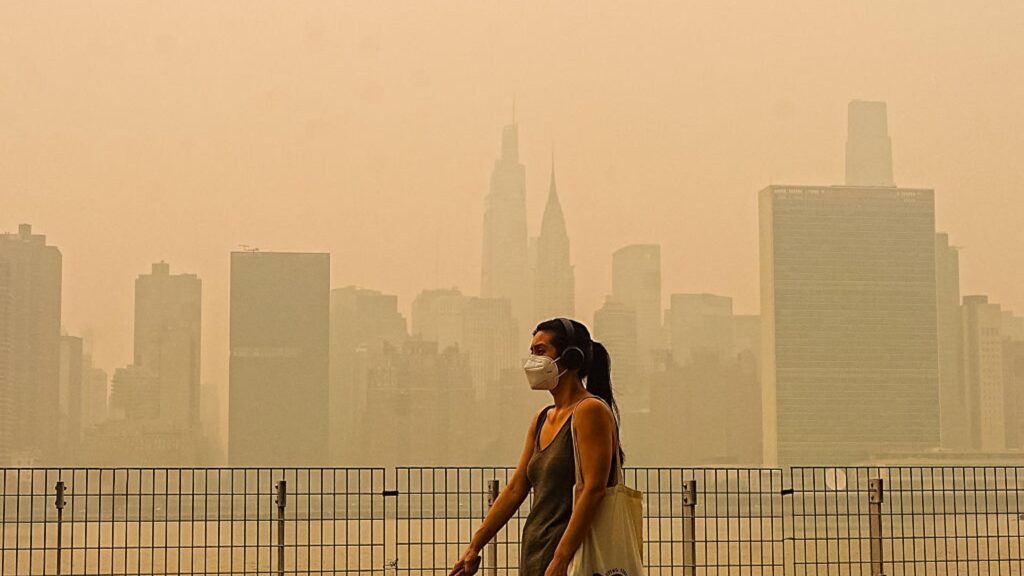
It’s felt all but impossible to escape the reality of our changing climate this past month, from extreme heat at London Climate Action Week to wildfire smoke across the U.S. northeast and midwest. While each individual event is dramatic in its own right, I’ve been struck by the breadth. Everywhere seems to be undergoing its own unique climate event at the same time.
In many conversations, climate change gets boiled down to individual events, or even just the simple sum of multiple events. But the impacts this summer offer a useful reminder that it’s not so simple. While economies may be able to absorb one climate shock, the risks grow when they accumulate and occur across geographies and assets simultaneously. You might call it “death by a thousand cuts.”
Already, this bludgeoning has become visible in insurance markets. Insurance is an obvious place for these challenges to show up first. Insurers price based on short-term risk and can’t defer a loss the way an equity investor can, so they either raise prices or exit the market. We’ve already seen those in the most at-risk markets, including both Florida and California.
But insurance is not alone. We’re starting to see indicators of other, similar slow-moving financial disasters. Earlier this month, the Bank of England quietly said that climate change was creating a spending pressure on governments, contributing to growing sovereign debt loads. Last month, the International Monetary Fund warned that climate disasters were creating an “impossible trilemma” for countries. Disasters drive countries to take on more debt, making it harder to fund the adaptation necessary to prepare, and then face higher default risk.
This is a dangerous cycle with implications for investors and businesses across the economy. Sovereign debt flows through to the rest of the economy. Too much of it leads to higher interest rates for businesses, lower private investment, and lower growth. One disaster, even a record one, can be absorbed. The danger is when they all happen at once, and then continue to happen. A never-ending string of extreme events threatens economic havoc in a way one event doesn’t.
Thus far, capital markets more broadly have been slow to respond to this threat for a variety of reasons. Climate risk is difficult to model and plays out over long time-periods. Meanwhile, investors discount future risks and prioritize quick returns. And, importantly, they generally expect that events will be non-correlated and therefore easier to absorb.
This view may change. The Bank of England warned last December of the possibility of a climate Minsky moment, where assets reprice rapidly due to climate shock. It’s also possible that repricing happens gradually over time. In any event, the cumulative effect of concurrent disasters should not be taken lightly. Markets often ignore risks when they feel isolated, or idiosyncratic, but once they are understood as systemic they are priced.
For many who work in climate, this season of extremes has revived the longstanding prediction that the effects of rising global temperatures will help drive a resurgence in concern among policymakers and the general public. I hope so, but I’m not so sure. While some studies have suggested extreme weather events can drive support for climate action, many others have shown minimal effect. And we’ve also seen the opposite effect: climate events that triggered populist backlash led by anti-climate politicians.
While it’s hard to predict how exactly these events will shape public engagement on climate, markets have a simpler logic to them. Climate related events are exacting a growing cost. And it’s now clear both that those costs will grow and that economies aren’t fully prepared. If and when investors look at the same information and determine that those costs aren’t fully accounted for, asset prices will take a hit.
To get this story in your inbox, sign up to TIME’s Future Proof newsletter here.
The post Climate’s Compounding Financial Toll Is Becoming Harder to Ignore appeared first on TIME.