Early in the Cold War, even as the United States and the Soviet Union engaged in a relentless nuclear arms race, they treated nuclear technology as a tool of soft power and diplomacy — something to share and export, a seal on alliances and a token of friendship.
Thus Dwight Eisenhower’s America launched the Atoms for Peace program, which helped build civilian nuclear programs around the world, in the same year that it executed the Rosenbergs for giving the Soviets our atomic secrets. The Soviet Union likewise exported forms of nuclear power to Eastern Bloc nations and Mao’s China. In each case, the broad goal was to spread the tech while maintaining control over the weapons, taking very different approaches to the two forms of nuclear strength.
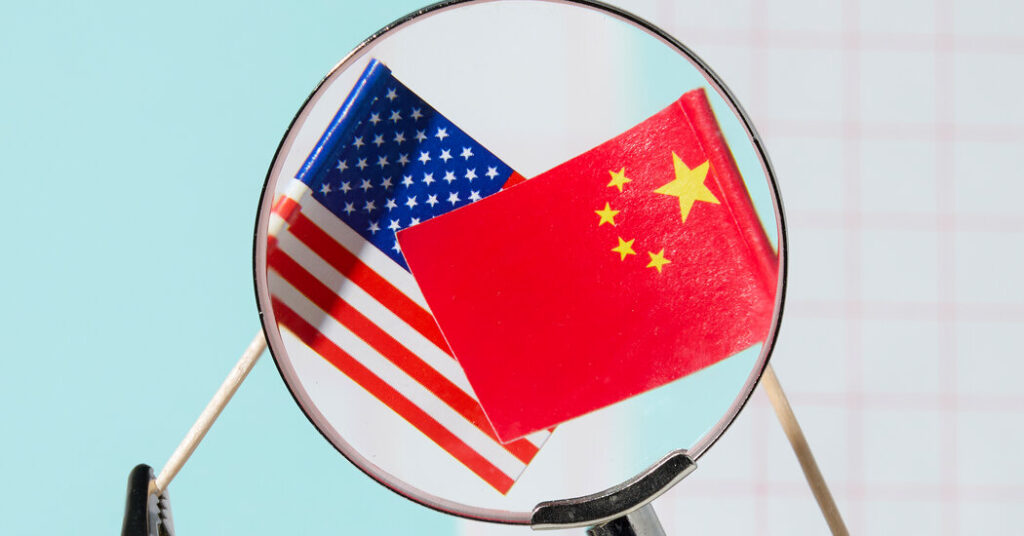
This history suggests a framework for understanding the difference between the American and Chinese approaches to artificial intelligence. The United States is behaving as though frontier A.I. models could be the equivalent of nuclear weapons, offering an immensely destructive form of power that requires a careful and jealous watch. American A.I. tycoons constantly talk as if they were engaged in an Oppenheimer-style race (complete with Oppenheimer-style moral hand-wringing), the American military-industrial complex is intent on keeping China from closing the current A.I. gap, and both industry and government increasingly treat frontier models as grave security threats.
Meanwhile, China treats the models that its companies produce as the equivalent of nuclear energy, a lower-risk technology to be shared and commercialized to win friends and influence the world and undermine the advantages of the American A.I. giants. There is some Chinese lip service to risk and safety, but little sense that this is a unique power to be hoarded, a geopolitical trump card or a weapon with existential stakes.
For a while (well, for a few months, but that’s an eternity in A.I. time), I’ve wondered about the sincerity of the Chinese position. Since its companies and models have consistently lagged behind Anthropic and OpenAI, China has obvious incentives to use open source to undermine Silicon Valley’s profits and reach, all while letting Washington worry about the risks that the most cutting-edge models may create. Were China to suddenly surpass us, I’ve speculated, the incentives might change, and it might start trying to lock down and weaponize its best models, treat them as state secrets and sovereign goods.
We do not yet have a Chinese model that surpasses our own, but this week brought a model that may come close, Kimi K3 from the Chinese company Moonshot AI. And so far Beijing is treating Kimi K3 like all its prior models: It’s going to be open source for maximum adoption, without any American-style fretting over risks and guardrails and export controls.
This decision should make us a little more confident that Beijing’s overall approach is sincere. It suggests that the Chinese don’t just reject the utopian and dystopian scenarios common in Silicon Valley, where past some threshold the power of artificial intelligence totally remakes the world. They may not even be especially “risk-pilled,” in the sense of worrying about the kinds of perils that today’s A.I. models might already create — through the power to hack and bring down complex systems, the power to help terrorists create bioweapons, the uncertain risks of rogue A.I. behavior and more.
American A.I. companies and the national security state seem to assume that we’re already at a point where you simply can’t let the world use the best A.I. models without controls and guardrails any more than you’d ship atomic bombs or ICBMs to random homes or private companies. Whereas the Chinese are willing to shrug and push the envelope and let America fret about safety and sovereignty, on the assumption that A.I. is a normal technology and the safety concerns will get figured out along the way.
Or to return to a more cynical reading, maybe they’re making a double bet. If A.I. creates only modest risks and isn’t actually some kind of strategic superpower, their open-source models are the best way to undermine the American advantage and make the world like China more than us. Alternatively, if we do get some kind A.I. Chernobyl from someone misusing a Chinese model — well, the repercussions and backlash will still probably hurt U.S. companies the most, because the American public is already skeptical of A.I. and primed for data center moratoria.
I’m not sure where this leaves the A.I. safety movement, which is responsible for a lot of that pro-regulatory priming. The cause of A.I. safety has advanced along several lines in the United States, benefiting from the progressive left’s hostility to Silicon Valley, the Pentagon’s anxiety about the power of privately controlled models and the A.I. industry’s internal doomer culture.
But it avails the would-be regulators nothing to slow American progress if China believes it’s playing a completely different game.
The Times is committed to publishing a diversity of letters to the editor. We’d like to hear what you think about this or any of our articles. Here are some tips. And here’s our email: [email protected].
Follow the New York Times Opinion section on Facebook, Instagram, TikTok, Bluesky, WhatsApp and Threads.
The post China’s A.I. Play Is Different From America’s appeared first on New York Times.