I still think of the final line of the first book of Laura Ingalls Wilder’s “Little House” series, which came close to breaking my 6-year-old brain. Lying snug in her trundle bed, in a log cabin, listening to Pa’s fiddle, little Laura Ingalls thinks, “Now is now. It can never be a long time ago.” I was in my room in a Canadian suburb when I first read that line, and it was the first time I had ever considered that my life would someday be considered the “olden days.”
Wilder published the original series of eight books in the 1930s and ’40s, about her childhood homesteading in the American Midwest in the 1870s and ’80s. One measure of great art must be that it allows for endless interpretations to fit the moment. “Little House in the Big Woods,” the first book in the series, appeared at the height of the Great Depression, when the public was hungry for stories of resilience and hope during punishing times. The promise of Go West, Young Man was busily being replaced by the harrowing reality of the Dust Bowl. Then there was the television series starring Michael Landon and Melissa Gilbert, which premiered in 1974 in the aftermath of Vietnam and Watergate, and chose to play up a kind of focus on mythic heartwarming American family values. (The show ended its run in 1983, though it lives on, even today, in reruns. Ronald Reagan reportedly once claimed it was his favorite program on TV.)
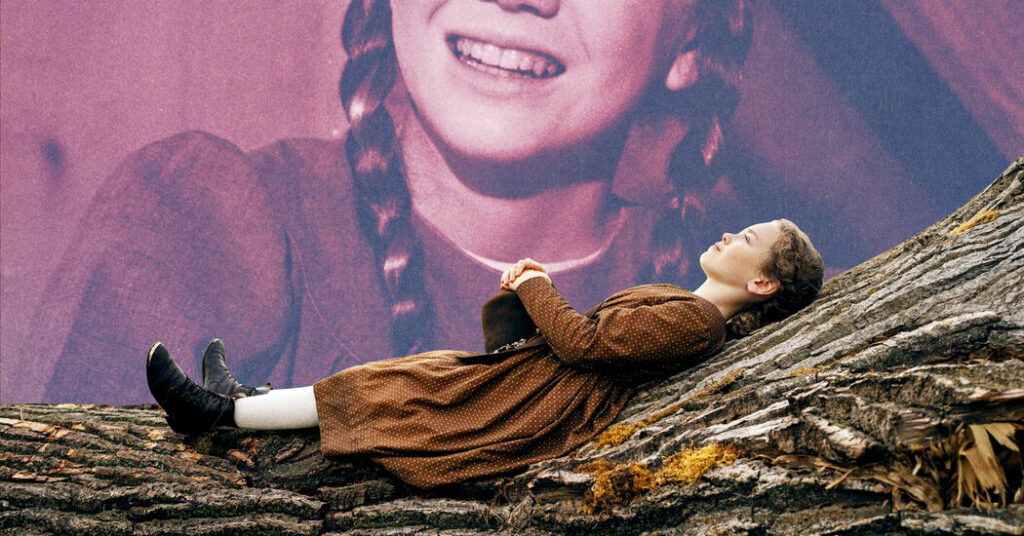
Now there is a Netflix reboot, which, though equally saccharine, and hardly truer to the books than Mr. Landon’s interpretation, presents a much more complicated vision, fitting for a country deep in a painful and violent battle over its own history.
Wilder’s original series follows the Ingalls family from Wisconsin to Osage land in southeastern Kansas, to a dugout alongside a creek in Minnesota, to the Dakota Territory, where they barely survive a historically brutal winter and where Laura becomes a teacher and meets her husband, Almanzo (nicknamed Manly). It is a heroine’s journey, wrapped up in a fairy tale, with Jobian levels of suffering, all starring a young girl, written by an old woman. (Wilder was in her mid-60s when she started writing her novels.)
Laura was proof to me, as a child, that it was possible to contain multitudes. She was a girl who enjoyed adventure and felt constrained by rules. She hated being forced to wear a bonnet that limited her sightline, but she could also devote five pages to descriptions of women getting ready for a dance. She was petty and jealous and brave and beloved. Even now she still fascinates me.
As much as Jack Kerouac’s “On the Road,” “Little House” is the definitive American Odyssey (free of drugs and sex, with women given a starring role). The houses Laura describes are all small and cozy — filled with the warmth of hearths, family and the sound of Pa’s fiddle. The cooking, even when meager, is almost always good. Everything, even the prairie grasses, is always “clean.” Pa with his shotgun, and Jack the brindle bulldog, are often standing guard.
They need the protection. The world outside is as wild and dangerous as it is magical, though like Pa, Laura is clearly thrilled by the danger. “Laura knew that wolves would eat little girls,” Wilder writes in the opening pages of the first book, right before her father awakens her in the middle of the night to see the two wolves who have parked themselves in front of the house to howl at the moon.
Reading the books again as an adult, however, can sometimes feel like reading a horror novel. The family frequently lived in destitution. (Their dugout seemed magical to me as a child, but it hits differently when you think of Ma dealing with her period, for instance, under such primal conditions.) There are other, more troubling questions that nag at the reader. Why is Charles Ingalls dragging his family from place to place exactly? Did they really want to go?
And then there’s the racism. Native Americans are described as terrifying and alien, “wild men with red skins.” Laura repeatedly asks to be shown a “papoose,” which she is sure Pa will do, “just as he had shown her fawns, and little bears, and wolves.” Ma hates the people who inhabited the land before them. But the worst offender is another white woman squatting on the Osage Diminished Reserve who tells Ma that “the only good Indian was a dead Indian.” This sentiment is repeated later in the book by her husband. But Pa disagrees. He figures they “would be as peaceable as anybody else if they were let alone. On the other hand, they had been moved west so many times that naturally they hated white folks.” These are just some examples.
Defenders will say Laura was simply echoing the sentiments of the time, which may be true. And yet from the vantage point of 2026, this language feels frighteningly contemporary. The Trump administration has embarked on a concerted effort to reframe the official scope of American history from multiracial and multiethnic to one that focuses almost entirely on the achievements of white, Christian Americans. The worst language in “Little House” — and the books contain more than their fair share of racist depictions — pales in comparison with what regularly emanates from this White House.
I admittedly missed almost all of this when I read the books as a white child in Canada, enamored as I was with Laura’s adventures. But there was one scene that always alarmed me. In the final chapters of “Little House on the Prairie,” the Ingalls family is watching the Osage leave their reserve. (They had been forced to sell their land by the American government, something the reboot makes clear.) As they pass by, Laura finally spots the Native American infant she’s longed to see.
“Its hair was as black as a crow and its eyes were black as a night when no stars shine. Those black eyes looked deep into Laura’s eyes and she looked deep down into the blackness of that little baby’s eyes, and she wanted that one little baby. ‘Pa,’ she said, ‘get me that little Indian baby!’”
The scene deeply unnerved me. Who was the baby? Where was she going? What had happened to her?
The Netflix series attempts its own answer to this question, and others, casting its gaze outside the Little Houses as much as in.
In the reboot, the Osage characters are given fully fleshed-out identities. Laura befriends an Osage neighbor girl by the name of Good Eagle, whose family is contending with the reality of losing their land to white settlers.
While Wilder often emphasized and exaggerated the family’s isolation, in the Netflix show, the Ingallses are far from alone. In one episode, Laura gives a speech on the meaning of Independence, the town and the idea, that focuses on the need for community and support. The Native Americans depicted are no longer presented as thieves, but as individuals taking back what they believe is rightfully theirs from invasive settlers claiming and plundering the land. Dr. George Tann (Dr. Tan in the books), the real-life Black doctor who in 1870 delivered Laura’s sister Carrie and saved the family from malaria, occupies a starring role. The shopkeeper is a Black woman who moved from Nicodemus, Kan., an all-Black settlement founded by formerly enslaved people at the close of Reconstruction. Pa’s brother George, who fought in the Civil War, is clearly suffering from post-traumatic stress disorder. The railroad barons — the tech oligarchs of those days — are cast as the bad guys, working in nefarious concert with the government that has lured white settlers with promises of free land in the hopes of using them to more quickly eradicate Native Americans.
None of this is laid out plainly in the books. But a closer read alludes to much of it.
For instance, in the book “By the Shores of Silver Lake,” which follows the Ingalls family into the Dakota Territory when Pa takes a job at the railroad, Laura “saw strange large depressions, straight-sided and flat-bottomed, that had been buffalo wallows.” By the end of Laura’s childhood, the buffalo population had been decimated at the behest of the U.S. Army, in an effort to eradicate Native Americans’ main food source and open land to white settlement.
In reframing the narrative, the show has simply taken these smaller observations and elevated them to the main story line.
So here we are again at another moment of immense political and social precarity, welcoming in yet another take on the story. The new adaptation incorporates some of the best parts of what Laura offered — courage, wonder, resilience — while widening the aperture of her lens. It insists on recognizing the humanity of all the people who made up Laura’s world, not just those inside her log cabin.
In rebooting “Little House,” a text that, for better and worse, has come to dominate our understanding of the era of Western expansion in American history, the show once again holds up a mirror to the nation. We might use it to honestly ask ourselves how we got here, and who we have become in the process.
Source photographs by Eric Zachanowich/Netflix and NBC Television.
Glynnis MacNicol is a contributing Opinion writer. She is also the host of the podcast “Wilder: A Reckoning With Laura Ingalls Wilder,” and the author of “Mostly Here to Enjoy Myself.”
The Times is committed to publishing a diversity of letters to the editor. We’d like to hear what you think about this or any of our articles. Here are some tips. And here’s our email: [email protected].
Follow the New York Times Opinion section on Facebook, Instagram, TikTok, Bluesky, WhatsApp and Threads.
The post A ‘Little House’ for Our Era appeared first on New York Times.