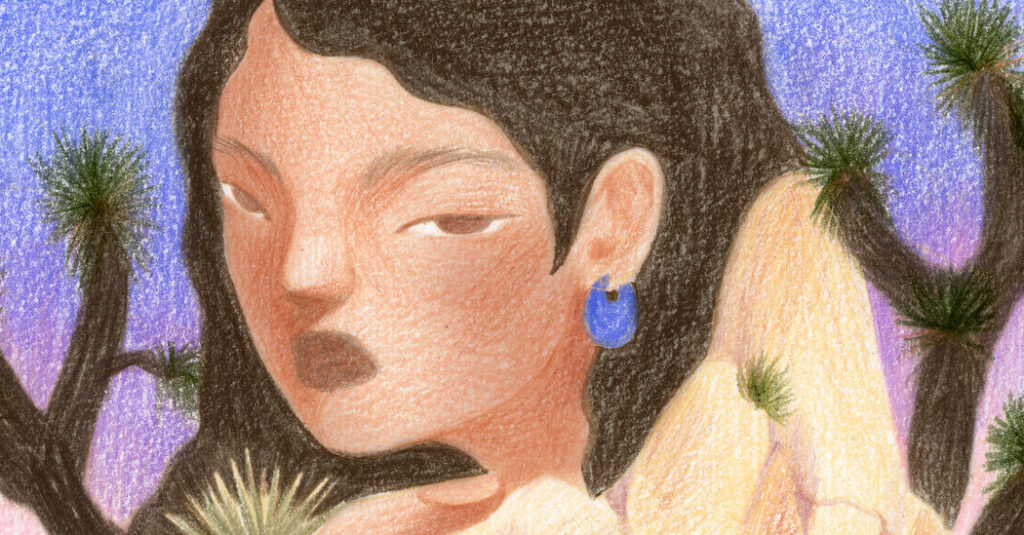
YELLOW PINE, by Claire Vaye Watkins
In the 1996 book “Sperm Wars,” the British popular science writer Robin Baker posited that all of human sexual behavior is driven by the biological patterns of male ejaculate. “Whenever a woman’s body contains sperm from two (or more) different men at the same time,” he argued, “the sperm from those men compete for the ‘prize’ of fertilizing her egg.” Only 1 percent of sperm are the “fertile ‘egg-getters,’” he ventured; the remainder are “kamikaze” sperm whose job it is to band together to defeat the enemy.
For reasons she can’t explain, Rose, the protagonist of Claire Vaye Watkins’s new novel, “Yellow Pine,” finds herself clinging to this sexist and scientifically dubious theory amid an existential crisis. Twenty years after she first found this “dumb book” in the lost-and-found at her public pool in Pahrump, Nev., she is living alone in a cinder-block cabin 40 miles from her hometown, divorced and devoid of her only child for most of the year, grieving both of her parents and her Al-Anon sponsor and freshly dumped by the love of her life, Miles, who’s already dumped her once before.
And then there are the dying tortoises. When she’s not collecting her paycheck as a fund-raiser for the Sierra Club (“a culture of idiots, ostriches and profiteers”), she banters with a motley crew (a retired park ranger, a trust-fund anarchist, an eco-feminist Ph.D. candidate, a pot farmer called Pastor Jack) who are protesting the building of an environmentally devastating solar array on 5,000 acres of arid, formerly public land that a multibillion-dollar energy company has incongruously, inexplicably named Yellow Pine.
It happens to be the natural habitat of hundreds of endangered tortoises, a species particularly ill suited to the violent uprooting the Bureau of Land Management is forcing upon them. Like Rose, who left Pahrump for college and marriage in Reno before returning as if by gravitational pull to the remote, “barely livable” place that raised her,
the evicted tortoises always came back. Slowly, but with their famed steadiness, the displaced tortoises went home. Or they tried. They returned looking for their burrows, for where they’d always found food, for the exact spot where they scratched a certain groove in the dirt to gather dew. They came looking for their mates, for their babies. But instead of home, sustenance or love, the tortoises would come up against a “tortoise exclusion fence” that would soon replace the pink-flagged stakes now delineating the Yellow Pine site. An adult tortoise would scrape slowly alongside the tortoise exclusion fence for miles, circumnavigating the site until it died.
Despite these calamities on a personal, social and geological scale, Rose decides now is the time to have a baby. And so hatches her plan to conceive a fatherless second child by a method she calls “the Swirl,” i.e., recruiting several men to have sex with her in a given ovulation window, egging on the sperms’ competitive spirit in order to maximize her chances of insemination. The method “appealed to Rose’s hedonism, her frugality and anti-capitalism, was megabohemian and patently feminist,” Watkins writes in a pithy little summary of her protagonist’s frenzied, spaghetti-at-the-wall approach to a personal politics.
It also, for all Rose’s disillusionment with corporate greed and liberal greenwashing, comes to encapsulate both her and the desert’s stubborn, possibly delusional sense of hope.
Like Watkins’s previous work — the drought dystopia “Gold Fame Citrus”; the postpartum autofiction “I Love You but I’ve Chosen Darkness”; her prizewinning story collection, “Battleborn”; a 2020 essay titled “The Burning West” — “Yellow Pine” is another hymn (requiem?) to her Mojave home: “an infinite undulation of dying basins held by rainbow mountains,” where something called kangaroo rats feast on something called brittlebrush and “a sea of creosote swam nightly by a small clan of coyotes.” Where a military base or bombing site lies beyond each of the seven mountain ranges she can see from her window.
The book is less of a novel than a novel-length riff, but what it lacks in the way of narrative arc it amply provides in passages of gobsmacking beauty juxtaposed with gobsmacking destruction, in bizarro humor, desert-dry wit and a blistering, more-is-more style of lefty critique. “For what?” Watkins writes of the solar array’s carnage, the taxonomic cost of the so-called “green energy” powering those Silicon Valley data centers, “all so the earth’s affluent could find every email they’d ever written?”
Four books into her oeuvre, one gets the sense that what keeps pulling Watkins back like a doomed tortoise to this place where the air feels like “the hot breath of hell” is more than just her biography. In the Mojave’s very precarity, she shows, lies not just its majesty, but its power to endure.
“We’re here, all of us, because of struggle,” she proselytizes to a potential baby daddy, twisting the gist of “Sperm Wars” into a basis for the most essential kind of optimism nature has to offer. “An epic struggle and equally epic cooperation.”
The man, very down, replies: “Word.”
YELLOW PINE | By Claire Vaye Watkins | Riverhead | 244 pp. | $29
The post The World Is Burning. She Wants to Have a Baby Anyway. appeared first on New York Times.