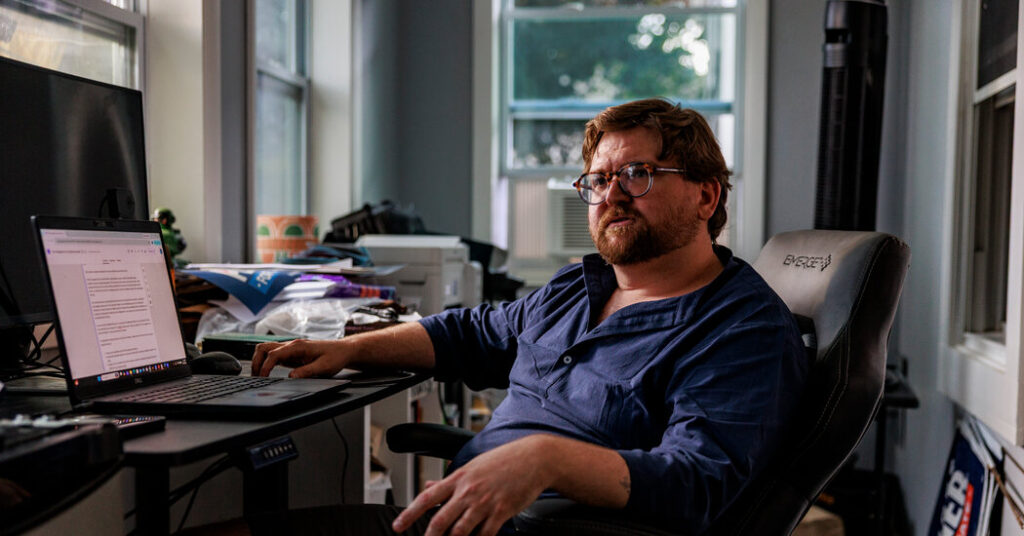
Ryan Warren sat in his home office in Fairfield, Maine, on a recent morning, racing to design campaign materials between Zoom meetings and phone calls with fellow political organizers.
Just days earlier, he had been working to elect Graham Platner to the U.S. Senate. But after Mr. Platner’s withdrawal from the race amid scandal, Mr. Warren had a new mission: finding a way to keep his populist movement alive while scrambling to find a new Democratic nominee.
“Our movement was not solely about Graham, even though he brought us together,” Mr. Warren said.
The implosion of Mr. Platner’s campaign followed months of controversy about his personal behavior, culminating in an accusation of rape, which he denied. It crushed the spirits of his most loyal supporters: Some of them felt betrayed by his behavior, while others saw the allegations as a plot by establishment Democrats to derail Mr. Platner’s insurgent campaign.
Now his supporters — including what his campaign claimed was an army of 15,000 volunteers — are contemplating whom to back among an unwieldy field of a dozen candidates.
Many Platner activists are also questioning the fairness of the political moment and whether they want to keep participating in politics at all.
The extraordinary situation in Maine has arrived as Democrats are waging a high-stakes effort to defeat Senator Susan Collins, the five-term Republican incumbent. Flipping the seat is a critical part of the Democrats’ efforts to take control of the Senate.
Spencer Toth, Mr. Platner’s former organizing director, said that the nominee who ultimately emerges from this truncated campaign will benefit from the volunteer infrastructure that has taken shape over the past year. What remains to be seen is whether any of the candidates can excite the network of volunteers who once supported Mr. Platner.
“Many of these candidates claim to espouse progressive beliefs that are similar to Graham,” said Mr. Toth, who worked briefly for the state Democratic Party after his role with Mr. Platner. “The thing is, it was never about the bullet points, but rather the way he was willing to speak to any issue directly and honestly that made voters love and trust him.”
The state’s Democratic Party will hold a convention to choose a replacement for Mr. Platner next weekend, and most of the candidates are promising to pick up his progressive platform. Courting his most loyal volunteers could be critical to the party’s success in the fall.
Crystale Lapham, a former volunteer for Mr. Platner, wants to ensure that the people who voted for him in the Democratic primary now have a voice at the convention. She and Mr. Warren are part of a large network of volunteers — known as the Maine People Powered Movement — who have released an open letter that includes a platform inspired by Mr. Platner’s campaign that they hope the candidates will endorse.
It includes proposals like expanded health care, a minimum tax on billionaires and increased rights for labor unions.
Their goal is to pack the convention with as many delegates and voters as possible.
Still, Ms. Lapham said, Mr. Platner’s campaign was about more than just a list of progressive policy proposals.
“The volunteer community loved Graham for his belief around grass roots, community-led organizing,” she said.
Several candidates, including Troy Jackson, a former State Senate president; Shenna Bellows, the secretary of state; and Dr. Nirav Shah, a former public health official, quickly signed on to the platform.
Mr. Jackson said his campaign is making sure to bring up those issues that Mr. Platner had focused on — including, he said, Medicare for all, prescription drugs and child care — in conversations with people who are viewed as likely to be elected as convention delegates.
“These are all things that I believe in wholeheartedly, and I don’t want to see die, regardless if it’s me or not,” Mr. Jackson told reporters at an anti-ICE rally in Biddeford, Maine, on Monday. “I just don’t want those issues to go away.”
Speaking to reporters at his campaign office on Wednesday, Dr. Shah said that he did not want to see supporters of Mr. Platner “become cynical and check out of politics, but harness that indignation that we all feel right now.”
He acknowledged that part of Mr. Platner’s appeal was his personal charisma.
“A lot of that campaign’s appeal was the person as much as it was the policies,” he said. “What I’m hoping to do is show folks that, although I have a different style than Graham, the passion, the policy priorities and the fact that I’m not beholden to anybody, is still there.”
In a statement, Ms. Bellows had praise for the volunteers who built the movement that helped power Mr. Platner to victory in the Democratic primary in June. “You didn’t just organize a platform,” she said. “You kept a promise to Maine alive over the last week when it mattered most.”
Suzanne Carver, a Platner activist, has already decided to back Ms. Bellows, whom she believes has the best chance in the general election.
“Ultimately the No. 1 goal is to replace Susan Collins,” said Ms. Carver, who lives on Beals Island.
Other volunteers are waiting to hear from the candidates at forums being held over the next week and at the convention.
About 4,000 people have applied to be convention delegates, and about 11,000 people have registered to vote in the contests in each county this weekend to see who will attend the convention and select the new nominee. Officials with the Maine Democratic Party say this level of engagement is a testament to the fact that they have put together a process in a short time frame that is fair and democratic.
“The logistics of this are mind-boggling,” Marcia Myers, the chair of the Hancock County Democratic Committee, told a meeting of about 100 people on Thursday night.
Still, some former Platner supporters are wary of the process.
After their meeting on Thursday, Ms. Myers stood outside the Unitarian Universalist Church of Ellsworth and spoke to voters, including Bethany Preble.
Ms. Preble, 59, had supported Mr. Platner, and now worried that the movement he built would splinter in a manner that would benefit Ms. Collins.
Any infighting that results from disagreements over the convention and the selection of delegates could undermine the energy and unity Democrats will need to beat Ms. Collins, Ms. Preble said.
Ms. Myers said the party was looking for the most equitable outcome in a short time frame: The deadline for the state party to submit a replacement for Mr. Platner is July 27, two days after the convention.
“It is not going to be satisfying for everybody,” she said.
Ms. Preble noted that the more than 150,000 people who voted for Mr. Platner in the primary dwarfed the 601 delegates who would be choosing his replacement.
“It doesn’t sit well in my stomach,” she said.
“I’ve always been a Democrat, I’ve always voted Democrat, she said. “But I really feel like we’re missing a boat.
“We never had this much momentum in the entire spirit of the Democratic Party,” she added, “and we’re going to blow it.”
Ms. Myers disagreed.
“I don’t think we are going to blow it,” she said. “I don’t think we have to blow it.”
Bayliss Wagner contributed reporting from Portland, Maine. Esmé E. Deprez contributed reporting from Ellsworth, Maine.
The post Without Platner, Maine Democrats Scramble to Keep Grassroots Energy Alive appeared first on New York Times.