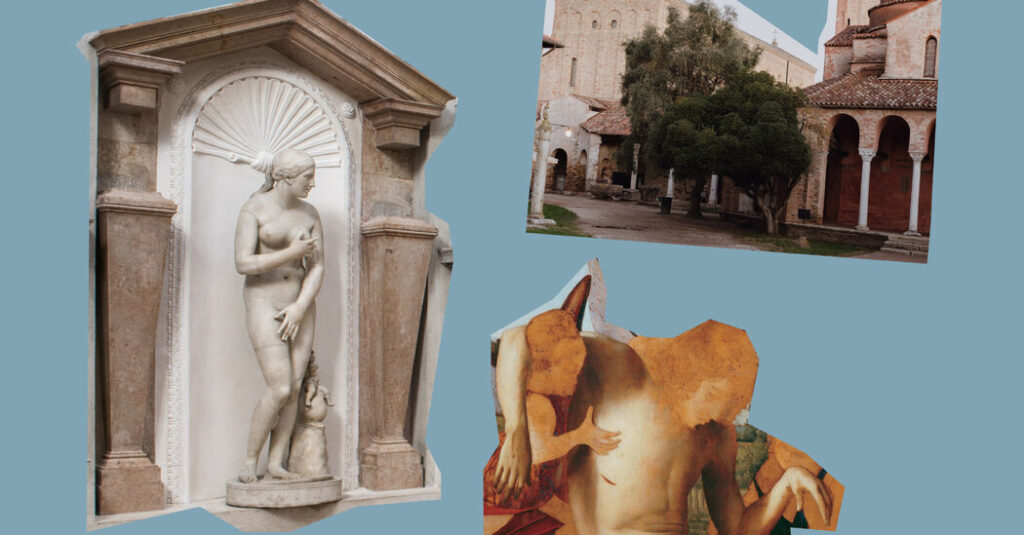
Venice has struck visitors for centuries as otherworldly, a city of memory floating in a lagoon — but also decadent, feverish, and at constant risk of submersion. “Half fairy tale, half tourist trap,” Thomas Mann called this place in “Death in Venice,” and his double diagnosis has only grown more acute in the Instagram-and-easyJet age. Every time I wash up here, I go through the same cycle: first the thrill of seeing the light shimmering on the water, then exasperation from the overtourism (as if I’m not part of the problem…), and, finally, once I settle into its rhythms and rediscover its paintings and palazzi, a renewed awe. Take it slowly, look past the selfie sticks, and Venice is still sublime.
Find these five and discover more art on our Google map of Venice.
1. A half-lost painting, more sacred for its scars
Titian, Tintoretto and Veronese form the holy trinity of the Venetian Renaissance, but the most heart-stopping painting in this city was done by a Sicilian. In a quiet corner of the Museo Correr you’ll find a tender depiction — not too large, suitable for private devotion — of the dead Christ comforted by three angels, clustered over an open tomb. Antonello da Messina, who painted this Pietà around 1476, was one of the first Italian artists to embrace the exciting new Flemish technology of oil paint, whose slow drying times allowed him to render the skin tones of Christ’s wounded body with then-unprecedented naturalism. Christ’s knees seem to come out of the picture into our world. The Strait of Messina glistens in the back, as if through an open window.
But one or more “restorers” blew it big time, and Antonello’s painting has been severely damaged. The faces of Jesus and the three angels are now almost entirely gone. The seraphs’ blanked-out legs slice open the Sicilian landscape. The miracle of Antonello’s Pietà, though, is how much authority it retains despite the damage — or maybe even gained from the injury. The mystery of the Triduum, the three days when Christ was both alive and dead, finds an echo in this abraded painting: lost but still here, and now, at the museum, resurrected.
This masterpiece of Renaissance painting can be found within a masterpiece of modern display. In the 1950s, the great Venetian architect Carlo Scarpa was tasked to redesign the Correr’s picture gallery, overlooking Piazza San Marco. He conceived of a simple easel, made of iron and wood by Venetian artisans (who are still working!), bringing the paintings off the wall and back into our face. Antonello’s vision of the tomb still hangs on one of these self-supporting frames, suspended between this world and the next.
Museo Correr, San Marco, 52.
2. A palace dense with gods, on the walls and in the air
At the height of its power in the early 1500s, the merchants and magistrates of the Venetian Republic built palaces and monuments that would rival Rome’s. One family, in particular, bought in bulk.
Palazzo Grimani, a grand pile of colored marble, was a showcase for a noble family with a mania for collecting antiquities, which it displayed in a purpose-built tribuna, or receiving room. The sculptures got scattered in subsequent centuries, but in 2019, Palazzo Grimani reopened the antiquities chamber with over 200 Greek and Roman statues. This was a temple of humanism, and it still staggers centuries on.
Here the gloomy Gothic decadence of Venice makes way to light-filled splendor, modeled after the Roman Pantheon. With so many sculptures it can feel like a staring contest: Apollo and Antinous face down Aphrodite and Dionysus. Goddesses nestle in scalloped niches, and river deities perch on the pediments. Look up at the ceiling, with its sunken coffers, its glazed skylight, and … who is that, flying through the air? It’s the beautiful young Ganymede, kidnapped by Zeus in the form of an eagle. I get dizzy when I look up at him, and not only from the optical illusion. His face, though missing a nose, retains a thrilling, disconcerting look of fear and delight.
Before the birth of the modern scientific museum, noble collections like the Grimani’s had their own conception of sophisticated display: intentionally dense, placing more importance on the total visual effect than individual objects. Almost 500 years later, the reconstruction of this room is its own achievement in archaeology — as well as just an eyeful of beauty.
Museo di Palazzo Grimani, Rugagiuffa, Castello, 4858.
3. A secret garden hiding behind one of Italy’s finest churches
There are nearly 140 churches in Venice, and you could make it your business to visit them all, but my one-and-done pick is happily never too crowded: the Church of the Most Holy Redeemer, better known as Il Redentore, standing proud on the island of Giudecca and facing Venice proper with a facade of blinding white.
This is a plague church — the word quarantine, you may know, comes from the Venetian practice of ordering 40 days’ isolation on visiting sailors — built in the grateful aftermath of a lethal pandemic in the 1570s. Andrea Palladio, the golden child of Veneto architecture, devised a groundbreaking design with a grand staircase and overlapping pediments, plus a dome that looms above the island. Every July since it opened, Venetians build a pontoon bridge across the basin, linking Redentore with the rest of the city in gratitude for the plague’s end.
So far, so serenissima. But what I want you to discover is behind Palladio’s gleaming facade: a secret garden, unseen for centuries by anyone who wasn’t a Capuchin friar. In 2024, following years of negotiations and renovations (not to mention a flood that salted the earth), the Redentore garden is now open to the public. Simple wooden pergolas — laid out in a cross, naturally — segment the garden, after the medieval fashion, into zones for flowers, herbs, fruit trees, and vegetables. An apiary, a lily pond, chapels of modest brick: These simple elements, in the midst of heaving Venice, frame a lagoon-side Eden.
Special enough to have this garden as a refuge; Redentore is in sight of the cruise ship terminal, after all. But I love it here because this garden is a civic and religious institution just as much as the church. You come here for an hour’s calm, but you leave feeling that an apricot tree has as much sanctity as an altarpiece.
Chiesa del Santissimo Redentore, Giudecca, 194.
4. An ancient mosaic, intact on a near-abandoned isle
The outer islands of Venice are numerous (nearly three dozen) and various, with functions ranging from glass manufacturing to mental asylum. The most evocative of them may be Torcello, in the north of the lagoon, which was the first of the islands in the marsh to be inhabited by landlubbers escaping barbarian invasions in the 5th century A.D.
Almost nobody lives here anymore. But on this spongy wetland is one of the most astonishing works of religious art in Italy: a boggling, action-packed mosaic that is a relic of Byzantine Venice. Spanning the rear wall of Santa Maria Assunta, the oldest church in the lagoon, this wall of gold depicts Christ three times over: first on the cross, then pulling Adam and Eve out of hell, and then presiding over the Last Judgment. A river of fire, cohering from thousands of red and white tiles, guides our eyes to the right of the door, a Hell where angels fan the flames. All the green tiles are on the left side of the door: a land of milk and honey, a paradise of glass. Choose your own ending!
In the 12th and 13th centuries, the artisans from Constantinople who laid down its uncountable tesserae had a pretty obvious iconographic mission: Let these parishioners know that your immortal soul was no trifling matter. But there are no parishioners any longer on Torcello, just day-trippers. The mosaic of the Last Judgment therefore has a stranger, more haunting tinge: Long before Doomsday, we may see a preview of the End in the midst of a holiday.
Basilica di Santa Maria Assunta, Torcello.
5. A contemporary architect’s reinvention of a shadowland
Venice, for 500 years, has been a city of the dead. Time seems to hang in the air; beauty can’t be untangled from decline. All of that becomes literal on San Michele, the island cemetery and final home of Ezra Pound, Igor Stravinsky, Sergei Diaghilev and so many other Venetian adoptees.
But if you hop the vaporetto to this little island, wrapped by brick walls and dotted with high cypresses, you’ll find a new chapter in the life and death of an old city. The firm of David Chipperfield, the Berlin-based British architect of restrained monumentality, has spent decades renovating and extending Venice’s eternal resting place. He first subdivided its repetitive rows of graves into elegant courtyards ringed with concrete colonnades, and then built an ossuary and other service elements on a new extension. The outer walls are of the same gray Istrian stone familiar from Venice’s churches, but inside, around the graves, are thin columns of concrete.
This is very quiet architecture, in a city that can be very loud. And yet, the restrained character of Chipperfield’s courtyards has restored the romance of San Michele, where for so long, visitors to Venice moped and marveled. On many visits to this city I’d pay San Michele no mind, chugging past its vaulted brick bulwarks on the way out to the airport. Chipperfield has remade the island of the dead as a place for the living.
San Michele Cemetery, Isola di San Michele.
More Art to Discover
Find all of these on our Google map of Venice.
-
Scuola Grande di San Rocco, Dorsoduro: the Sistine Chapel of Venice, or maybe its Hall of Mirrors. Tintoretto’s masterpiece, still curiously underappreciated, turns the sacred story into a furious labyrinth of piercing oranges and shining whites.
-
Olivetti Typewriter Showroom, San Marco: a splendid former storefront designed by Carlo Scarpa, hidden right on the city’s main piazza. A central staircase has irregular steps that seem to float in the air; the floor is embedded with chips of Venetian glass.
-
Scuola di San Giorgio degli Schiavoni, Castello: the usually quiet home of panel paintings by Vittore Carpaccio, including the sublime “Saint Augustine in His Study.” The theologian has his vision amid his books and astrolabes and a cute little dog.
-
Aula Mario Baratto, Dorsoduro: more Scarpa, a university lecture hall this time, with a view of the Grand Canal. Modern wooden struts frame arched Gothic windows; the desks and chairs make a show of careful wood joinery.
-
Wagner Museum, Cannaregio: the apartment where the composer died, hidden (very well hidden) inside what is now a casino. Not much is original — there’s a replica of the couch where he expired — but it’s a temple of decadence.
-
Municipal Garage, Piazzale Roma: Yes, really, I’m sending you to a parking garage, but this is one of the great works of modern Venetian architecture. Long ribbon windows and huge helical ramps became hallmarks of Rationalism; no wonder Mussolini came to inaugurate it.
-
Biblioteca Marciana, San Marco: one of the world’s oldest and grandest libraries, but with almost none of the crowds at the Doge’s Palace across the way. Tintoretto and Veronese painted some of the philosophers on the walls.
-
Auditorium “Lo Squero,” San Giorgio Maggiore: One of the world’s most graceful small concert halls, whose stage is backed by a glass wall giving onto the lagoon. Administered by the Giorgio Cini Foundation, which also puts on reliably smart art exhibitions.
The post My 5 Favorite Places for Art in Venice appeared first on New York Times.