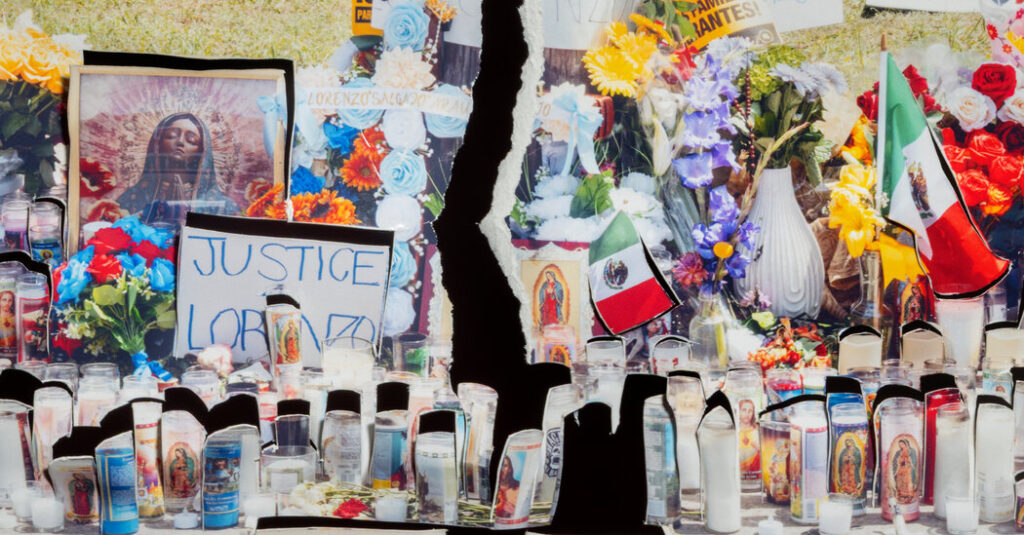
He was a construction worker, a husband and father of three. He had also been living in the United States as an undocumented immigrant for over 35 years. On the morning of Tuesday, July 7, Lorenzo Salgado Araujo was driving to work in Houston when he was stopped by federal agents during an ICE enforcement operation and shot in the abdomen. He died hours later at the hospital. Officials from the Department of Homeland Security claim that the agent who fired his weapon was acting in self-defense. But many in the Latino community sees it another way: “We are being hunted like dogs,” said one Latino resident of Houston.
As a Mexican American lawyer and policy expert who has spent my career trying to fix our immigration system, I view Mr. Araujo’s killing as a tragic failure. For decades, our country has refused to recognize and protect millions of people like him: undocumented immigrants with deep ties to this country who have waited decades for Congress to create a path to earn legal status as they work, pay taxes and support our economy.
Latinos in America are in a crisis. Less than a week after Mr. Araujo’s killing, a Colombian immigrant named Joan Sebastian Guerrero was also killed by a federal immigration agent. We are being racially profiled, wrongfully arrested, detained and separated from our families. Every Latino, from the undocumented to those with legal status to longtime U.S. citizens, is threatened by President Trump’s immigration enforcement machine. Many people, myself included, do not leave home without a passport.
But Mr. Trump was put into power with the help of the largest share of Latino voters for any Republican president. While the majority of Latino voters supported Kamala Harris in the 2024 election, 46 percent of Latino voters chose Donald Trump. Latinos shifted toward Republicans by more than 20 points in key states like Nevada and Michigan. The ICE operation that led to Mr. Araujo death was in Texas, where Mr. Trump won Latino voters by a 10-point margin.
How could those Latinos support Mr. Trump when he espoused such anti-immigrant views? That is the same frustrated question I heard again and again since the 2024 election. The question reveals just how deeply the political establishment misreads who Latinos are and what they want.
The vulnerability that Latinos are feeling right now creates an opportunity for Democrats to establish political momentum around what the community has been saying loud and clear: We want both a secure border and a legal pathway for the people who have built their lives in this country to become documented and safe.
Immigration, and how to enforce immigration law against undocumented immigrants, has always been a complicated issue within the Latino community. The internal division traces back to the farm workers movement, when the issue of the undocumented fractured Latinos who were organizing for their rights.
The recent allegations about the leader of that movement, Cesar Chavez, have been devastating to our community, particularly in this moment when we feel so under attack. For those of us who entered this work in their legacy, it’s been horrific to learn that another Chicano rights hero, Dolores Huerta, has also accused Mr. Chavez of sexual assault. But while we reckon with his actions, I’ve been lingering on a particular strategy that Mr. Chavez and some of his peers put into motion with consequences that still ripple today: His argument that Latinos would grow their political power in America by turning our backs on the undocumented.
At the height of his organizing work, Mr. Chavez didn’t merely take a hard-line position on immigration — he worked to exclude undocumented and newly arrived workers from the labor movement, because they were often used as scab labor against unions. In the 1970s, he launched what became known as “the Illegals Campaign,” encouraging union members to block Mexican immigrants from crossing the border. Those who disagreed with Mr. Chavez saw that the government did not distinguish between Latino citizens and those without documents when it raided farms, and began to organize with these workers instead.
Mr. Chavez was right that California growers recruited Mexican laborers to replace striking farmworkers, weakening the United Farm Workers’ leverage at the bargaining table. But he misidentified the threat. The problem was not undocumented workers, but an agricultural system that depended on keeping workers vulnerable, and an immigration system that kept them deportable and outside the protections of labor law.
Some of the early leaders advocating for Latino rights made the assumption that excluding the undocumented from the Latino civil rights movement, and pushing for immigration enforcement, would eventually be rewarded by security and belonging in this country. Growing up in a household shaped by the Chicano rights movement, I often heard this sentiment: that we could never be truly American so long as the number of undocumented Latinos in America kept growing.
For Latinos who have lived here for decades, sometimes generations, our experiences are not the same as new arrivals. It’s why immigration has remained so fraught in the Latino community, and has colored decades worth of political decision-making. It’s part of the reason many Latinos believed that when Mr. Trump promised mass deportations, he was not referring to them.
The full picture of the Latino community is lost on many in the Democratic Party. Latinos prioritize the economy and health care over immigration, yet the party has too often reduced a racially, ethnically, linguistically and regionally diverse people to this single cause: immigration. Worse still, they have misunderstood Latino attitudes on immigration altogether, wrongly assuming they want lax enforcement policies because they want to legalize the undocumented.
There are an estimated 14 million undocumented immigrants living in the United States. Some 10 million of them are Latino, including many who are parents of U.S. citizen children. Polling and research show that Latino voters reject policies that are overly punitive to people who have been working and living peacefully in their communities for years. But when it comes to the border, Latinos, like many Americans, are supportive of policies that deter unauthorized migration and the deportation of those who have committed violent crimes.
In several presidential elections, we have seen Latino voters in both parties support candidates who pledge to strengthen border control and legalize undocumented immigrants. Yet, over the last decade, Democrats have gotten this wrong. This mistake was most apparent during President Joseph Biden’s administration, and we are still feeling the consequences of those decisions today.
I’ve watched firsthand how efforts to legalize the longtime undocumented went from the centerpiece of the Democratic agenda during the Obama years to falling by the wayside during the Biden administration. I was part of the Biden transition team and then joined the White House National Security Council, and saw how little political capital the administration put into trying to accomplish immigration reform. The President’s U.S. Citizenship Act, which would have legalized millions of undocumented people, was left languishing.
The Biden administration also misjudged the border. Even before the border crisis began, Latino policy advisers and elected officials were ringing the alarm. After almost three years of migrants overwhelming border communities, Latino officials still weren’t getting the resources they needed. Rolando Salinas Jr., the Democratic mayor of the Latino-majority border city Eagle Pass, Texas, declared a state of emergency in September 2023 after more than 5,000 migrants crossed the border in just days. At the time, he said that he had heard nothing from the White House: “Nobody has bothered to call me, anyone in the city staff, saying: ‘Hey, this is the federal government. We know what you are going through, this is our plan of action.’ Nothing. We’re here, abandoned. We’re on the border. We’re asking for help. This is unacceptable.”
While the Biden administration struggled to manage the massive influx of migrants at the border who ended up in cities like New York and Chicago, it made policy choices that deepened tensions within Latino communities. Newly arrived migrants received work authorization, and in some cities, emergency housing and legal aid, while many working-class Latinos faced rising housing costs and economic hardship.
This reinforced the perception that the administration was willing to find solutions for new immigrants, while ignoring undocumented Latinos already living in the United States. But even then, when Mr. Biden returned to Congress in the fall of 2023 to negotiate a border security deal, the White House did not include protections for the undocumented.
Legalization became a promise brought out only during election cycles. “The prevailing political calculus has always been to court Latino voters ahead of November, only to lock campaign promises away in a drawer come January,” said Vivian Graubard, a former senior adviser in the Obama and Biden administrations. Latino voters have noticed. In a March 2026 poll, a majority of Latino voters said Democrats tend to break their promises on immigration.
The broken promises and brewing resentments helped Mr. Trump secure an unprecedented number of votes from Latinos. They saw Mr. Trump as someone who could boost the economy, stop the crisis at the border and prioritize them over new arrivals. And, once again, a familiar wedge was being used to divide the Latino community. Voters made the same assumption that Mr. Chavez did decades ago: that a secure border and cracking down on unchecked migration would improve their lives.
Mr. Trump’s second term has revealed the consequences of leaving millions of undocumented Latinos unprotected. The effects of aggressive enforcement are rippling through communities from Maine to Houston. Families are skipping doctor’s appointments, children are missing school and workers are afraid to show up for their jobs. Fear has spread far beyond undocumented households, touching citizens, legal residents and mixed-status families alike.
The Pew Research Center found that one in five Latinos knows someone who has been deported or detained, and 43 percent of Latinos fear being asked to prove their citizenship during routine daily activities.
The president’s policies on immigration and the economy have already begun to reshape the political landscape. In November 2025, Latinos swung toward Democrats in New Jersey and Virginia. A month later, voters in Miami — a stronghold of Latino support for Mr. Trump — elected Eileen Higgins as the city’s first Democratic mayor in nearly three decades. Caitlin Jury, a researcher at Equis, a polling and research group focused on Latinos, said many Latinos who voted for immigration enforcement felt betrayed by witnessing immigration enforcement agents target hard-working immigrants and families instead of just criminals, all while Mr. Trump did nothing to lower the cost of living.
But as Lorella Praeli, the co-president of Community Change, a nonprofit that works on building working-class and multiracial political coalitions, told me: “Democrats should be careful not to confuse Trump’s failures with their own success.”
After all, the voting pendulum has swung before: Latino voters moved toward Democrats in the 2018 midterms after Mr. Trump separated thousands of families at the border, only to swing back toward Republicans in 2020 and 2024. And even as enforcement in the interior of America horrifies them, many Latinos approve of Mr. Trump’s handling of border security, and are relieved that the chaos of Mr. Biden’s approach is over.
But Ms. Praeli sees a way for Democrats to cement the shift this time: “The opportunity before Democrats is to put legalization back at the center of their agenda — not just as a promise on the campaign trail, but as a governing priority in office.”
Democrats seem to be squandering the opportunity, even as Latinos are facing violence in their communities at the hands of federal agents. Starting in Los Angeles, then Chicago, Minneapolis, and beyond, ICE’s overreach into Latino communities often came with violent interactions, shootings and even deaths, both in custody and during arrests. Silverio Villegas González, an undocumented father and cook originally from Mexico, was killed by ICE agents during a vehicle stop near Chicago. Marimar Martinez, a 30-year-old U.S. citizen, was shot five times by a Border Patrol agent and later prosecuted on charges of assaulting, resisting or impeding federal officers (she pleaded not guilty and the case against her has been dismissed).
Yet it wasn’t until the killings of Alex Pretti and Renee Good that the Democratic Party finally moved to show a unified front against Mr. Trump’s enforcement tactics, withholding funding for the Department of Homeland Security for a historic 76 days. That it was the lives of white protesters that seemed to matter was not lost on many Latinos.
Democrats have been working from a broken playbook: they treat border security and legalization as competing political choices. Claire Trickler-McNulty, a former assistant director of the Office of Immigration Program Evaluation at ICE, told me, “Enforcement and legalization are not opposites; they are prerequisites for each other.” Now, they have a chance to take the opening that Mr. Trump’s enforcement overreach has created and offer a new vision of the immigration system.
There are glimmers of hope that Democrats can get it right. In Texas, where the Democrat James Talarico is running for Senate, he appears to be making gains within the Latino community on the issue of immigration. He is advocating both a secure border and more pathways to legalization for undocumented immigrants who are longtime residents to earn residency and citizenship. “Our border should be like a front porch — it should have a welcome mat out front and a lock on the door,” reads one of his campaign slogans.
That message seems to be resonating. In a survey of Hispanic business owners in Texas, 20 percent reported losing an employee to deportation this year; according to the same survey, Mr. Talarico leads among these business owners by 7 percent. One day after he condemned the death of Mr. Araujo in Houston, he launched his plan to secure the border. It’s clear he is listening to Latinos who don’t see the two policies as contradictory.
Mr. Araujo was a man with only a civil immigration violation, who worked for over three decades, paid taxes and raised three U.S. citizen children, and was killed by federal agents seeking to meet arbitrary arrest targets. He had been undocumented for 35 years, with no clear path to legal status, just like millions of others who are still waiting. After this summer’s Supreme Court decisions, another 1.3 million immigrants with temporary status could join their ranks. Every undocumented Latino left to languish in legal uncertainty puts a target on our entire community. As long as the promise of legalization remains unfulfilled, all Latinos are at risk of what happened to Mr. Araujo.
If Democrats want to offer a real alternative to mass deportation, and win back voters who don’t believe the party will fight for them, they should start by making sure no one spends another thirty years waiting for the opportunity Lorenzo Salgado Araujo never had.
Source photograph by Brandon Bell/Getty Images.
Andrea Flores, a lawyer, has advised on immigration policy in Congress, the Department of Homeland Security, and for both the Obama and Biden administrations.
The Times is committed to publishing a diversity of letters to the editor. We’d like to hear what you think about this or any of our articles. Here are some tips. And here’s our email: [email protected].
Follow the New York Times Opinion section on Facebook, Instagram, TikTok, Bluesky, WhatsApp and Threads.
The post Latino Americans Are in Shock. Can Democrats Finally Do Something? appeared first on New York Times.