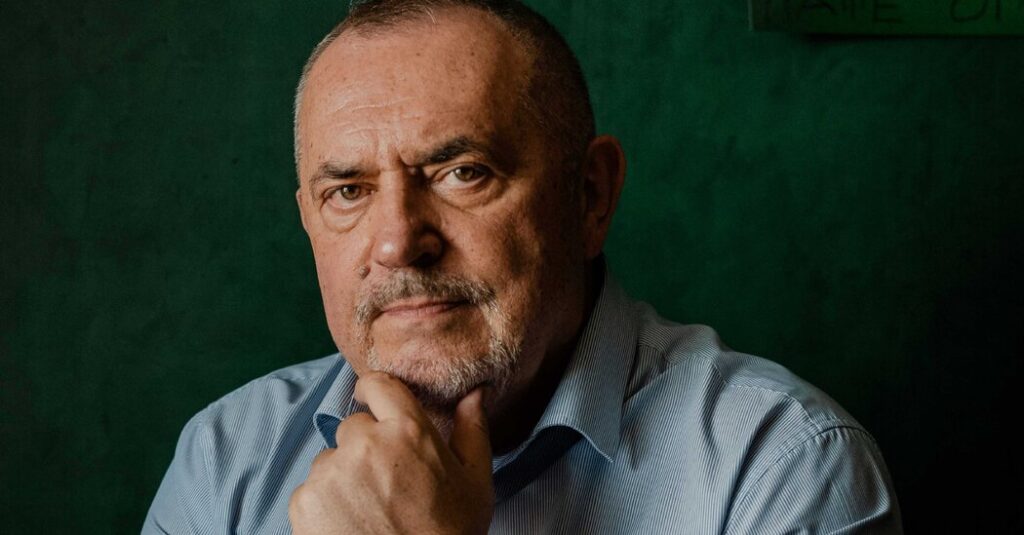
When the masked men came banging on his door in a Moscow suburb this week, it seemed like overkill to Boris B. Nadezhdin.
He had already been designated days before as a “foreign agent,” ending his decades-long run as a political survivor in a Russian system that jails, kills or drives into exile most of its opponents.
Now Mr. Nadezhdin, an outspoken opponent of the war in Ukraine, was being detained, albeit briefly, and charged with a minor offense less than three weeks after registering to run in September’s parliamentary elections, the first since Russia’s full-scale invasion in 2022.
Mr. Nadezhdin said it was clear why it had happened. “This shows that among our leadership, there is panic and chaos,” he said in a video interview from his home on Tuesday.
The Kremlin spokesman Dmitri S. Peskov said of Mr. Nadezhdin’s troubles, “None of this has anything to do with the Kremlin.”
But Mr. Nadezhdin said the move against him reflects the pressures confronting the government, all related to the war. Drone strikes have caused a fuel crisis and brought the war home to cities like Moscow and St. Petersburg. Inflation is soaring as war spending strains the economy. Anger over internet restrictions has spread far and wide.
Attempting to silence Mr. Nadezhdin, 63, indicates that the Russian government is leaving little to chance in an election that, while heavily stage-managed, could still reveal hints of public discontent. He had been one of the rare sources of criticism that persisted through years of deepening repression, but the Kremlin’s tolerance for them is quickly vanishing.
Until recently, Mr. Nadezhdin, who has ties to some of President Vladimir V. Putin’s top lieutenants, including the spin doctor Sergei V. Kiriyenko, had been able to openly voice his calls for democratic reforms and an end to the war.
Mr. Nadezhdin first held government posts in the 1990s. He made a long-shot bid for the presidency in 2024, with thousands of people standing in line to support his candidacy. The Central Election Commission later said that he had not gathered enough signatures to get on the ballot. But he remained at liberty.
“I know very well that I am alive and free only because I do not cross two red lines,” he said in an interview in Moscow earlier this summer. He never makes personal attacks against Mr. Putin, though he criticizes the president’s policies, he said, and he never receives financial support from abroad.
In the video interview this week, Mr. Nadezhdin said he had always understood that his chances of keeping alive his latest candidacy, for a seat in Parliament, until Election Day were slim. But he said he wanted to use his campaign platform “to bring the truth to the people and draw attention to the situation in the country.”
That platform is gone. Last Friday, Mr. Nadezhdin was named by the government as a “foreign agent,” a designation intended to punish critics of the Russian political system. With it comes a ban on political, media and educational activities, onerous financial reporting requirements and the stigma of being labeled a puppet of a foreign power.
On the same day, Candidates’ HQ, a network of grass-roots activists dedicated to helping independent candidates run election campaigns, was named a foreign agent, too, for “spreading false information about Russian authorities’ decisions.” Dmitri T. Kisiev, the founder of Candidates’ HQ, was the chief of staff for Mr. Nadezhdin’s abortive 2024 presidential campaign.
Because he had already registered his candidacy, Mr. Nadezhdin would have been able to continue his campaign as a foreign agent, but if he had won, he would not have been able to take office. More immediately, the label banned Mr. Nadezhdin from teaching, after 20 years as head of the law department at his alma mater, the prestigious Moscow Institute for Physics and Technology.
The Russian authorities did not stop there. On Monday, the masked men sent by the state took him to court near his home in Dolgoprudny, a northern suburb of Moscow, where he was accused of “displaying extremist symbols.”
Mr. Nadezhdin’s alleged offense was that on his Telegram channel, he had cited a 2023 video on the YouTube channel of another opposition activist. That video, in its 48th minute, flashed the “extremist symbol” in question, an image of Alexei A. Navalny, the late opposition leader.
The authorities have designated Mr. Navalny’s network as “terrorist” and “extremist.” He died in an Arctic penal colony in 2024. He and Western governments said that he had been poisoned by Russian agents.
Mr. Nadezhdin said the effort to dig up something to accuse him of showed that the authorities were aware of the high levels of discontent among ordinary Russians.
“They are getting into people’s pockets, beds and phones,” he said, referring to the worsening economic conditions, anti-L.B.G.T.Q. measures and policies seeking to reverse population decline, and mobile internet blackouts and restrictions on foreign apps.
The pressure on Mr. Nadezhdin is part of a wider crackdown on opposition-minded politicians, even those who had no chance of making it into the lower house of Parliament, known as the Duma.
“This machine can go only forward suppressing everything around, and it is reckless and cruel,” said Andrei V. Kolesnikov, a Moscow-based journalist. “They also can’t allow the appearance of new political leaders of any kind in opposition.”
Yabloko, the only officially registered party that has called openly for an end to the fighting in Ukraine, has had several prominent members barred from the ballot on pretexts like the one used against Mr. Nadezhdin.
The party has not held any seats in the federal Parliament since 2003 but maintains a presence in some regional legislatures. It has now lost its strongest candidates for both federal and regional offices, said Igor Yakovlev, the party’s spokesman.
“Some of them have been winning seats for decades,” Mr. Yakovlev said in a phone interview from Moscow. “They are very well-known politicians in their regions, people vote for them.”
Russian elections offer only a veneer of democracy. But Mr. Yakovlev said that having opposition politicians on the ballot was important, even if the government fudged the results and the true count was not revealed to the public, because the Kremlin could gain some insight into voter sentiment and perhaps change policies.
“We hope that this will somehow influence foreign policy,” he said, referring indirectly to the war, “and we hope that this will save lives of people who would die if all this continues.”
Mr. Yakovlev said his party’s leadership had been open about its inability to protect candidates from persecution but still had no problem finding people who wanted to represent it in the election.
Opposition campaigns mobilize voters who would otherwise stay passive, with no allegiance to any party, said Aleksandr Kynev, a Moscow-based political analyst. Government pressure on opposition politicians is meant to prevent such voter mobilization, he said, and to instill fear in would-be candidates.
“No one wants to be named a foreign agent, have their business taken away tomorrow, et cetera,” he said. “This cruelty toward Yabloko and toward Nadezhdin is demonstrative.”
Russia’s Communist Party is considered part of the “systemic opposition,” meaning that it votes with the ruling United Russia on matters important to the Kremlin but differs on other issues.
But it, too, has been subjected to pressure. This month, a court in St. Petersburg sentenced Ivan Apostolevsky, a party member of the regional legislature, to 10 days’ detention, ending his plans to run for a seat in the federal Parliament.
He faced a familiar charge: displaying extremist symbols. In his case, the accusation related to reposting, in 2018, social media posts that included the logos of Facebook and Instagram. Their parent company, Meta, was labeled “extremist” by the government in 2022.
A court hearing on Mr. Nadezhdin’s charge of displaying extremist symbols is set for Friday morning. Such charges are punishable by up to 15 days in jail for a first offense, and up to four years in prison for a repeat one.
In the video interview three days earlier, he said he was considering exile for the first time. On Thursday morning, he was notified that he was forbidden to leave the country.
The post A Russian Political Battle Ends With a Visit From Masked Men appeared first on New York Times.