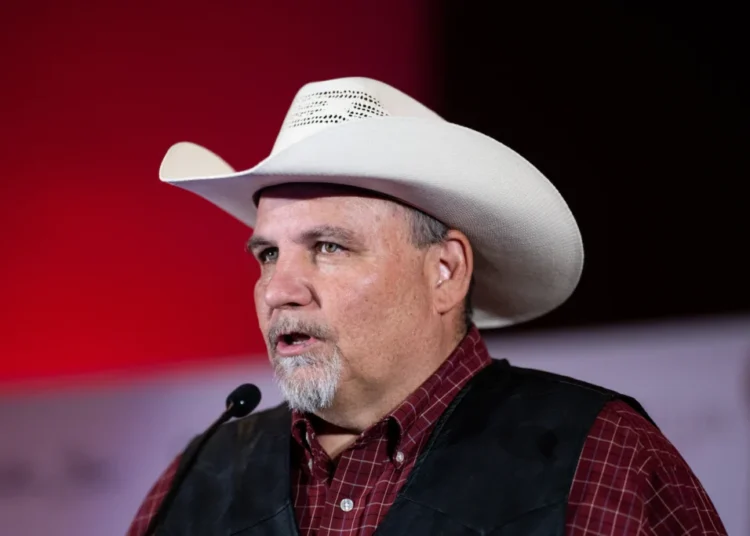
Nations don’t always get to pick their heroes, especially not in a time of war. Most Ukrainians, given the choice, would probably not want a character like Denys Shtilerman to be the architect of their revenge against Russia. He studied in Russia, became wealthy in Russia, worked for a Russian military institute, and served two stints in Russian jails. Some of his close associates are wanted in Ukraine for corruption. Yet Shtilerman, a prolific designer of weapons, has earned admiration across Europe for his role in Ukraine’s defense.
His company, Fire Point, produces the bulk of the long-range drones that Ukraine has used to bring the war to Russian soil. Scores of them roll off the company’s production lines each day to be launched into Russia by night. Its missiles reach as far as Siberia, more than 1,000 miles away. The campaign of strikes, mostly targeting oil refineries and other energy infrastructure, has humiliated the Kremlin, snarled the logistics of its military, and forced many millions of Russians to suffer through rampant shortages of fuel.
For the first time in years, Ukraine appears to have Russia on the ropes, and no supplier of weapons, foreign or domestic, is doing more than Shtilerman to keep it there. His ambitions go far beyond Ukraine. In several interviews this year in Kyiv, he told me about his plans to change the global balance of power by developing cheap and effective missile technology. Above all, he wants to help Europe build its own missile-defense shield without relying on the United States. “What’s horrible is that America, even before Trump, was a completely unreliable partner and ally,” Shtilerman said this winter during a tour of his missile factory near Kyiv. “We want to be independent of all suppliers, especially the Americans.”
At a gathering on Monday in Paris, the leaders of nine European countries formalized their plans to build such a system alongside Ukraine: Denmark, France, Germany, Italy, the Netherlands, Norway, Spain, Sweden, and the United Kingdom, all members of the NATO alliance. In announcing what they called their Integrated Anti-Ballistic Missile Coalition, these nations said in a joint statement: “We acknowledge the unique experience of Ukraine, gained in defence against Russia’s war of aggression.” Ukraine, they said, would be a founding partner in the missile shield.
Shtilerman has spent more than a year laying the ground for this system; he prefers to use its code name, Project Freyja, after the Norse goddess of beauty, love, death, and war. In February, he showed me the missile, known as the FP-7x, developed to serve as the basis for Freyja. “This is what the very autonomy we’ve been talking about for years looks like,” Shtilerman wrote in response to Monday’s announcement in Paris. “It’s not America that decides whether Europe can defend itself. Europe is building its own shield.”
The project illustrates how Europe has reacted to President Trump’s threats against NATO, such as his desire to seize Greenland and annex Canada. Denmark, which has faced the most aggressive rhetoric from Trump of any NATO member, has also been the most intent on working with Ukraine and, in particular, with Fire Point. But it’s not alone. By developing their own arms industries and forming new defensive coalitions, many European states have sought to ease their reliance on the U.S. for their security. The shift has made Ukraine a valued partner.
[Read: ‘We are learning to bully back’]
It has also marked a dramatic reversal of fortunes for Shtilerman. Earlier this year, his company got mixed up in one of the worst corruption scandals in Ukraine’s recent history. Shtilerman has not been accused of breaking the law, but anti-corruption investigators are reviewing some of his contracts with the military. Amid the scrutiny, Shtilerman has continued signing production deals and joint ventures with European defense firms, which seem undeterred by all of the controversies.
Some of the points on Shtilerman’s resume, in particular his ties to Russia, would be enough to tank the career of another Ukrainian businessman. He told me, for example, that he worked in the early 2000s for the Moscow defense institute that produces Vladimir Putin’s “little nuclear suitcase,” which the Russian president would use in a crisis to authorize the use of nuclear weapons. When I asked Shtilerman why he would share this information with a journalist, he shrugged and said that, given his role in the missile industry, all of his secrets would come out eventually. It would be better, he said, for the public to get the dirt from him and not from Russian leaks and character assassins.
In that sense, his disclosures could give him some immunity from further scandals. But he also seems to believe that his success has made him indispensable, not only to Ukraine but also to the rest of Europe. “We have a chance right now, working together, to gain our independence from America and burn down the Russian empire,” he said. “We’re not going to miss it just because of all the crap people say about me.”
The last time we met, on a humid night at the end of May, Shtilerman had just returned to Kyiv from testing the guidance system of his Wunderwaffe, the FP-7x. A group of engineers from Fire Point had loaded the rocket into a long-haul truck and driven it down to the Black Sea coast that morning. Shtilerman had followed in a chauffeured van. In the evening, he sent me a video of the missile taking off from a dirt road surrounded by farmland, its engine leaving a trail of white smoke in the sky.
The test failed, he later told me, because Fire Point had neglected to control the work of its contractors. “Now we’re imposing those controls, and we’re installing cameras to watch what they do.” He did not seem all that disappointed. After the launch, he took off his T-shirt and went for a swim in the Black Sea before making the drive back to Kyiv. We met up that night for a walk in a city park, with Shtilerman’s bodyguards following along.
Calls to assassinate him have appeared on Russian state TV in recent months. “I sleep each night in a different place,” he said. It was close to midnight, and he claimed not to know where he would crash once we finished talking. “Wherever they take me,” he said, glancing around at the security detail, “that’s where I’ll go.”
None of the guards looked more intimidating than their charge. Tall and muscular, Shtilerman carries himself with a kind of impatient menace that makes his employees go stiff around him. Once, when I noted that his biceps must require a lot of time at the gym, he answered without hesitation: “People with a high IQ find that most things come easy. You get used to achieving your goals in no time. Exercise is the antidote. It teaches you that not everything can be achieved in a second.”
His achievements in the field of rocket science have come astonishingly fast. Fire Point emerged after the Russian invasion in 2022, when the company set out to design Ukraine’s most effective long-range attack drones. According to Shtilerman, it now churns out roughly 200 a day. Each one carries enough explosives to blast through a wall of reinforced concrete and, when launched from Ukraine, can hit any point in Moscow or St. Petersburg.
Last summer, Fire Point unveiled its first cruise missile, the Flamingo, and now produces up to three of them a day. Fired from the back of a truck, the weapon reaches roughly twice as far as its American counterpart, the Tomahawk, and carries a much larger payload. It also costs about half as much to produce, in part because Flamingos use jet engines repurposed from old Soviet airplanes. The design choice makes the missiles look strange, their rear end bulging. But Shtilerman doesn’t care about aesthetics. He uses the cheapest components available.
At one of his factories, he showed me a stack of fuselages for his drones, pointing out that the wings were filled with what looked like Styrofoam. “They aren’t made to last,” he said. “They need to fly for 15 hours. Anything beyond that is a waste of money.” In another part of the facility, the screams of industrial machinery made talking difficult, and the fumes from hot epoxy filled the air. Most missiles, like the Tomahawk, are made of aluminum alloys and other metals. Here a team of engineers used strands of carbon fiber to form the body of a rocket, which looked like a mummy being wrapped in ribbons of plastic.
[Read: The Atlantic’s interview with Volodymyr Zelensky]
Various branches of Ukraine’s armed forces have launched thousands of Fire Point drones and dozens of its missiles. After several of the most dramatic strikes—against Russian oil refineries, military airfields, weapons factories—President Volodymyr Zelensky thanked the company and its engineers. But in some cases, Shtilerman told me, the military has kept quiet about the source of its missiles, not wanting to associate itself with him or his company. Following one strike in February, he said, “We had to convince them to announce that it was Fire Point.”
A lot of the controversy surrounding Shtilerman comes down to a question of fairness: Did he achieve success through hard work and ingenuity, or did he use his connections to gain an edge? Shtilerman admitted to me that a mix of these factors had allowed his company to pull ahead.
[Read: Building tanks while Ukrainians master drones]
By Shtilerman’s account, Fire Point got off the ground with a few million dollars of his own fortune, which he earned in Russia, mostly through real-estate deals. In 2023, during the second year of the war, he bankrolled the creation of his first long-range drone. The weapon, known as the FP-1, gained attention the following spring, when it earned top marks in a competition for drone makers. Various suitors then offered to buy the company from Shtilerman, he said, including some of the country’s wealthiest businessmen. Among them was Tymur Mindich.
Mindich, an old friend of Zelensky’s, is now a wanted fugitive in Ukraine, hiding out in Israel to escape arrest on charges of large-scale corruption. His ties with the president go back decades. During Zelensky’s early career in show business, Mindich co-owned the production company that made the future president’s movies and TV shows. They remained close after Zelensky took office, in 2019, and they stayed in touch after the Russian invasion.
Shtilerman knew about their relationship; it had been widely reported in the media. In the spring of 2024, when Mindich sought to invest in Fire Point, Shtilerman asked him for a political favor. He told me that he needed the state to grant him access to blueprints for Soviet-era missile technology, which was stored in classified archives in Ukraine. “I didn’t care how this got done,” he told me. “I just needed to get it done.” (Mindich’s lawyers in Israel did not respond to emails seeking comment.)
According to Shtilerman, Mindich used his political connections to pry open those archives in 2024, making them available to a group of Ukrainian companies, Fire Point among them. The files included instructions for how to make the S-300 missile system, a centerpiece of Russia’s air defenses inherited from the Soviet Union. Those blueprints proved useful to Fire Point in learning how to clone Russia’s more advanced missile system, the S-400, which formed the basis for the FP-7x.
By the end of 2024, Shtilerman said he agreed to sell half of his company to Mindich for $100 million, at a discount of 20 percent to its estimated value at the time. Before they could finalize the sale, Shtilerman told me, a foreign bidder appeared with a more enticing offer. Edge Group, a defense conglomerate from the United Arab Emirates, wanted to buy a third of the company for $780 million. Shtilerman maintains that neither sale went through.
While the talks were under way last year, Mindich was under investigation for serious crimes. The National Anti-Corruption Bureau of Ukraine, a law-enforcement agency known as NABU, had bugged Mindich’s apartment in Kyiv, and detectives picked up his conversations about Fire Point. In one intercepted call that was later leaked to the press, Mindich had told the defense minister about the proposed sale of a large stake in the company. Their conversation did not identify the buyer. But Mindich talked about Fire Point as though he already controlled it and stood to profit from its sale.
Not long after that conversation, police raided Mindich’s apartment. NABU accused him of masterminding a scheme to extort millions of dollars from companies in the electricity sector. The case had nothing to do with Fire Point, but anyone associated with Mindich suddenly came under suspicion. Hours before detectives came to arrest him, on the morning of November 10, Mindich fled the country. Ukrainian journalists later tracked him down in Israel. In an interview with Ukrainska Pravda filmed on a beach in Tel Aviv, he denied all of the charges against him, and he insisted that he never owned a stake in Fire Point.
When I asked Shtilerman about this, he stuck to the same story. Nearly all of the company’s shares—97.5 percent, according to corporate records—belong to Shtilerman. But the leaked recording of Mindich’s phone call created widespread suspicions in Ukraine that he secretly owns the company, and that Shtilerman is just a front.
Despite all of the damage that Mindich’s case has done to Fire Point’s reputation, Shtilerman holds no grudge against him. “I can’t say anything bad about Mindich,” he said. “First off, he loves his mom. He’s very charming. He helped us out, all the way to hell and back, without asking anything in return. He helped Fire Point.”
Since the end of last year, Shtilerman has faced the corruption scandal head on, addressing it on numerous podcasts and TV interviews. His strategy appears to be a kind of radical transparency, revealing details about his past in Russia that other businessmen might go to great lengths to hide.
His first stint in a Moscow jail, Shtilerman told me, resulted from his involvement in one of Russia’s most notorious financial schemes. After the fall of the Soviet Union, the state privatized many of its enterprises by handing out shares to the people who worked in them. Many of these workers sold their shares for pennies to a class of savvy entrepreneurs, who thus gained ownership of entire industries on the cheap. The deals defined one of the ugliest chapters of Russia’s transition to capitalism in the 1990s. The newly minted millionaires fought one another for control of the privatized assets. Many of these battles played out in fits of gangland violence. Some businessmen used corrupt cops and judges as weapons in their corporate wars.
Shtilerman, then living in Moscow under the name Denis Danilov, had earned a small fortune in the software business, and he told me that he had used it to buy up millions of dollars’ worth of shares in a privatized oil company. In 1999, he said, a rival oligarch tried to steal those shares from him. When Shtilerman refused to hand them over, he was arrested and spent the next two years in Butyrka, a crowded pretrial detention facility near the center of Moscow. “I’ve spent so much time in smoke-filled cells that cigarettes don’t bother me anymore,” he said about this period in his life.
Upon his release, his main asset in the job market seemed to be his diploma from one of Russia’s elite technical universities. It helped him find work at a defense institute in Moscow that, according to Shtilerman, develops computer systems and communications gear for the Russian military, including Putin’s nuclear briefcase. He worked at the institute until 2008, when he resigned in protest over the Russian invasion of Georgia, he said. For about a decade afterward, he invested in real-estate deals in Moscow, amassing about 12,000 hectares of land in its suburbs and another “few thousand hectares” in the city itself, he said. That amount of property would likely be worth billions of dollars.
One of these deals, involving the purchase of land from a bankrupt chicken farm, got Shtilerman locked up again in 2018, according to Russian court documents that he shared with me. He remained behind bars for about six months before the authorities agreed to release him without charge. The following year, he moved to Ukraine, the country of his birth, and started using the name Shtilerman. (The change, he told me, reversed a decision made by his father, who tried to protect the family from anti-Semitism in the Soviet Union by using a Russian-sounding surname, Danilov, rather than their Jewish name.)
Once settled in Kyiv, “I didn’t get involved in business,” Shtilerman said. “So that I would not have to pay bribes and deal with our local beau monde.” He said that his ex-wife and their two children remained in Moscow while he focused on passion projects and philanthropy in Ukraine. In 2021, he worked with a young architect named Iryna Terekh on a plan to develop and beautify public spaces in Kyiv. When the Russian invasion started the following year, the two of them became co-founders of Fire Point, and Terekh served first as the company’s chief technology officer and later became its CEO.
Shtilerman ran the operation from behind the scenes. To protect his ex-wife and children in Russia, he said, he hid his ownership during the first three years of the company’s existence. Journalists dug up his links to Fire Point only last summer. The Kyiv Independent reported in August that anti-corruption investigators in Ukraine were looking into whether Mindich owned the company, and it identified Shtilerman as an early investor in Fire Point.
[Read: What’s eating ‘Putin’s brain’?]
The report forced him out of the shadows. After its publication, he rushed to evacuate his family from Moscow. Shtilerman feared that his ex-wife would be arrested and their kids placed in an orphanage if the Russian authorities discovered their ties to one of Ukraine’s top arms manufacturers. “I moved them elsewhere,” he said. “Bought them a house.”
Based on the offer from the United Arab Emirates, the value of Fire Point could be well over $2 billion. But Shtilerman declined to sell the stake, he told me, in part because of Project Freyja: He wagered that his collaboration with the Europeans could soon make his company even more valuable. No other arms manufacturer in Ukraine, let alone a start-up, has had nearly the same success. Some of Fire Point’s competitors in the defense sector have complained that through his political connections, Shtilerman had an unfair advantage.
“The stratospheric growth of Fire Point has two key reasons: the lobbying of senior officials who generously stuffed money into an unknown start-up, and the blatantly high prices that gave the company’s owners exorbitant profits,” Yuri Kasyanov, the developer of a rival drone, wrote in column published in May.
Shtilerman dismisses such attacks as bellyaching. His most basic long-range drone, the FP-1, costs the military about $55,000, within the same price range as its Russian counterpart. In a letter to Fire Point in May, NABU said the company’s owners are not suspects in any of the agency’s investigations. But, as part of a broader probe of defense contracts, the pricing of some of its drones remains under review, according to the letter.
Even amid the scrutiny, the Defense Ministry continues to do business with Fire Point. So do Ukraine’s European allies. In March, the Danish government partnered with Fire Point on the construction of a factory to make fuel for its missiles. To clear the way for another collaboration with the company last year, Denmark reportedly bypassed more than 20 of its own laws and regulations. Hensoldt, a major defense firm in Germany, announced a project with Fire Point last month to develop the antiballistic-missile system. On Monday, France agreed to license Ukraine to produce French-designed cruise missiles and air-defense interceptors as part of the coalition to develop a joint missile shield.
Last week, at the NATO summit in Ankara, Turkey, Trump made a similar pledge. He told Zelensky that the U.S. would grant a license for Ukraine to produce Patriot interceptors, one of the most effective weapons in the world for shooting down ballistic missiles. The day of that announcement, Shtilerman told me that Fire Point would be ready to make Patriots in Ukraine. But the challenge could take years, and it will not distract him from working with the Europeans on a missile shield free of American components. “The principle is simple,” he told me. “Let’s make a missile shield that no one can shut off, that can make us independent and secure.” That is to say: secure from Russia, and independent of the United States.
The post Ukraine’s Dr. Strangelove appeared first on The Atlantic.