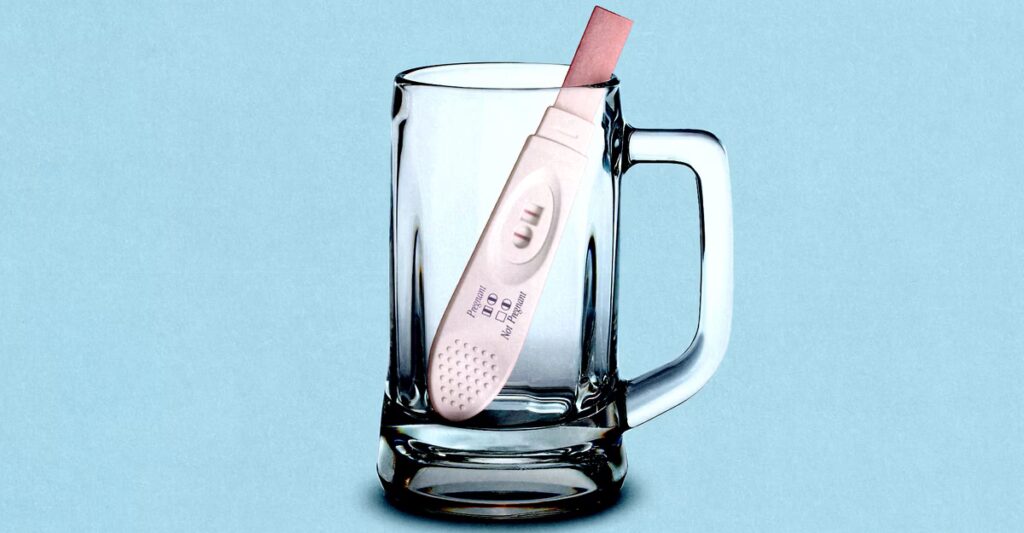
Pretty much everyone knows that women aren’t supposed to have alcohol while they’re pregnant. Even just a drink a day, the American College of Obstetricians and Gynecologists warns, can cause lifelong problems with a baby’s coordination, behavior, and learning. Not all mothers-to-be follow this advice, of course, but the official guidance is clear: “There is no safe amount or type of alcohol use during pregnancy.”
Male drinking and its potential negative effects on a fetus have gotten considerably less attention. The ACOG does not have the same alcohol-related recommendations for men on its website, and doctors do not generally bring up the topic in prenatal appointments. A few years ago, however, Kara Thomas, then a graduate student at Texas A&M University’s veterinary school, suggested an experiment that would explore whether a father-to-be’s alcohol consumption could also pose risks. She wanted to see whether alcohol used by a male mouse before impregnating a female mouse might change the facial features of the resulting fetus.
The student’s professor, Michael Golding, was initially against the idea. He assumed that a fetus would need to be exposed to a toxic level of alcohol for its face to be affected—a level that typically comes from heavy drinking by the mother during pregnancy, not from drinking by the father before pregnancy. “When that was wrong, I was stunned,” Golding told me. The study results showed that when a male mouse drank alcohol, then impregnated a female mouse that was not given alcohol, their fetuses tended to develop facial changes, such as smaller jaws, similar to those seen in some human children with fetal alcohol syndrome.
[Read: Doomed to be a tradwife]
Since then, Golding’s team has found a variety of other ways that alcohol consumed by the father before conception can affect a fetus. Among the issues Golding has seen in the offspring of alcohol-using mouse fathers compared with children of control mice are higher inflammation, liver damage, accelerated aging, and changes in the retina. The team’s research has also found that male preconception alcohol use can result in problems with the placenta and worse IVF success rates. (All of Golding’s studies use mice because researchers cannot deliberately expose prospective human parents to alcohol. He noted that the alcohol-metabolism pathways in mice and humans are similar, and that therefore one could expect similar effects of preconception alcohol use between the two species.)
Other research has resulted in similar findings. Kelly Huffman, a psychologist at UC Riverside, has found changes in the neocortex, worsened coordination, and impaired motor learning in the offspring of mice whose fathers were heavily dosed with alcohol prior to their conception, compared with control mice. These findings have led Golding, Huffman, and others to recommend that men stop drinking if they’re trying to become fathers.
Golding said he thinks that the harmful effects happen because alcohol puts the mouse father into a state of oxidative stress, and that this may cause his sperm to dial down the mitochondrial and metabolism functions of any potential new embryo that it creates. Through a process called epigenetics, the alcohol-affected sperm may carry chemical instructions that alter the way that genes are expressed in the embryo, leading to an array of changes in the fetus. Some human studies point to a similar phenomenon at play: Along with his colleagues, Gregg Homanics, a molecular neurobiologist at the University of Pittsburgh, has found that, in humans, a parent or even grandparent’s alcohol-use disorder was associated with changes in gene expression in hundreds of their children’s and grandchildren’s genes, including in those related to cancer development.
As concerning as this research may seem, it remains rife with unanswered questions. Golding said that the precise dose of alcohol that’s harmful in humans is not clear, but chronic drinking is likely worse than occasional drinking because the former is more of a stressor on the body. In some of Huffman’s studies, the mice are held at a human equivalent of a .08 blood alcohol level, or the United States’ legal driving limit, but few people maintain that level all day, every day. (And researchers don’t yet know whether preconception alcohol use has any effect on a woman’s eggs, because eggs are harder to study than sperm and don’t regenerate.)
Also unknown is how long prior to conception a father’s drinking might matter, or whether alcohol poses a greater risk than other substances or behaviors. Work on paternal consumption of THC, the primary active chemical in marijuana, for instance, has so far produced small or inconsistent findings. But paternal obesity might be consequential: Sarah Kimmins, an epigenetics expert at the University of Montreal, has found that men with an elevated body mass index, or BMI, tend to have sperm with altered DNA methylation—chemical signals that could change the development of the embryo or placenta—in areas linked to neural development. This potentially provides one explanation for why some studies show that obese men are more likely to have children with autism.
I asked Golding and Homanics why, given their research, more kids don’t have symptoms of fetal alcohol syndrome or other related problems. Most American men drink, after all, which might suggest that most American kids would have these issues. Homanics told me that not every man who consumes alcohol will cause harm to his future child; his genetic susceptibility and the amount he drinks might play a role. Golding said that fetal-alcohol-spectrum disorders are “grossly underdiagnosed,” and that therefore more children might have the condition than we think.
Perhaps the biggest caveat to all of this is that so many of the studies have shown effects only in mice. Several studies of human paternal drinking, which largely rely on retroactive reports of alcohol consumption, have found associations with fetal size, congenital heart diseases, birth defects, and infant-mortality risk. The evidence, however, is inconsistent and not necessarily causal. And some scientists are skeptical of the epigenetic mechanism that Golding and others describe: “To me, the idea that sperm mitochondria would pick up heritable defects and transfer them to the offspring is a stretch,” Adrian Bird, a genetics professor at the University of Edinburgh, told me. “There may be something going on here, but I would need to see it reproduced independently with larger numbers of animals before being convinced.”
[Read: The warnings I almost didn’t heed]
Still, Golding said that, given what he and others have found, men should avoid alcohol for about 90 days before attempting to get their partner pregnant. “The less you drink, the healthier you’re going to be,” he said. (However, some traces of past debauchery might be irreversible; Kimmins told me, ominously, that “we actually don’t know how much you can reverse damage done” from bad habits earlier in life.) Huffman had similar advice: If you’re “actively trying to have babies,” she said, “both the man and the woman should be abstaining” from alcohol.
Kimmins was even more expansive in her warnings: She argued that, for the sake of future generations, men should aim to live extremely healthy lives—not only in terms of their alcohol consumption but in every dimension. “Eating well is what men should be doing,” Kimmins said. “How a father lives his life will definitely impact the health of his sperm epigenome, his fertility, and then can impact the next generation.”
Just as I was about to point out to Huffman that occasional drinking is broadly accepted by society, she told me, “Biology doesn’t care what’s legal.” I worried aloud that this advice, even if warranted, might not be realistic. Birth rates are declining in much of the world because many people have become reluctant to start families. Telling men to completely stop drinking for months before they even attempt to become fathers doesn’t seem like it would help fertility. Huffman saw it differently: “We spend a lot of our lives sacrificing for our children,” she said. “I think it’s not a massive ask for us to get used to it early.”
Perhaps a gentler takeaway from this research is that doctors could do more to scrutinize the father’s health when a couple are planning a family or experiencing fertility struggles. Women are told to avoid deli meats, soft cheeses, and even a drop of alcohol during pregnancy, but Golding’s research and similar studies suggest that a prospective father’s health behaviors can also be important. If a couple struggle to conceive, for instance, the man’s diet or alcohol use could be affecting fertility. “I think the message definitely needs to get out that men also have a responsibility” for their children’s health, Kimmins said.
Maybe, then, the question becomes one of relative sacrifice: If the couple conceive, the pregnant woman will have to endure the better part of a year—a stretch of time that may be filled with awkward work parties and weddings of people she barely knows—without so much as a glass of wine. In solidarity, her partner can probably spend a few months cutting back.
The post The Researchers Who Want Dads-to-Be to Stop Drinking appeared first on The Atlantic.