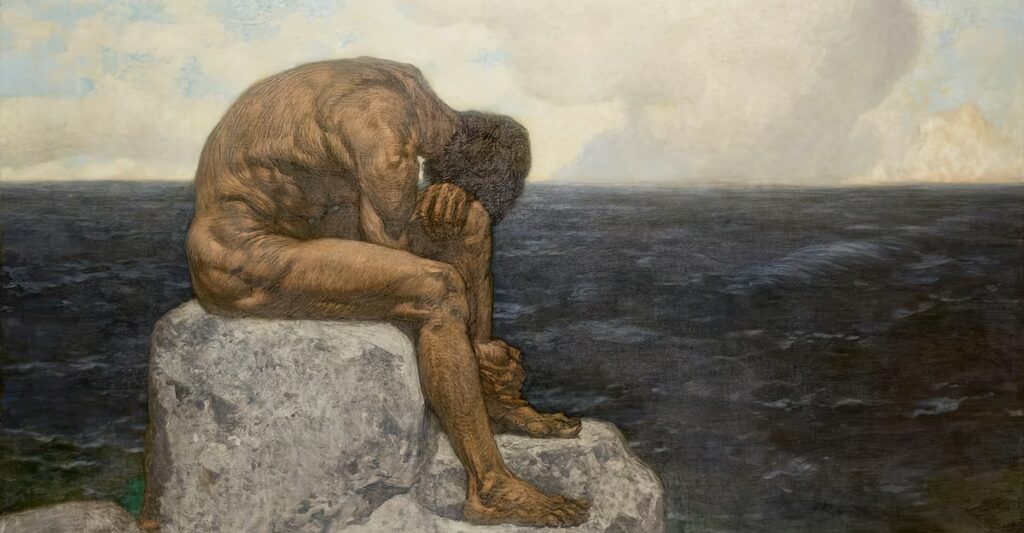
If you lived in the Bronze Age and were sailing the wine-dark sea, you’d soon understand the need for gods. You don’t know about low-pressure systems or atmospheric circulation, about ocean currents or the contours of the seafloor. You know only that the sky has darkened, the wind has shifted, and the waters have begun to rise. The sudden appearance of thunder, lightning, and towering waves crashing against the hull demand an explanation: gods. Zeus and Poseidon are at it again—one hurling thunderbolts, the other whipping the sea into a frenzy. Or perhaps Athena has withdrawn her protection. You offered sacrifice before setting sail. Maybe one bull wasn’t enough?
The randomness and unpredictability of existence, the mindless violence of it, necessitated myth. This early religion was a kind of technology, an attempt to make order out of chaos.
There are so many reasons why the stories of ancient Greece endure, why they are some of the first narratives I remember from elementary school, why my daughter’s graphic-novel version of The Odyssey is so tattered. Yes, these stories have monsters in them, heroic adventures, and black-and-white morality tales. But they also plunge deep into a primordial place: into our essential helplessness, and the desire to conquer it with meaning.
The Odyssey is the greatest example of this in the Western canon; it is a story about a man whose heroic deed is survival—who simply wants to set right what has been upended. Odysseus longs to regain his place as a father and husband and leader. He wants to go home. His son, Telemachus, wants to correct the wrong that is occurring in Ithaca, where suitors have violated the codes of hospitality and are aggressively vying for his mother’s hand. Penelope, the queen, wants to return to a time of stability, when Odysseus ruled and her place was secure, and when everyone knew what was expected of them. “The worst thing humans suffer is homelessness,” Odyssesus says, and I don’t think he’s referring just to being lost at sea. (I’m quoting here and elsewhere from Emily Wilson’s translation.)
The Odyssey as a human-scaled story is clearly what the director, Christopher Nolan, had in mind for his new blockbuster version. In one interview about the movie, describing the process of beginning to write the script, he said that he’d put the poem away and written down just what he remembered of it, and what had come out was something “earthy and intimate and relevant and accessible.” This is how I’d describe the film. What stuck in his memory were the human characters and their personal struggles, and what he forgot were the gods.
[Read: An Odyssey deserving of the biggest screen possible]
For all the culture-war debates about the liberties Nolan took in his casting, his most radical deviation from the text has to do with agency and who has it. In the poem, the gods are forever manipulating the story. Athena is like Odysseus’s overbearing coach, offering hints about what’s going to happen in the future, egging him on, and occasionally cloaking him in disguises. Poseidon, upset that Odysseus blinded his son, the Cyclops Polyphemus, decides to make his return home difficult and long and wet. The gods do occasionally point out that humans have more choice than they think they have. “This is absurd, that mortals blame the gods!” Zeus kvetches. “They say we cause their suffering, but they themselves increase it by folly.” This may be true, but it is also true that the epic can sometimes resemble a game of foosball between Athena and Poseidon.
How does personal responsibility enter into this world of unfathomable dangers? On one level, this story—and every myth—is about the intervention of the gods in human affairs. But closer to the ground, we can understand that those gods represent all of the many forces outside our control, which means we still have some autonomy. You have to make moral choices despite all of the external pressures weighing down on you (call them gods, if you will). Odysseus is told by the sorceress Circe that he will have to sail through narrow straits that will force an impossible choice on him: on one side Scylla, a six-headed monster who will grab six of his men for lunch, and on the other Charybdis, a colossal whirlpool that might destroy his entire ship. He has to decide. And he chooses to sacrifice six men rather than risk losing them all.
In the film—which stars a steely-faced Matt Damon as Odysseus (one part Jason Bourne, one part Mark Watney from The Martian)—this moment is presented as something like the trolley problem in moral philosophy: Can the hero curb his instinct to be heroic and brave the whirlpool, and instead make a decision that will save the greatest number of people?
Nolan’s version of The Odyssey places significant weight on these questions, especially on what we do to maintain order and whether we act graciously toward one another—an ethic of hospitality referred to as Zeus’s law. In what I found to be the most striking sequence of the film, Odysseus, disguised as a beggar, is speaking with Penelope (played by Anne Hathaway) about the Trojan War and the disruptive technology he came up with to break the siege: the Trojan horse. In the classic tradition, this bit of strategic genius is the ultimate proof of Odysseus’s mētis, or cunning intelligence. But here, he talks about it with remorse. He played a trick on the Trojans by exploiting the culture of gift-giving. We’ve already seen the sacking of Troy in a heroic flashback, staged as a crafty trick, but now we revisit it—as a war crime.
Odysseus tells Penelope that, once the Achaeans finally breached the walls, he witnessed “10 years of rage” unleashed; under the glow of burning houses, we see women being dragged away to be raped, looting and wanton murder everywhere. Damon as Odysseus looks stunned as he sees the consequences of what he has wrought. To draw a parallel from the Nolan canon, he is J. Robert Oppenheimer reckoning with the unintended effects, physical and moral, of the weapon he has created. Odysseus even implies that his delay in getting home might have as much to do with a guilty conscience as with intervening gods or the enchanting sorceress named Calypso.
[Read: The absurd misunderstanding fueling the debate over The Odyssey]
In another famous episode, when Circe (Samantha Morton) turns Odysseus’s men into pigs, she explains her spell-casting by describing the men’s pillaging and abuses in war as piglike. She is giving them back their real identities, she says, and judging their character in ways that simply wouldn’t make sense if their fate were out of their own hands.
Where are the gods in all of this? They appear in the film the way they would appear to humans: through thunder and lightning, through the elation of triumph and the experience of pain and longing. Among the major gods, only Athena is personified (by an ethereal Zendaya), but she is not the warrior goddess of the poem. She is more like a projection of Odysseus’s own conscience, materializing the way an angel might land on one’s shoulder. She represents his desire for goodness, home, and order. (In the scenes of Troy’s sacking, we return to a repeated image of Athena’s statue being beheaded, the ultimate violation.) This is all very far from the dominant film depiction of Greek mythology that I remember from my own childhood, 1981’s Clash of the Titans, in which the gods hang out together in togas on Mount Olympus, with Laurence Olivier as Zeus dictating much of the action.
Nolan’s film has already been knocked by some critics for its psychologically modern portrayal of Odysseus as a man plagued by PTSD and haunted by that horse. And his version is undeniably meant to speak to us now as well as to avoid some serious turnoffs, such as Odysseus’s boasts about looting and taking slaves. Nolan’s anti-war message can also occasionally come off as anachronistic, as when Odysseus tells Penelope that the Trojan War is not really about retrieving Helen but actually about Agamemnon’s efforts to secure trade routes—I doubt I’m the only one who heard an echo of the troubles over the Strait of Hormuz.
And yet, for all that makes this a 21st-century Odyssey, Nolan has captured something essential about why the story still matters and always has. The gods were there only as a way for people to make sense of the senseless. Why does a child die? What causes natural disasters? Who brings on the cycles of violence that each side knows will lead only to more death and destruction? We can imagine that we have more sophisticated explanations for most of what affects our lives than the ancient Greeks did. But this is the false comfort we find in science; there is still so much outside of our power. The best we can do is what Odysseus does—try to keep it together, make decent choices, value our relationships to one another. Even with all of the gods and monsters, this is still just a story about whether one man will get to go home to his wife and son. If this means something after thousands of years, maybe that’s because the desire for solid ground in a baffling and chaotic world is unchanging.
The post The Odyssey Was Never About the Gods appeared first on The Atlantic.