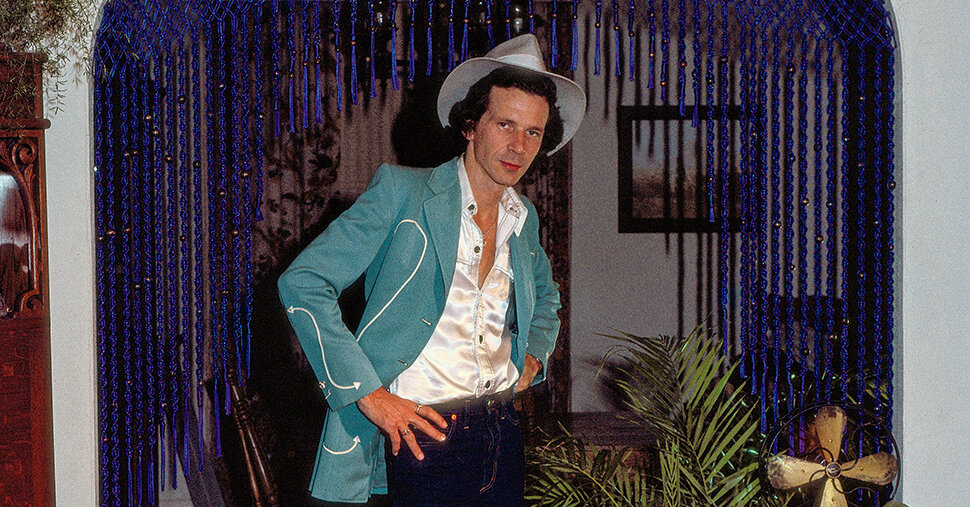
In the summer of 1976, as America marked its Bicentennial and break with the British monarchy, Gary Stewart was celebrating his own coronation.
Crowned by Time magazine as the “king of honky-tonk” music, Stewart had earned his regal sobriquet with a run of classic country songs about loving, cheating, drinking and dying. Stewart’s reign at the top would be relatively brief — a half decade of hits interspersed with headlines about his drug busts and record label battles. His self-destructive streak helped turn him into a vanishing act.
By the early 2000s, Stewart was far from fame, holed up in a double-wide trailer in his hometown, Fort Pierce, Fla., consumed by addiction and personal tragedy. He’d already lost his son to suicide when, in late 2003, his wife of 42 years, Mary Lou, died unexpectedly. A grief-stricken Stewart took his own life just a few weeks later. He was 59.
In the aftermath, there would be no tribute albums, lavish reissues or reputation-burnishing documentaries. Outside of a small, devoted cult, Stewart became a faded figure.
This year, however, Stewart’s profile received its biggest boost since his hit-making heyday thanks to the publication of “I Am From the Honky-Tonks,” a definitive biography by the author Jimmy McDonough. The reissue label Delmore Recording Society follows with the first deep dive into Stewart’s archives with “One Track Mind,” a collection of previously unreleased songwriting demos.
That activity comes as a group of notable young country stars — the Billboard chart topper Ella Langley; the Country Music Association’s male vocalist of the year, Cody Johnson; and the Grammy-winner Zach Top, among them — have been covering Stewart’s songs, singing his praises, and exposing his music to a new generation of fans. “There’s something so raw about Gary Stewart,” Top said in an interview. “Every syllable he sings, he makes you feel it. His music isn’t for everyone — but the ones that do connect with it, they’re hardcore.”
“Gary touches a nerve in people,” said McDonough, who spent four decades chasing the story of Stewart’s life. “You become obsessed. That’s what happened to me and to a lot of others who’ve heard his music.”
For those who knew him best, like Tanya Tucker, his friend, collaborator and a Country Music Hall of Famer, the idea of a Gary Stewart revival in 2026 brings a lot of joy. “Some people are just too precious for this life,” Tucker said. “Gary was one of them. He never got his due while he was here. But maybe his time has finally come.”
A Short Stay at the Top
“You have to understand,” said Stewart’s daughter, Shannon Royce Ashburn, “my dad ate, slept and breathed music.”
As Ashburn recalled in a recent interview, life in the Stewart home was less than conventional. “My poor mom couldn’t even have a living room or a dining room,” she said. “Basically, our house was filled with Dad’s record collection, thousands of albums and all these guitars and amplifiers. It was just music, music, music all the time.”
Born in Letcher County, Ky., in 1943, Stewart was the oldest of 12 children. In the late ’50s, the family fled the coal mining camps of Appalachia seeking opportunities on Florida’s Treasure Coast. Stewart’s father, George, was a cockfighter, while his mother, Georgia, sold Avon Products, and some illicit substances on the side.
Stewart was just 16, a high school dropout playing in a rockabilly band called the Tom Cats, when he met Mary Lou Taylor, five years his senior. The attraction was instant and the couple married soon after — a passionate, tempestuous union that would last the rest of their lives.
A natural-born musician with a flowing style on piano and guitar, Stewart would gig and tour with a series of bands through the mid-60s, playing rock, pop, R&B and blue-eyed soul. But he found his calling writing and singing country. In 1965, at the urging of his fellow Floridian and country singer-songwriter Mel Tillis, Stewart and his partner Bill Eldgride struck out for Nashville. They quickly found success as Music City tunesmiths, getting their songs cut by the likes of Hank Snow and Cal Smith, but it would take Stewart another decade to establish himself as a solo artist, landing a string of hits in the mid-70s.
He once memorably described a country song as “a three-minute soap opera,” and signature sides like “Drinking Thing,” “She’s Actin’ Single (I’m Drinkin’ Doubles)” and “In Some Room Above the Street” illustrated his point: These short, sharp musical melodramas, delivered in a high striking vibrato, cut through the era’s placid country-pop to make their way to the top of the charts.
Through the back half of the ’70s, Stewart found success and also a diverse group of admirers including Bob Dylan, the Allman Brothers, Waylon Jennings and the Clash. But after a few years, the hits suddenly dried up. His label, RCA, tried teaming Stewart with the up-and-coming singer-songwriter Dean Dillon for a pair of duet albums. When that failed to reignite his career, Stewart was dropped by the label in 1983.
One Writer’s Obsession
Around that time, McDonough caught one of Stewart’s rare New York City appearances at the Lone Star Cafe. McDonough went expecting some “pompadoured song salesman in a Nudie Suit” replicating his radio hits. Instead, the concert proved a revelation. “In addition to his honky-tonk stuff, the guy could pound the piano like Jerry Lee Lewis, play stinging Southern Rock like the Allmans, croon a ballad like Bobby Darin and play an acoustic blues that would have Tommy Johnson nodding his head,” McDonough said. “It just blew me away.”
At the time, McDonough was working as a sound editor for films, but seeing Stewart redirected his life. He spent the next few years chasing down the singer, who’d abandoned his career and disappeared into Fort Pierce, where he was living a hermetic, hedonistic existence. Determined to drag Stewart back into the spotlight, McDonough finally pinned him down in 1987 and spent 10 days and nights interviewing him at his home. Over the course of intense conversations and occasional fights — Stewart was fond of hurling knives in McDonough’s direction — the pair formed a strange, profound kinship.
The experience formed the basis of a lengthy Stewart profile published in the Village Voice in 1988, kick-starting McDonough’s writing career. The story also revived Stewart’s fortunes, as he made a comeback and cut a trio of albums for the California indie roots label HighTone Records before retreating once again.
McDonough would go on to write acclaimed gonzo biographies of other artists, including the mercurial Canadian rocker Neil Young, the exploitation film auteur Russ Meyer and the enigmatic soul singer Al Green. But he couldn’t shake his Stewart obsession and eventually, inevitably, returned to the subject. “It took years to get to the bottom of Gary’s life,” McDonough said. “As much as anyone could ever get to the bottom of the guy.”
The 542-page “I Am From the Honky-Tonks” largely succeeds in that effort, unpacking the reasons Stewart fell off the charts and out of favor with the Nashville establishment so dramatically in the early ’80s. “RCA wanted him to keep turning out those drinking songs that had been hits,” McDonough said, “but Gary got bored easily and wasn’t going to do the same thing over and over again.” Injuries sustained in a serious car accident in 1980 led to Stewart’s addiction to painkillers. “Add to that his utter indifference to success — he genuinely did not give a damn about money or fame,” McDonough said. “The music industry didn’t know what to do with someone like that.”
The narrative takes a darker turn during the final years of Stewart’s life, at which point he was down to playing the occasional money gig on a circuit of Texas dance halls and Native American reservations, where he remained a popular attraction. Following the death of their troubled son, Joey, in 1988, both Stewart and his wife, Mary Lou, fell deeper into pills as a way of coping. Mary Lou died in her sleep in late 2003 — possibly from a heart attack, likely exacerbated by her drug use, though no autopsy was performed. Stewart was inconsolable.
“We all tried to cheer him up as much as we could,” recalled Tanya Tucker. “I told Gary, ‘We’ll get some pals together and we’ll go away and write. We’ll write an album of songs and dedicate them all to Lou.’ But he was already gone in a way.”
Stewart’s last performance was in December 2003, at a local bar called Pineapple Joe’s. He joined the house band for a couple Jimmy Reed and Elvis Presley covers, before delivering a haunting version of his own “An Empty Glass”: “Somehow I’ll make it home and cry myself to sleep,” he sang. “That’s how my day ends, every night for me.”
Ten days later Stewart was found in his trailer, dead from a self-inflicted shotgun wound.
Inspiring a New Generation
In an era where even the work of minor artists is endlessly anthologized and repackaged, Stewart’s catalog remains largely untouched. Sony Music, which owns Stewart’s RCA material, put out a best-of compilation just after his death, but nothing since. Even now, half of Stewart’s albums for the label — including “Little Junior” (1978), “Gary” (1979) and “Cactus and a Rose” (1980) — are out of print and unavailable digitally.
“And there’s tons of other incredible stuff just sitting in the RCA vaults that no one’s heard,” said Mark Linn, owner of the Nashville-based label Delmore Recording Society. In cooperation with Stewart’s daughter, Linn is hoping to fill the void by releasing some of his pre-RCA recordings, starting with the new “One Track Mind,” a 20-track set chronicling his songwriting efforts from 1967 to 1971.
Even on those demos never intended for public consumption, Stewart delivers each song as if his very life depended on the performance. “Gary looked at any recording as something for posterity,” McDonough said. “It didn’t matter if he was cutting in a big professional studio or sitting in his trailer singing into my tape recorder. His thing was, ‘You’re gonna remember this song for the rest of your life.’”
That brand of artistic intensity has attracted a legion of fans to Stewart’s work in recent years. “Gary Stewart made serious music,” said the contemporary honky-tonk singer Charley Crockett. “In terms of his themes, it’s real music for adults, and that’s maybe what’s been missing from country.”
The interest in Stewart’s music has even begun to transcend the country realm. The North Carolina indie-rock band Wednesday recorded a crunchy, noisy cover of “She’s Actin’ Single (I’m Drinkin’ Doubles)” that’s become a staple of their live shows.
“Gary wrote some of the best songs of all time,” said the Wednesday frontwoman, Karly Hartzman. “You had to dig a little bit to find them, so ultimately covering him feels like discovering buried treasure and then throwing all the doubloons to the audience.”
Recently, Hartzman sent McDonough a video from a Wednesday concert in Sydney, Australia, where young people in a sold-out venue were dancing and singing along to Stewart’s song. “To think that Gary’s music is crossing over to other generations and other hemispheres,” McDonough said, chuckling. “He would have been over the moon with that.”
Ashburn said, “It just goes to show you how ahead of his time he really was.”
“Dad would be so thrilled that he’s still touching people’s lives through his music,” she added. “That’s all he ever wanted.”
The post The Resurrection of Country Music’s Ultimate Vanishing Act appeared first on New York Times.