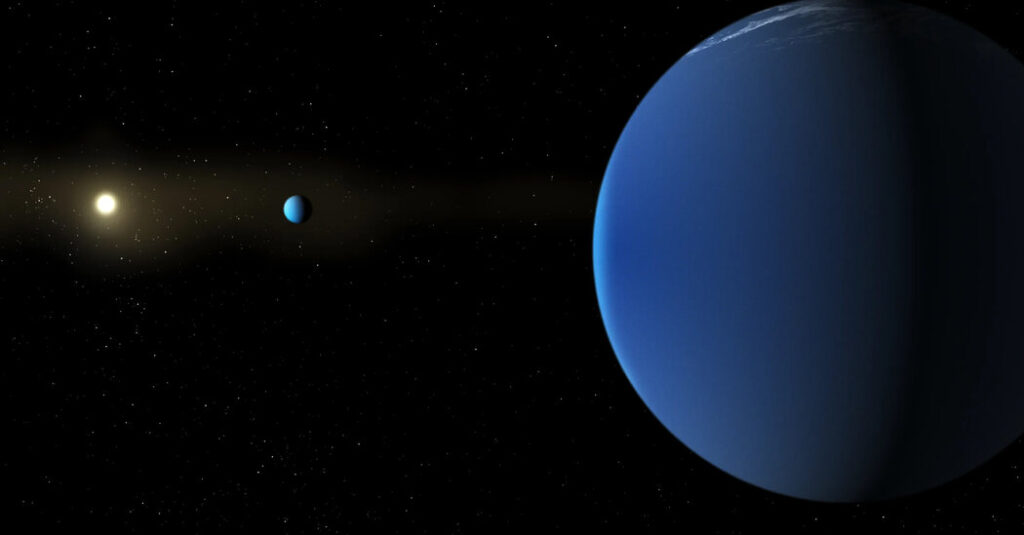
Astronomers have found a pair of the lightest giant planets known in the universe in a star system about 1,100 light-years away, according to a new study.
The discovery of these two gas giants, which are less dense than cotton candy, will help astrophysicists better understand the most extreme and unusual ways planets can form.
“We want to understand the full story of planet formation and evolution,” said George Dransfield, an astrophysicist at Oxford University who led the study. “The challenge with super-puff planets is that they don’t fit neatly into our models.”
A super-puff planet almost shouldn’t exist. It’s effectively a gas giant with an impossibly tiny core, one that should be too small to gravitationally pull in the vast volume of gases that scientists have found in their atmospheres.
A gas giant’s core typically has a mass at least 10 times the mass of Earth. But many super-puffs have total masses — the core and atmosphere together — that are less than that. “So how does a core one or two or five Earth masses accrete this large amount of gas?” said Jessica Libby-Roberts, an astronomer at the University of Tampa who was not involved in the study.
It makes little physical sense, and it’s a puzzle scientists have been working on for about a decade. The first potential super-puff planets were identified in 2014, three of them orbiting a star called Kepler-51. That was the first time scientists had come across planets with astonishingly low densities, and they didn’t know what to make of them.
“It just seemed impossible,” Dr. Libby-Roberts said. “Do we have to scratch everything we understand about planet formation and start over?”
Two years later, the term “super-puff” came onto the astronomy scene, coined by Eve J. Lee, an astrophysicist at the University of California, San Diego. Dr. Lee published her work on the possible ways that super-puffs could come to be. Her conclusion was that they formed in the right place under just the right conditions: It had to be cold enough that even an undersized core could pull in gases, which then wouldn’t have enough energy to escape. There couldn’t be too much dust, so gases could quickly accumulate. An unexpected atmosphere could build.
A picture was coming into view. But as scientists found more super-puff planets — the count is now 39 — things only grew weirder. “Every single one is strange,” said Juliette Becker, an astronomer at the University of Wisconsin-Madison who was not involved in the study. “All of them are pushing boundaries.”
Also complicating things is that some of the planets thought to be super-puffs might not be the real deal, Becker said. There’s a possibility that some may appear to have low densities for other reasons, including having Saturn-like rings that are tipped and facing the telescope.
Every bit of information helps scientists figure out what’s really going on. That’s where the new study comes in.
The two planets, TOI-791b and c, were first spotted by volunteers with a planet-hunting program that NASA runs with its Transiting Exoplanet Survey Satellite. The research team then dug into the candidate planets, estimating their ages, sizes and behaviors.
The two planets, they concluded, have exceptionally low densities, comparable to that of some of the lightest materials humans have made, called aerogels. Even though the puffs are the same size as or larger than Jupiter, they have just 3 to 6 percent of Jupiter’s mass.
The discovery “was very exciting to see,” Dr. Libby-Roberts said. “Super-puffs are rare in and of themselves. It’s even rarer to see multiple super-puffs in the same system.”
Only four systems were known to host multiple super-puffs. Adding even one of these “sibling” systems to that list is invaluable for understanding the conditions in which they could have formed. It narrows down possible explanations even further and makes it more likely that they are really puffball planets, rather than a trick of a telescope.
It would be a “massive cosmological coincidence” to have that happen, Dr. Dransfield said.
Work on these planets is just beginning. To have a complete chart of the planets’ movements, scientists would need to observe them for almost a century, Dr. Becker said.
More immediately, Dr. Dransfield is hoping for time with the James Webb Space Telescope, which peers deep into space by capturing infrared light. That would help the team understand the planets’ compositions and shapes, building on the earlier discoveries of the Kepler-51 super-puffs.
Plenty of uncertainties will remain as this research continues. But for Dr. Libby-Roberts, that uncertainty is part of the draw of the work.
“It’s important to never lose our imaginations,” she said. “It turns out the universe is a lot weirder than we could ever predict.”
The post Rare Pair of Improbably Light ‘Super-Puff’ Planets Is Discovered appeared first on New York Times.