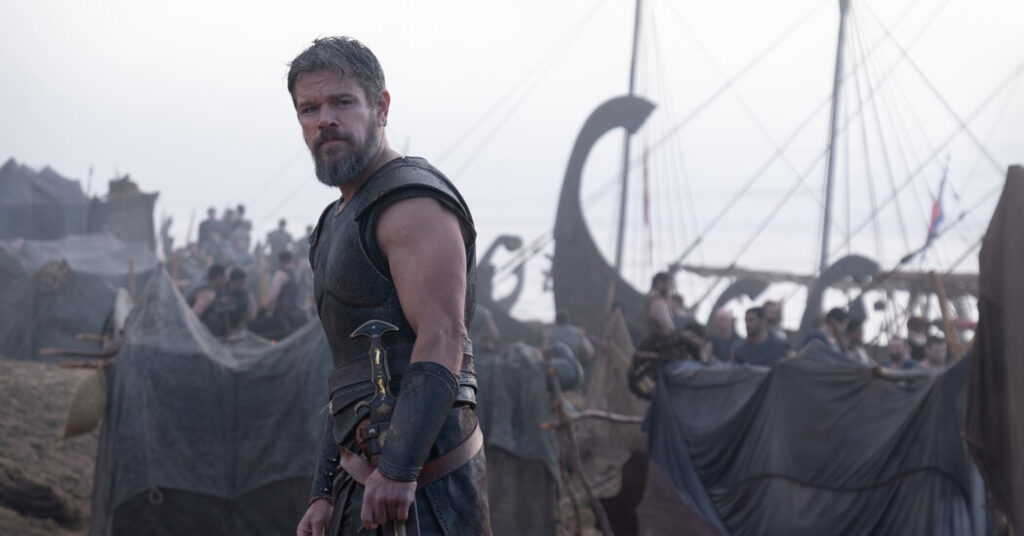
The master of the epic blockbuster takes on the granddaddy of all epics with this summer’s “The Odyssey.” Christopher Nolan’s new film adaptation of Homer’s Ancient Greek saga stars Matt Damon as the wandering hero Odysseus, who must make his way — via many detours — home to his wife and son in Ithaca after helping lead the Greeks to victory in the Trojan War (a campaign covered in Homer’s other much-lauded poem, the “Iliad”).
Hopefully the movie moves you to revisit the original text, a story so rich it has drawn readers for millenniums, via many translations. And if you’re craving even more adventures with Odysseus and company — or if you want some context on the real history of the era, or original takes on classic myths — look no further than these books.
Ulysses
by James Joyce
Although we have just missed Bloomsday, any day is a good day to start reading “Ulysses.” Perhaps the most famous reimagining of Homer’s epic, this stream-of-consciousness, modernist novel transposes the hero’s journey from the wine-dark sea to the streets of turn-of-the-century Dublin, ingeniously refracting Homer’s “Odyssey” through the perspectives of the ironic “heroes” Stephen Dedalus and Leopold Bloom. Don’t be put off by its abstruse reputation: “Ulysses” is a deeply pleasurable read — a voyage through the mundane that touches the sublime. Read our review.
Circe
by Madeline Miller
The beautiful, vindictive witch Circe plays a small but significant role in the “Odyssey”: transforming sailors into swine, holding them captive on her island and advising the weary Odysseus, who becomes her lover, on how to navigate some of the trials still to come on his journey. Miller’s retelling gives the sorceress the spotlight and puts an enchanting, feminist spin on her story. The book explores Circe’s many adventures beyond Homer’s poem — Athena, the Minotaur, Daedalus, Medea and more all cross her path — and gives her psychological depth that shows her supposed vengefulness in a different light. Read our review.
Ilium
by Dan Simmons
Few retellings of Homer’s epics are more creative than “Ilium,” which transforms the “Iliad” into a work of galaxy-spanning science fiction. In the distant future, the Gods, a race of powerful post-human beings, have forced Odysseus, Achilles and Agamemnon to entertain them by re-enacting the Trojan War on the surface of Mars. The only problem? The Gods don’t remember how the conflict ends — so they resurrect a 20th-century Homeric scholar, Thomas Huckleberry, to advise them (and wryly narrate our tale). There are spaceships and space donkeys and a Shakespeare-obsessed robot. It’s as erudite as it is wacky, and so much fun. Read our review.
Heroes
by Stephen Fry
Fry is best known as a beloved British comedian, but he is also the author of several nonfiction books about Ancient Greek lore, all of which are informative, approachable and related in the lively tone of your favorite high school English teacher. The series includes the Homer-specific “Odyssey” and “Troy,” as well as the gods-centered “Mythos.” But if you’re looking to expand your knowledge of the Ancients, try “Heroes,” which concerns “men and women who grasp their destinies, use their human qualities of courage, cunning, ambition, speed and strength to perform astonishing deeds, vanquish terrible monsters and … change the world.”
The Penelopiad
by Margaret Atwood
In 2005, the Scottish publisher Canongate Books asked a group of novelists to write their own versions of ancient myths. Atwood’s contribution is a retelling of the “Odyssey” from the perspective of Penelope, Odysseus’ loyal wife. Atwood’s Penelope is irreverent and shrewd, taking the reader through her marriage to Odysseus, her trials with the suitors who arrive in his absence and her bitter rivalry with the wayward Helen with hilarious candor. Her cynical recounting, as she roams the underworld, breathes new meaning into a familiar story.
Cold Mountain
by Charles Frazier
Frazier’s astonishing debut novel is a distinctly American retelling of Homer’s epic. Here, Odysseus becomes Inman, a wounded Confederate deserter whose quest to return to his beloved Ada in North Carolina takes him across a Civil War-ravaged nation. While she waits for her love, Ada joins forces with another woman, Ruby, to try to save her family farm. Frazier divides his narrative between Inman’s and Ida’s points of view, and is as interested in his characters’ internal journeys as their often grueling physical ones. (The 2003 film adaptation starring Jude Law, Nicole Kidman and Renée Zellweger is also excellent.) Read our review.
Autobiography of Red
by Anne Carson
As modern encounters with Greek myths go, Carson’s take on the monster Geryon is among the most incandescent. An enormous, winged, three-bodied beast, Geryon was slain by the hero Hercules, whose 10th labor was to procure the giant’s cattle. The creature’s story was given new depth in the sixth century B.C. by the Greek poet Stesichorus, who imagined his life before this deadly encounter. Carson’s Geryon is a brilliant boy, tender and creative, who isn’t killed by Herakles but has a torrid affair with him that ends in a crueler fate than myth imagined: a broken heart. Written in verse, the book includes a droll imaginary interview with Stesichorus himself. Read our review.
Tales From Ovid
by Ted Hughes
Let us hop from Ancient Greece to Rome, where Ovid composed his masterpiece “Metamorphosis.” The epic poem stretches from the birth of the universe to Julius Caesar and comprises more than 250 stories, including the myths of Narcissus, Arachne and the star-crossed Pyramus and Thisbe. In “Tales From Ovid,” a modern reinterpretation of the Latin classic, the poet Hughes pares these hundreds of tales down to a manageable 24, which he translates in boldly original free verse. “The result is that rare thing,” our reviewer wrote. “An inspired act of translation that stands as vigorous poetry in its own right.” Read our review.
The Trojan War
by Barry Strauss
Strauss, a Cornell University historian, uses Homer’s “Iliad” as a jumping off point to explore what we do and don’t know about the true circumstances of the Trojan War. Drawing on recent archaeological discoveries as well as extensive research on conflicting accounts of the period, the book draws the line between historical fact and historical fiction in entertaining, accessible prose. Was Helen of Troy an actual person? Did the Greeks really win with a giant horse? Strauss provides context while attempting to untangle the truth behind some of Homer’s more fanciful inventions.
Talking Classics
by Mary Beard
Why should we care about (literally) ancient history? The benefits of a classical education are enumerated with style and passion in the latest book by Beard, the recently retired Cambridge professor best known for her riveting books on Ancient Rome. Beard’s case for antiquity is articulate and rich in her trademark historical insight — but also animated by a contagious joy and curiosity. Her bone-deep love for digging into these long-ago civilizations was sparked, she writes, by a piece of fossilized bread. Yours just might come from the movies. Read our review.
The post Want More of the ‘Odyssey’? Read These Books Next appeared first on New York Times.