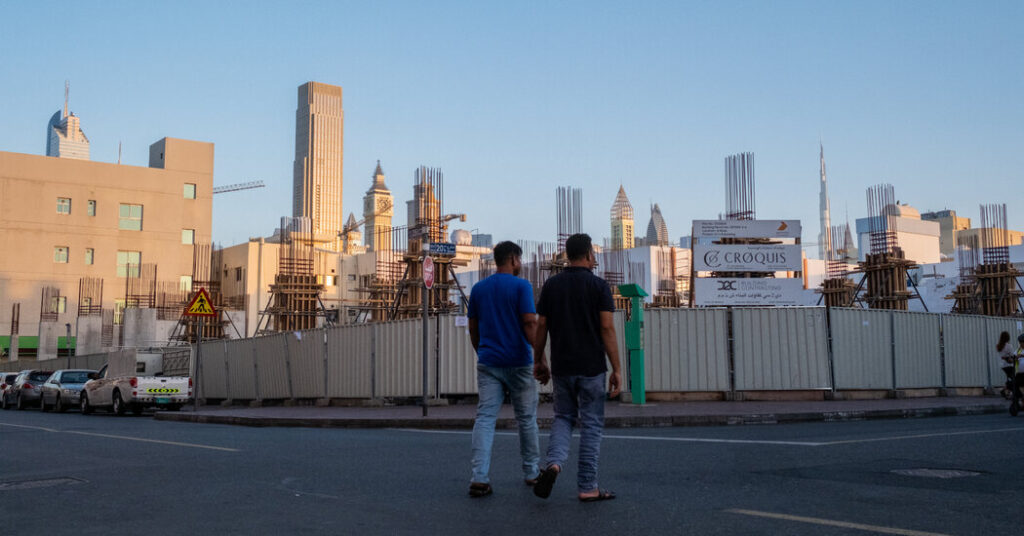
On a recent June day in Dubai, the United Arab Emirates’ largest city, Joy Vivanda walked the streets in 100-degree heat, scanning job advertisements on bulletin boards in search of her next paycheck.
Sometimes she approached strangers to ask if they needed a nanny or maid, a routine that has become familiar since the start of the U.S.-Israeli war with Iran.
“I have been doing this almost every single day for the last four months, but with no luck,” said Ms. Vivanda, 44, a domestic worker from the Philippines. She said she lost her job in March, weeks into the war, when the Russian family she worked for abruptly left Dubai and never returned. Stories like Ms. Vivanda’s have become common as Dubai is still reeling from a conflict that has unleashed far-reaching changes across the region.
For decades, the sprawling Persian Gulf city has represented a beacon of opportunity and security to people across the Middle East, Africa, Asia and beyond. With a tiny citizenry and plentiful jobs in the construction and service industries, it attracted migrant workers at such a rapid pace that today, roughly 90 percent of its population is made up of foreign nationals.
Over the past few months, as Iranian missiles and drones rained down on Dubai’s gleaming skyscrapers, killing and injuring civilians, the war struck at the city’s economy, which depends heavily on tourism and aviation. Dubai — located roughly 90 miles across the Gulf from Iran — was one of the hardest-hit cities in the Middle East, as the Emirates absorbed more of Iran’s retaliatory attacks than any other country. While many visitors stayed away, and some wealthy foreign residents fled, a growing number of low- and middle-income migrant workers appear to have lost their jobs, been forced into furlough or faced salary cuts.
In some densely populated working-class neighborhoods, migrant workers can be seen going door to door with résumés, seeking jobs.
The full picture of the damage has yet to emerge, as the authoritarian government releases very little up-to-date economic data. Dubai’s media office did not respond to a request for comment about how the war had affected unemployment and economic growth.
In an interview with CNBC Africa in April, Abdulla Bin Touq al-Marri, the Emirati economy and tourism minister, dismissed the impact of the war on the country’s economy as a “glitch” that would not last long.
“We are built on agility,” he said. “We are built on resilience.”
In interviews with foreign workers across Dubai, however, the pain caused by the war is palpable.
“There is simply no business,” said Mujeeb Rahman, an Indian accountant who said he was recently laid off, along with all of his colleagues, after sales at their catering company declined. “The company does not have enough cash flow to pay employees and suppliers.”
He fears finding another job will be difficult.
“Many companies are not hiring anymore,” Mr. Rahman said. “Everyone is trying to survive.”
A framework cease-fire agreement reached last month between the United States and Iran provided a shaky and uncertain respite from the fighting, raising hopes of an economic recovery. Yet as Washington and Tehran continue to trade strikes, many now fear a return to full-blown war.
A recent survey of 546 employers in the Emirates by ManpowerGroup, a recruitment company, found that one in four expected to cut jobs in the third quarter of 2026, while a third of businesses said they had no plans to recruit at all.
Some people The New York Times spoke to said that they had kept their jobs but that their salaries had been cut. Zekra Elsa, 21, an Egyptian saleswoman who works at a retail kiosk that mostly catered to tourists, said she had barely earned anything for three months as tourist numbers plummeted. Her employer stopped paying a fixed salary and moved her to a commission-based arrangement instead, but her daily sales do not even reach $150, she said.
Dubai’s government has approved economic incentive packages worth more than $680 million since the war began, aimed at easing the burden on businesses. And officials, billionaires and business executives in Dubai have publicly maintained a relatively optimistic tone as they speak about the war’s impact.
Khalid Jassim Mohamed bin Kalban, the chief executive of Dubai Investments — a state-linked corporation with subsidiaries across a range of sectors — said that the economic slowdown is expected to be temporary.
“You don’t see an exodus of people, you don’t see businesses being abandoned,” he said in an interview, arguing that Dubai has a track record of resilience. “That is because we have the strength, we have the wealth, people and knowledge.”
It is true that, in the past, many workers and foreign residents who left Dubai during crises — the coronavirus pandemic in 2020 and during the Great Recession of the early 2000s — have returned when the economy improved, or newcomers have taken their places.
It is too early to say whether and how the war will change Dubai in the long term. The Emirates is one of the largest source of remittances in the world, and the salaries of its low-income workers have consequences far beyond the country’s borders.
Venkat, an Indian housekeeper at a five-star hotel in Dubai, had helped pay the school fees of his two children in India, until he was laid off and sent back home in April. He told his story on the condition that he be identified by only his first name, worried about affecting his prospects for returning to Dubai.
“I am doing whatever I can to manage,” he said. “If I cannot come back to Dubai, my children’s future is at stake.”
That is also true for Ms. Vivanda, the domestic worker, whose income helps support four children in the Philippines.
She is reluctant to return home, she said, because there are no opportunities for her there. Instead, she is holding on to hope that things will improve.
Yanick Obi, 30, a welder from Cameroon, said that even though he has managed to hold onto his job, he lives with the fear of a layoff notice arriving at any time. The maintenance company he works for is struggling as new contracts have dried up.
“I go to work every day,” Mr. Obi said, “but there is no work.”
The post Dubai Was a Beacon of Plentiful Jobs, but Layoffs Reveal Costs of Iran War appeared first on New York Times.