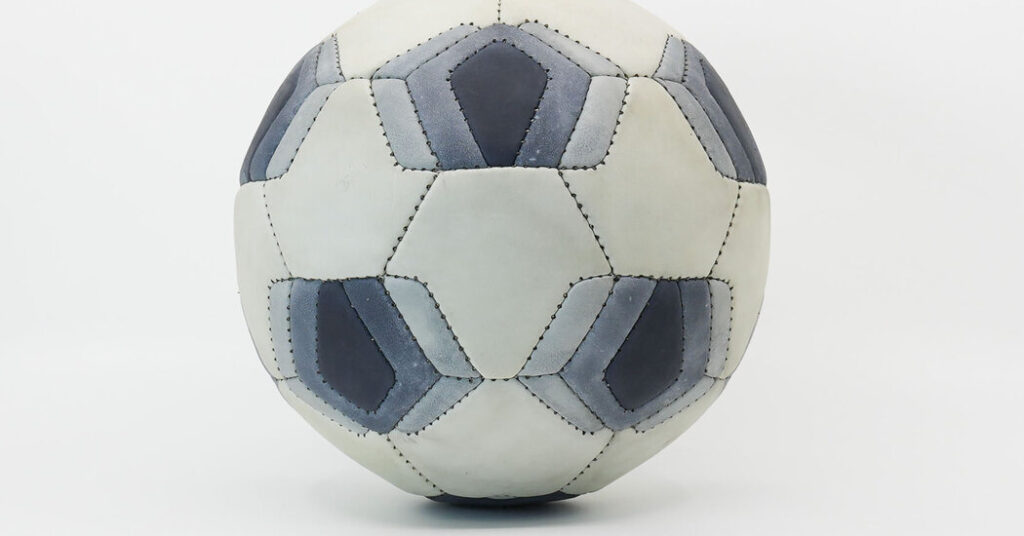
To kick off the final weekend of the World Cup, the National Museum of Mathematics (MoMath) in New York City — just a 10-mile diagonal-switch pass across the Hudson from MetLife Stadium — is offering a tutorial on “The Secret Geometry of the Soccer Ball.”
According to the invitation (registration required), the hands-on event this Friday explores the “symmetry and structure behind one of the world’s most recognizable shapes — and reveals the beautiful mathematics behind the beautiful game.”
“It will be a blast,” Chaim Goodman-Strauss, MoMath’s outreach mathematician, who will lead the presentation, said in an interview.
Symmetry happens to be Dr. Goodman-Strauss’s area of expertise. Walking down the street, he sees it everywhere — in building cornices, wrought iron gates, sidewalk pavers, shadows. In fact, he sometimes offers “symmetry strolls” of the city. And he is co-author of two books on the subject; the latest, with Heidi Burgiel and John H. Conway, is “The Magic Theorem: A Greatly-Expanded, Much Abridged Edition of The Symmetries of Things.”
And what better paragon of symmetry is there than the iconic 32-panel, black-and-white soccer ball? “It is the most symmetrical a spherical pattern can be,” Dr. Goodman-Strauss said.
In an interview, Hannes Schaefke, the football innovation lead at Adidas, maker of the classic Telstar ball, agreed. “Metaphorically, yes, the ball — including its tech features — does represent a perfectly balanced system, however it’s rotated,” Mr. Schaefke said.
So as the quadrennial apex of the world’s game approaches, it’s worth celebrating the mathematically marvelous ball at the heart of it all.
Symmetry 101
The 14 balls below might look more or less identical, but they demonstrate 14 different varieties of spherical symmetry, owing both to the shape and arrangement of their panels and the patterns embossed on top:
Generally, symmetry refers to a harmonious or balanced display of parts. Mathematically, it is more nuanced.
“The symmetry of an object is described in terms of an action or transformation performed on the object,” said Doris Schattschneider, professor emerita of mathematics at Moravian University. “An object has symmetry or is symmetric if it appears unchanged after the transformation.”
Given its patchwork construction and graphic patterns, a soccer ball can have two types of symmetry: reflection symmetry and rotation symmetry. Reflection symmetry means what it sounds like: that the object “has two identical halves that are mirror images of each other,” in Dr. Schattschneider’s words. Rotation symmetry means an object looks exactly the same as its starting position after a rotation of less than 360 degrees. For instance, a square looks identical four times when rotated every 90 degrees about its center. A perfect cube has a total of 24 such rotational symmetries — rotating around various axes piercing face-to-face, corner-to-corner, and edge-to-edge.
The Platonic solids — the tetrahedron, cube, octahedron, dodecahedron and icosahedron, from left, below — are the foundation of mathematical symmetry, especially in spheres.
These are the only five convex (bulging only outward) polyhedra that are perfectly regular: Every vertex, edge and face are the same. When inflated to more rotund versions of themselves, the resulting entities — a spherical tetrahedron, say (far left, above) — inherit the same symmetries.
And they start looking a lot like soccer balls.
The Classic
The classic soccer ball has 12 black pentagons surrounded by 20 hexagons. For a time, it was the official soccer ball — the Adidas Telstar was used for two FIFA World Cup tournaments, in 1970 and 1974. It displays the same symmetry as the regular icosahedron.
But whereas the icosahedron is an assemblage of 20 equilateral triangles, the iconic ball is a truncated icosahedron: The corners, or vertices, are lopped off in such a way as to produce its orderly conglomeration of hexagons and pentagons.
Building upon that classic construction, any number of balls with varying graphic designs are symmetrically the same:
It’s possible to count symmetries for any given object, and these all display 120 in total. Some of them are rotational symmetries — obtained by turning the ball around certain of its axes (such as those that run through the centers of opposite black pentagons or opposite hexagons). Others are reflections — obtained by treating the sphere’s equatorial lines, a.k.a. great circles, as mirrors. And others still are rotary-reflection combos.
When Dr. Goodman-Strauss analyses the Telstar, he marks the symmetries with red lines, or imaginary mirrors, dissecting the ball along the great circles:
The dissection shows how the ball is composed of 120 copies of the basic unit (fundamental domain): a triangle with corners measuring 36, 60 and 90 degrees. When reflected and rotated repeatedly about the sphere, that single triangular unit produces the soccer ball’s classic pattern.
One common way of describing this geometric construction is with the notation *532. It provides instructions for creating an actual three-sided kaleidoscope that generates an image of the ball.
To make such a kaleidoscope, stand three mirrors perpendicular to a surface so that they form a triangle, where the angle at one mirrored corner is 180 degrees divided by 5 (36 degrees); another corner is 180 degrees divided by 3 (60 degrees); and another is 180 divided by 2 (90 degrees).
Then, if you carefully fit the single black-and-white fundamental unit inside, its reflections will bounce back and forth to generate the image of a soccer ball. The blue polyhedron below is a spherical dodecahedron generated by a kaleidoscope:
The Trionda
David Swart, a software developer and math-art scholar in Waterloo, Ontario, is a self-described “soccer-ball pedant.” He has given a talk or two on the subject. Recently he was surprised to look back at his 2015 PowerPoint slides and see this image:
It’s those spherical polyhedra again, he said, but “replace each straight edge with an S curve.” There at far left is the basic panel design — that spherical tetrahedron, but with curvy triangles — for Adidas’s 2026 FIFA World Cup match ball.
Named Trionda — for three (tri) waves (onda) — the ball is symbolic of the three host countries: Canada, Mexico and the United States. And the ball’s symmetries surf along with the three-ness.
“It has the rotational symmetry of a regular tetrahedron, denoted 332,” Dr. Goodman-Strauss said of a Trionda, as he marked one up in preparation for his MoMath presentation. The red, orange and yellow dots each represent gyration points, he said, “about which the pattern may be rotated by some amount, and everything lines up as it was before.”
“If you have a Trionda ball of your own, you can spin it around these points and see the rotational symmetry for yourself,” he said. “About the red dots are twofold 180-degree rotational symmetries; around the others are threefold 120-degree rotational symmetries.”
Mr. Schaefke, the Adidas football innovation lead, said in an email interview that “one of the most important challenges in ball design is achieving symmetry.” And he noted, “The mathematics behind football design starts with a simple question: How can points be distributed as evenly as possible across a sphere?”
The Impossiball and Other Provocations
No consideration of soccer ball mathematics would be complete without a survey of the one-of-a-kind specimens dreamed up by Jon-Paul Wheatley, an artisanal soccer ball maker in Austin, Texas.
For instance, this ball by Mr. Wheatley is named the “Hat Trick.” It is based on a new shape — discovered by David Smith and collaborators in 2023 — called “the hat,” which tiles a two-dimensional plane aperiodically. Here is Mr. Smith’s special edition:
Another, aptly named the “Impossiball,” is based on an infamous U.K. road sign depicting soccer balls composed with only hexagons — a geometric impossibility.
“From one particular angle the ball looks like it’s made of hexagons only, but that’s impossible,” Mr. Wheatley said. “We had to create all sorts of warped panels to pull it off, which you can see if you look at it side on.”
Perhaps even more disturbing is Mr. Wheatley’s ball below, which looks blurry by design, even when at rest. He named it “Glitch Ball.”
It “mimics the effect of going cross-eyed,” Mr. Wheatley said. He was inspired by a tattoo that had the same effect: “I wanted to see if I could recreate it on a spherical 30-panel ball.”
An analysis by Dr. Goodman-Strauss: “He chose to blur the ball as if it had been rotating about one of its symmetry axes — that wrecks the other symmetries but preserves those around that axis.”
Dr. Goodman-Strauss added that this was a great way to show how a smaller symmetry “group” — a technical term referring to related symmetries — lies within the larger group of all the ball’s symmetries.
Mr. Wheatley was unaware of any scientific term that described this effect. On social media he asked what a fitting name for this ball might be. Suggestions included: “Astigmatism,” “Discom(ball)bulate,” “Header” and “Irritaball.” One person commented: “That’s the only ball that may give keepers more trouble than the Jabulani.” — the 2020 World Cup match ball notorious for its “knuckleball” movement. Its super-smooth surface and eight-panel design made it a wildly unpredictable in flight.
Not a Sphere, But Delicious
Dr. Goodman-Strauss, with his symmetry radar, did not miss the special-edition doughnut produced for the World Cup by the Doughnut Plant in New York City.
After weeks of brainstorming, the lead baker, Dhanu Nepal, refined the idea with critical input from Angel, his 11-year-old soccer-loving son. Angel suggested that Doughnut Plant’s signature tres-leches-flavored doughnut would be the optimal canvas. Mr. Nepal then developed the hand-piping techniques — using two glazes, dark chocolate and white — that made the design production-ready.
“For the doughnut — which is a torus, not a sphere — the delightful point is that we can run the same kind of analysis,” said Dr. Goodman-Strauss, who had yet to actually do the math. But, he added, “Math explains the symmetries of sugary doughnuts just as well.”
The post A Tribute to the Mathematically Marvelous Soccer Ball appeared first on New York Times.