When it comes to the romance genre, contemporary British playwriting seems to have discovered a new species. Nick Payne’s 2012 “Constellations” is probably the most famous example of this type, or perhaps it’s “The Effect,” by Lucy Prebble.
Here’s what the species looks like: In a dark void lit by punchy bursts of light, a couple lives out a poignant relationship in pointillist time-lapse, skipping swiftly from one interaction to the next. The dramaturgy in these plays is novelistic (not to say romance novelistic) and tied together with at least one high-concept theme, like brain chemistry or string theory or stellar evolution. (In these shows, someone will often ask, “Is love even real?” And then a light will flicker, to suggest a synapse firing “love” for the first time.)
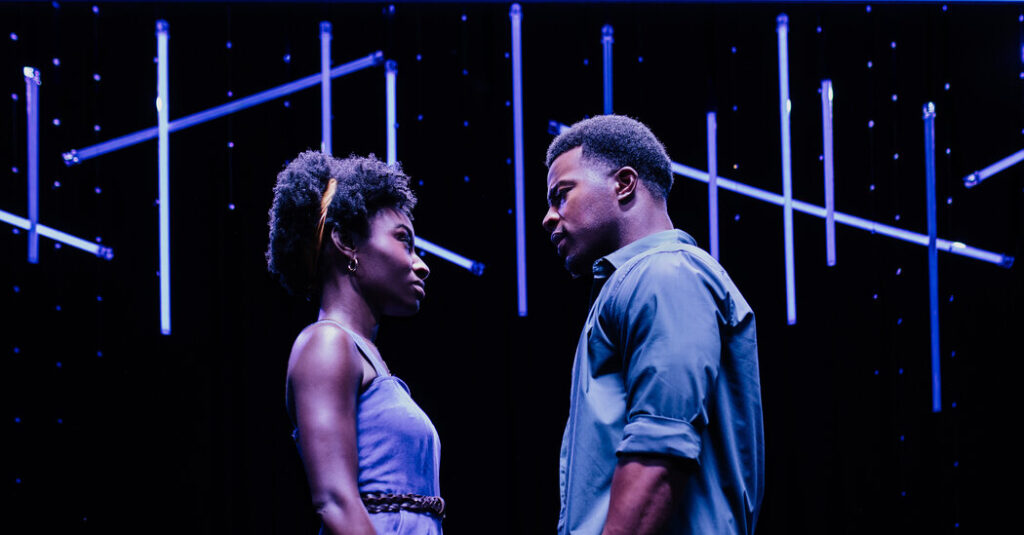
The playwright Benedict Lombe uses all these elements and more in her predictable but beautifully performed “Shifters,” which now fits snugly into the tiny Cherry Lane Theater, after having played on London’s West End in 2024. The director Lynette Linton imports her British production with most of its elements intact: Alex Berry’s glossy black playing space, defined by a kind of huppah of neon lights; Neil Austin’s percussive lighting design; a responsive soundscape by Xana.
Lombe’s two characters, Des (Heather Agyepong) and Dre (Daniel Ezra), become friends as teenagers and then navigate their mutual magnetic pull for a decade and a half. We first meet Des and Dre in their early 30s, as they run into each other at a funeral after a long estrangement. Their many flashbacks are then framed via the second person: “You’re 16, you’re in Year 3,” says Dre, dropping us into the past, or, as the lights go wild, “It’s your 20th birthday. And the vibes are top tier.”
Des and Dre’s teenage friendship begins with disagreements over music (Des argues for Congolese rumba, Dre for Nigerian Afrobeats) and over how to win a class debate. It’s through the debate framework that Lombe introduces the required high-concept theme, which is, hazily, fate.
Ezra’s sensitive Dre refers to the pair as “two little Black kids, destined to oppose each other, push each other, shift each other.” But Agyepong’s Des glitters with nerves, grinning brightly to cover her instinctive rejection of commitment. She doesn’t want to have some fated mate. “You find an article about the myth of first love,” Des says. “It tells you it’s down to a chemical system in your brain.” I bet she’ll change her mind, though. Her full name is Destiny.
Both characters also have an allotment of trauma. Here’s where the terrific acting matters most: Agyepong conveys Des’s extraordinary tension with a dancerly rigor, while Ezra — a charismatic, charming virtuoso — also shows an impressive gift for conveying secret sorrow.
Those qualities are vital for keeping the atmosphere serious, since Lombe’s narrative rush can accidentally turn a bit silly. For instance, as the two fast-forward into an adult romance, they’re pulled apart by Des’s overseas opportunities. “You didn’t stay!” Dre shouts. “You didn’t ask me!” Des counters. As far as I can tell, they are referring to a breakup that takes only half a page in the script. Do they not have phones? Vacations? WhatsApp?
At its hastiest, the show reminded me of the montage at the beginning of a television show, which flashes through the events of the previous season. And Lombe’s storytelling does appear to be deeply informed by soaps and the soap-adjacent: I thought I heard echoes of “One Day” and “Normal People” and even “Dawson’s Creek.” When Lombe included a kissing joke that seems reminiscent of “Raiders of the Lost Ark,” I realized she must be deliberately offering us a sort of supercut of romance tropes.
Her project involves linking those familiar motifs to the textures of the Black British millennial experience. She’s excellent at this: Dre starts the show by listing the food at his West African grandmother’s funeral (egusi soup, puff puff) and makes jokes about SheaMoisture shampoo changing its formula. Nearly every time the characters cue up a song on their phones, someone in the audience laughs in recognition. (This may have been even more true in London.)
So recognition — not fate — is the theme of Lombe’s play. There are a million romances out there, and plenty of plays that fit this time-hopping pattern. It’s rare, though, to see this treatment applied to Black love. (I can think of only the delightful “Table 17” by Douglas Lyons as a somewhat recent example.)
And in both the theater and in a relationship, there’s value in simply being seen, detail by detail. Linton’s hyper-intimate staging ensures that Ezra and Agyepong are in the equivalent of a cinematic close-up for the full hour and 45 minutes. I admit, if “Shifters” had been on TV, I might not have kept watching, deterred by one cliché or another. But you can’t switch a play off — and the enforced proximity with these two extraordinary performers did, at least, give me time to fall in love.
Shifters Through Aug. 30 at Cherry Lane Theater, Manhattan; cherrylanetheatre.org. Running time: 1 hour 45 minutes.
The post ‘Shifters’ Review: Fast-Forwarding Through a Predictable Romance appeared first on New York Times.