It has become a summer rite to bemoan how few Black students are admitted to Stuyvesant and other highly competitive public high schools in New York City. And the numbers are unpleasant. This year only three of 777 students admitted to Stuyvesant are Black. Last year it was eight out of 781.
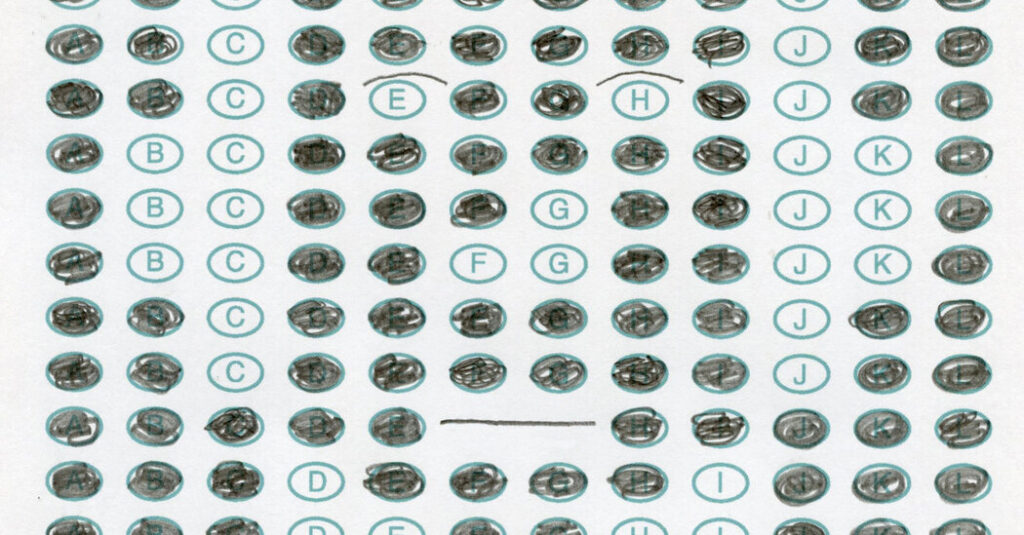
Since about one in five public school students in New York City is Black, many see the paucity of Black students at what are called specialized high schools as evidence that their admission standards must be unfair. “There needs to be a real, independent investigation into the admissions process,” the Queens borough president, Donovan Richards Jr., said after the latest results were released. Many have demanded the elimination of the Specialized High School Admissions Test — the sole measure of whether a student will be admitted (except at the LaGuardia performing arts school, which uses an audition process).
Is the problem the test, or what happens before the test?
Black students often attend poorly performing schools, but so do the sons and daughters of Asian immigrants, even if undocumented, who are admitted at far higher rates than even white students.
In New York City, growing up poor or working class has never barred a child from educational excellence. Poverty rates for Black, Latino and Asian New Yorkers are not that different. But Asian students of modest means are getting into the selective high schools in healthy numbers.
Why can’t poor and working-class Black kids?
Richard Carranza, the schools chancellor under former Mayor Bill de Blasio, seemed to imply that some sort of conspiracy was afoot: “I just don’t buy into the narrative that any one ethnic group owns admission to these schools,” he said several years ago, in reference to Asian students.
It isn’t that there is something discriminatory about the questions on the test itself. In the past, for instance, there were occasional questions on the SAT based on cultural knowledge that Black kids might not have, like the famous one assuming that students knew what a regatta was. But the S.H.S.A.T. doesn’t burden students with questions about which wine goes with chicken.
Black kids didn’t have trouble getting into specialized schools in the past. In 1975 there were 303 Black students at Stuyvesant. In the early 1980s, most students at Brooklyn Tech were Black.
That was before programs like Prep for Prep, which canvasses the city’s public, charter and parochial schools for promising minority students, gives them an after-school and weekend preparatory boot camp for 14 months and then funnels them into private high schools, where they receive need-based financial aid. This program serves about 650 students a year, many of whom might otherwise be admitted to schools like Stuyvesant. And that’s not counting other scholarship programs at private schools, boarding schools and parochial schools designed to increase the diversity of their privileged student bodies.
Another reason for the decline is that since the 1990s, too many Black students have been deprived of gifted and talented programs, in the wake of an antitracking movement that called for students of all abilities (and races) to be taught together. The gifted and talented programs smoothed the way to schools like Stuyvesant for many Black students in the past.
A major reason so many Asian students get high marks on the S.H.S.A.T. is the high use of test prep and tutoring programs in Asian communities. Black families are often not aware that New York City has free programs helping students prepare for the test, such as the New York City public schools’ DREAM program.
Several years ago, selective universities gave in to the idea that it was unfair to use standardized tests in admissions. But it turned out that the SAT and the ACT were an effective way to identify less advantaged students who would likely excel in college. Universities are now rushing to restore the tests to their admissions process.
So assailing the S.H.S.A.T. is behind the curve.
For years I’ve heard people imply that it is unfair to subject Black kids to tests of abstract cognitive ability, and I’m sorry to say that they are Black as often as not. Sometimes people even say the quiet part out loud, like a teacher stating in a discussion with other Black educators that Black students “are context-driven people” and that “there’s no such thing as thinking in isolation.” A Black professor once told me that academic journals and conferences in her field are requiring more statistical analysis than before, and that this is racist because “that’s not what we do.” Ibram X. Kendi, in his book “How to Be an Antiracist,” opposes giving standardized tests and asks: “What if we measured intelligence by how knowledgeable individuals are about their own environments? What if we measured intellect by an individual’s desire to know?” Glenn Singleton, Black and the head of a diversity training firm, has openly said that “scientific, linear thinking” is “a hallmark of whiteness.”
Saying that the analytical reasoning required by standardized tests is incompatible with Blackness sounds a lot like saying Black people are less intelligent than others and should settle for excellence in sports and entertainment but not academia. That sounds like Charles Murray.
If there is an argument that standardized tests are somehow incompatible with Black psychology, I want a clear case carefully made. Otherwise, faced with such small numbers of Black kids getting into Stuyvesant, there is nothing racist in asking: “How can we make Black kids do better on the test?”
Expand, don’t shrink, the number of gifted and talented programs. Expand and strengthen free, city-run test prep and tutoring.
What’s racist is pretending the test is the problem.
The post A Test Isn’t Racist. Assumptions About Black Kids Can Be. appeared first on New York Times.