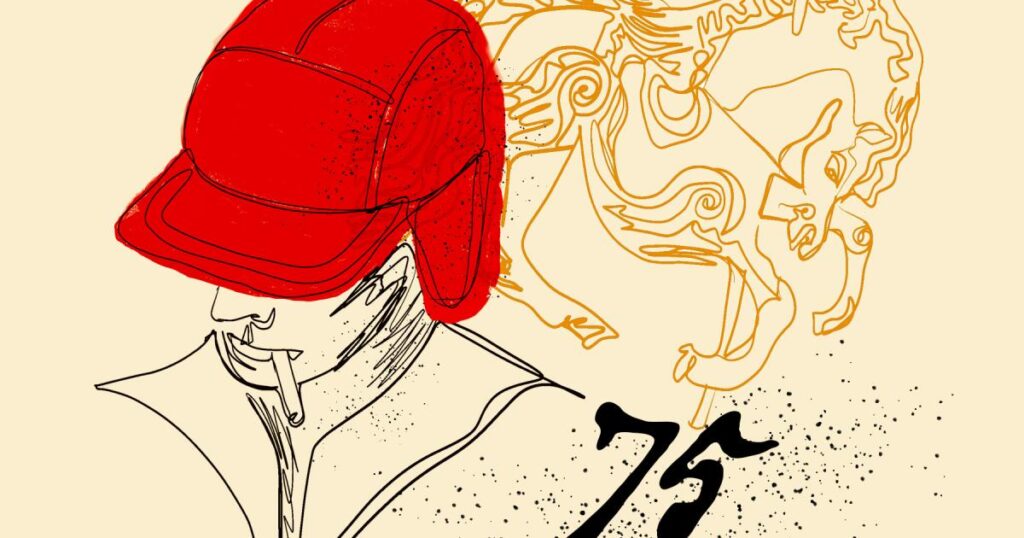
Books that end up on high school English syllabi are meant to signal to young people their cultural importance, but only one book has been routinely positioned as simply “cool.” Since its publication 75 years ago on July 16, 1951, “The Catcher in the Rye”has been heralded as a literary baddie. With its starkly rendered themes of alienation and apathy, and a CV of influence on murderers, rock bands, and a generation of ultracool writers, it adds up to a literary legacy unlike any other assigned reading.
But as each new generation gets further away from the novel’s original milieu and the image of Holden Caulfield has become shorthand for privileged disaffection, its necessity in curricula has been questioned. What was once revolutionary for its language and perspective now can scan as retrograde to some contemporary audiences as books become less and less connective for modern teens.
Despite this, to reread the novel today is to be struck by shades of a loneliness we talk about as a problem unique to the 2020s. Spotlighting Holden’s journey reveals the origin of our isolated young men, one that so often ends in radicalization or even worse … podcasting. While the novel has notably influenced several acts of violence, reading it with adult eyes reveals Salinger’s intervention for Holden: one of connection, love and carousels. It is a message worth teaching after all these years.
Since Salinger’s death in 2010, his family-run estate has teasedplans to release his unpublished works created after his retirement from public life in the mid-1960s. As of 2026, no further plans have been announced. In lieu of new material or commercialization of his properties, we are left to sit with and pore over the works Salinger left behind for us . To honor 75 years of “Catcher,” six contemporary California writers shared their thoughts on carrying the novel through their lives and what this enduring New York tale can still reveal for readers both young and old on the East Coast and West Coast.
So “if you really want to hear about it”…
Tod Goldberg
Author of more than a dozen crime novels, including the L.A. Times Book Prize finalist “Only Way Out.” Goldberg is the founder and director of the Low Residency MFA at UC Riverside and is currently a producer on an upcoming Netflix series. He lives in Indio, Calif.
How old were you when you first read it?
It was freshman year of high school, here in Palm Springs.
What was your opinion when you first read it?
I remember being blown away by it, thinking it was speaking to something profound that I was feeling at 15.
Has your opinion on the book shifted since then?
I read it again this weekend, and it is nothing like I remembered. What I remembered about it at 15 was more about the imagery than the actual emotions of the things that were happening. My mind had fixated on that last image of him watching his sister on the carousel.
To read it now at 55 is to understand the tenderness that exists in broken homes, particularly ones touched by death, because I think young people need to understand that there are people who will still listen to you.
What do you think it is about the novel that gives it such staying power in our culture?
Literature stands on the shoulders of literature, and I think it’s important for readers and writers to understand that there’s a line that can be drawn from “Catcher” to every popular YA novel that exists today. I think it’s important to understand where a story comes from and what initially gave artists the freedom to talk about the internal emotional struggles of young people.
Ottessa Moshfegh
Author of “My Year of Rest and Relaxation,” “Lapvona” and the Booker Prize-shortlisted “Eileen.” She lives in Pasadena.
How old were you when you first read it?
I really started reading adult books when I was about 9. It was one of the books that I remember reading [at home in Massachusetts] because I had been told it was significant.
What was your opinion when you first read it?
I don’t remember whether it inspired me or if it felt significant only because I had heard that it was supposed to be.
Has your opinion on the book shifted since then?
I bought it again maybe 10 years ago and started reading it, and was like, I don’t feel like learning something from a 16-year-old boy right now.
What do you think it is about the novel that gives it such staying power in our culture?
I don’t really know if it does, to be honest. I’m not sure that young people today are reading it the way they were in the ‘80s. We’re still living in extremely conservative times, and we’re sort of scared of the future, and some elements of culture like to look backward to prove that there’s a safe and accepted way of locating the beginning of a certain phenomenon that we currently don’t understand. I think it’s often unfair to put a book in this position — I feel like it should be appreciated for what it is without the pressure of future history.
David L. Ulin
Author or editor of more than 20 books, including “Sidewalking: Coming to Terms with Los Angeles.” A former Los Angeles Times book editor, he has a forthcoming flash fiction anthology, “American Flash Fiction,” arriving September 2026.
How old were you when you first read it?
I was 13 the first time I tried to read it, in the 1970s. I grew up in New York, so this was in my childhood bedroom. At that point, I was a little too young. I would say I was a kid with rebellious yearnings, but I hadn’t quite enacted those rebellious yearnings yet, so I stopped in the middle, and then when I was 16, after I had begun to enact those yearnings, I picked it up again, and I fell in love with it.
Has your opinion on the book shifted since then?
The last time I read it was when Salinger died during my time at the L.A. Times. I ended up writing the appreciation and reread it. At that point, I had not read it in about 25 years, and I had a 16-year-old son, so I read the book as a father, and I found it terrifying, and I think that’s part of its power. Holden thinks of himself as a rebel, but he actually is a lost child.
What do you think it is about the novel that gives it such staying power in our culture?
You can read it as Holden’s contemporary, but I could also later read it from the point of view of the parent. Somehow, Salinger, as a 31-year-old writer, had managed to encapsulate or encode all of those different points of view or perspectives into the novel, and I think that is one of the most astonishing things about it.
Oscar Villalon
The editor of the award-winning literary journal “ZYZZYVA,” Villalon is a writer and a former San Francisco Chronicle book editor who has twice judged the National Book Awards and three times juried the Pulitzer Prize for Fiction. He lives in San Francisco.
How old were you when you first read it?
I must have been 16 in my junior year of high school.
What was your opinion when you first read it?
This would have been down in San Diego at Mount Carmel High School. In my neighborhood, everyone was in Section 8 housing, so partly what fascinated me about the novel was this Anglo existence I wasn’t quite aware of: prep schools, and having enough money to be able to go anywhere you want; to take a hotel room and pay for it in cash, the sort of acts of New York City, which I knew really nothing about.
Has your opinion on the book shifted since then?
After rereading, the thing that struck me is the anger, you know? When the book was assigned, the idea was probably like, “You guys are feeling alienated; maybe you’ll be able to relate to him.” The funny thing is that I did not relate to him at all on that level. Reading it now, I wonder, to somebody who’s 16, if they would say he sounds like one of those 4chan guys.
What do you think it is about the novel that gives it such staying power in our culture?
There’s a lot of kids who come from privilege, who go to private schools, who should know better, who are flirting with and embracing fascism. Where does that come from? What kind of hurt does that come from? When you’re that young, you can’t see past your nose; the whole world’s just you and the challenge is to get out of that bubble and to have empathy — to see the world’s about others as much as it is about you.
Jean Kyoung Frazier
Author of “Pizza Girl” and screenwriter for the Emmy award-winning “Beef,” “Common Side Effects” and the forthcoming “Superfakes.” She lives in Los Angeles.
How old were you when you first read it?
I must have been in high school [in the South Bay] when I had to read it, so that must have been 2010?
What was your opinion when you first read it?
There’s this idea that to be young is to be happy, and young people don’t have problems. If anything, ages 14 through 19 were probably some of the most introspective times of my life. There’s a care and a tenderness in the book, and as young as Holden feels, you don’t feel like he’s being made fun of for being young; he’s treated with a lot of seriousness, and young problems are given a lot of gravity, because that’s how it feels when you’re that age.
Has your opinion on the book shifted since then?
I reread it again in college, and I remember liking it even more. There was an earnestness to it that’s very rare in literary fiction. You feel like you’re kind of alone in your feelings, so reading about Holden and his struggles, I think, is very comforting.
What do you think it is about the novel that gives it such staying power in our culture?
There’s something there with this young guy, who’s concerned about purity that remains true now, which is that people think things are phony. I mean, God, in this age of AI and everything being actually kind of fake and manufactured, is there a more relevant book?
Anna Dorn
Author of “Perfume & Pain,” “Vagablonde” and “American Spirits.” Her novel “Exalted “ was a finalist for the Los Angeles Times Book Prize. She lives in Los Angeles.
How old were you when you first read it?
I believe I first read “Catcher” in high school, in my sophomore American English class at Maret School in Washington, D.C., so I was 16?
What was your opinion when you first read it?
I adored it. I was on more of a “Gossip Girl”-esque tip back then, but “Catcher” was so much more fun and readable than anything else we read in school. I remember being taken with Holden’s voice, his humor, the fact that he hated everything. (I was, and still am, a hater).
Has your opinion on the book shifted since then?
I think the last time I read it was in college, and I remember being slightly less taken by it then, probably because I’d read more ranty, voice-driven fiction by that point, so it didn’t feel quite as singular. But I still think very fondly of it and the impact it had on me as a teenager.
What do you think it is about the novel that gives it such staying power in our culture?
Being a teenager who thinks everything is fake bullshit is a universal experience, and Holden embodies that adolescent angst so stylishly. I think if it can make any teens less lonely or less bored by high school English, it’s worth teaching. Those are timeless causes.
Messinger is a writer in L.A. who runs the Substack adumbmessinger.
The post Is ‘The Catcher in the Rye’ phony or still cool? 6 writers reflect on its legacy at 75 appeared first on Los Angeles Times.